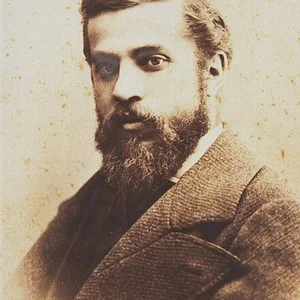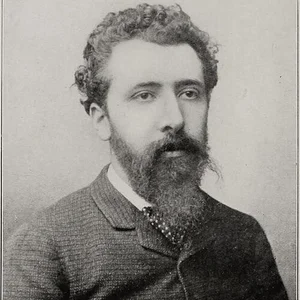

Georges Seurat (1859-1891) was a French painter and a major figure of Post-Impressionism. He invented Pointillism (or Divisionism), a technique based on the scientific juxtaposition of small dabs of pure color.
Georges Seurat(1859 — 1891)
Georges Seurat
France
6 min read
Frequently asked questions
Key Facts
- Born in Paris in 1859 into a middle-class family
- Painted 'Bathers at Asnières' (1884), his first large composition
- Created his masterpiece 'A Sunday Afternoon on the Island of La Grande Jatte' (1884-1886)
- Theorized Divisionism based on Chevreul's scientific research on color
- Died prematurely in Paris in 1891, at the age of 31
Works & Achievements
Seurat's first large composition, monumental and luminous, rejected by the official Salon but exhibited with the Indépendants.
A masterpiece of Pointillism and a manifesto of Neo-Impressionism, the result of nearly two years of work and countless studies.
A painting in which Seurat applies his technique to studio nudes, with “La Grande Jatte” visible in the background.
A nighttime scene of a fairground show in which Seurat explores artificial light and applies his theories on lines and emotions.
A cabaret dance treated according to the laws of Charles Henry: the rising lines convey gaiety and movement.
Seurat's last great canvas, left unfinished at his death, vibrant with dynamism and color.
Anecdotes
To paint his famous picture *A Sunday Afternoon on the Island of La Grande Jatte*, Seurat spent nearly two years studying the location. He would go there in the morning to make sketches and color studies, then return to the studio in the afternoon to assemble his enormous canvas, more than two meters by three.
Seurat almost never mixed his colors on the palette. He placed tiny dots of pure color side by side, relying on the viewer's eye to blend them at a distance: a blue dot next to a yellow dot was meant to create the impression of green. This scientific technique was called pointillism or divisionism.
Seurat drew inspiration from the work of the scientists of his time on color, notably the chemist Eugène Chevreul and his laws on the simultaneous contrast of colors. He wanted to turn painting into an almost scientific approach, rigorous and demonstrable.
Seurat died very young, at only 31, carried off in a few days by an infectious disease (probably tonsillitis or meningitis). His last great painting, *The Circus*, remained unfinished on his easel.
Discreet and secretive, Seurat had hidden from nearly all his friends that he was living with a young woman, Madeleine Knobloch, and that they had had a child. His close friends only learned of it at the time of his sudden death in 1891.
Primary Sources
Art is Harmony. Harmony is the analogy of Opposites, the analogy of Likes, in tone, in hue, in line.
If, in M. Seurat's Grande Jatte, one considers a patch of a few square centimetres of uniform hue, one finds on each of these centimetres, in a swarming of dots, all the elements that make up the hue.
A Sunday Afternoon on the Island of La Grande Jatte is presented to the public among the works of the new painters known as Neo-Impressionists.
Key Places
Seurat's birthplace, where he grew up, studied at the École des Beaux-Arts and spent most of his life as an artist.
An island in the Seine at the edge of Paris, a Sunday strolling spot that Seurat immortalized in his most famous painting.
An industrial suburb on the banks of the Seine, the setting of “Bathers at Asnières,” Seurat's first large composition.
Seurat received a classical academic training here from 1878, in the studio of the painter Henri Lehmann.
Ports on the English Channel where Seurat spent his summers painting luminous, calm seascapes using his Divisionist technique.
Typical Objects

Seurat arranged pure colors on his palette, carefully ordered according to the spectrum, which he avoided mixing in order to preserve their intensity.

Very small brushes allowed him to lay down thousands of tiny dots of color side by side on the canvas.

A scientific tool representing the organization of colors and their contrasts, inspired by the work of Chevreul and Charles Henry, which Seurat studied to build his harmonies.

Small wooden panels and notebooks on which Seurat made his open-air sketches, called “croquetons,” before composing his large canvases in the studio.

A greasy lead that Seurat used on textured paper for his famous black-and-white drawings, playing on the contrasts of shadow and light.

Seurat worked on very large formats: “La Grande Jatte” measures roughly two meters by three, mounted on a sturdy studio easel.
School Curriculum
Vocabulary & Tags
Key Vocabulary
Daily Life
Morning
Seurat often went to the banks of the Seine, to the Grande Jatte or Asnières, to observe the light and make small studies from nature. Methodical, he scrupulously noted the variations of color according to the hour and the weather.
Afternoon
In the afternoon, he returned to his Parisian studio where he patiently transferred his studies onto large canvases. The work was slow and meticulous: every centimeter was covered with thousands of dots applied one by one.
Evening
In the evening, Seurat sometimes frequented the cafés, cabarets, and circuses that inspired his last works such as *The Can-Can* or *The Circus*. He also read the scientific works on color and optics that fed his thinking.
Food
Like a middle-class Parisian of his time, Seurat ate a classic late-19th-century diet: bread, meats, vegetables, and wine. Discreet and absorbed in his work, he led a sober and orderly life.
Clothing
Seurat took care with his appearance and wore the dark suit, collar, and hat of the Parisian bourgeoisie, which earned him the nickname “the notary” among his painter friends. This discreet elegance contrasted with the bohemian style of certain artists.
Housing
He lived in Paris, dividing his time between the family home and his studio, a vast room needed to paint his immense canvases. Toward the end of his life, he quietly settled in with his companion Madeleine Knobloch.
Historical Timeline
Period Vocabulary
Liens externes & ressources
Références
Œuvres
Une baignade à Asnières
1884
Un dimanche après-midi à l'île de la Grande Jatte
1884-1886
La Parade de cirque
1887-1888
Le Chahut
1889-1890
Le Cirque
1890-1891