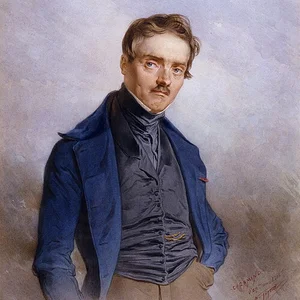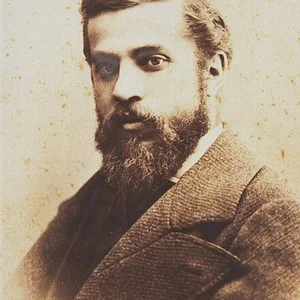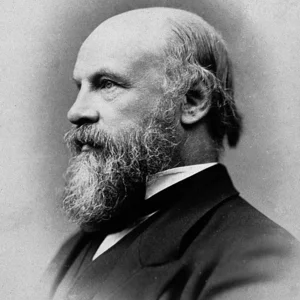

British painter and watercolourist, a major figure of Romanticism. A master of landscape, he revolutionised the depiction of light, atmosphere and the natural elements, paving the way for Impressionism.
William Turner(1832 — 1916)
William Turner
Royaume-Uni de Grande-Bretagne et d'Irlande
5 min read
Frequently asked questions
Key Facts
- Born in 1775 in London, admitted to the Royal Academy in 1789 at the age of 14
- Became a full member of the Royal Academy in 1802
- Painted *Rain, Steam and Speed* (1844), evoking the railway and industrial modernity
- *The Fighting Temeraire tugged to her last berth* (1839), one of his most famous canvases
- Died in 1851 in London, bequeathing his works to the British nation
Works & Achievements
Turner's first oil painting exhibited publicly, already marked by moonlight and his mastery of water and night effects.
A large, dramatic seascape that established his reputation as a painter of the fury of the elements.
A historical landscape inspired by Claude Lorrain, which Turner considered his masterpiece and bequeathed to the nation.
A series of paintings depicting the blaze at Westminster, the pinnacle of his painting of light and fire.
An elegy to the old warship hauled away by a steam tug, an allegory of the shift from sail to steam.
An almost abstract whirl of snow and spray, where form dissolves into light and motion.
A train emerging from a luminous mist, a painterly manifesto of the Industrial Revolution and a forerunner of Impressionism.
Anecdotes
On his deathbed in 1851, Turner is said to have murmured “The Sun is God,” summing up the obsession of his entire life: to capture light. His whole body of work was an attempt to paint dazzling brilliance rather than objects.
To paint the snowstorm in *Snow Storm: Steam-Boat off a Harbour's Mouth* (1842), Turner is said to have asked sailors to lash him to a ship's mast for four hours, so he could observe the fury of the elements from within. The anecdote, perhaps embellished by Turner himself, says everything about his quest for authenticity.
During the “Varnishing Days” at the Royal Academy, Turner would arrive with nearly blank canvases and finish them on the spot, before the eyes of visitors, adding dazzling touches in a few hours to outshine the neighbouring paintings of his rivals.
Upon his death, Turner bequeathed to the British nation nearly 300 paintings and 30,000 works on paper, on the condition that they be kept together. This “Turner Bequest” today forms the heart of the Tate's collections.
Discreet about his private life, Turner sometimes used the pseudonym “Mr Booth” (the name of his landlady and companion) when staying in Chelsea, so much so that his neighbours called him “Admiral Booth” without knowing his true identity.
Primary Sources
Turner bequeaths all of his finished works to the nation, on the condition that they be preserved and displayed together in a dedicated building.
Ruskin champions Turner as the greatest of landscape painters, “the one who, more than any other, has captured the truth of nature, of sky and of water.”
A collection of engravings classifying landscapes into categories (historical, pastoral, marine, architectural), conceived by Turner to demonstrate the full range of the landscape genre.
Key Places
Working-class district where Turner was born in 1775, above his father's barber shop.
Institution where Turner studied, exhibited every year, and taught perspective; the centre of his entire public career.
City of light upon the water that inspired some of Turner's most ethereal watercolours and oils following his travels between 1819 and 1840.
District beside the Thames where Turner spent his final years under the name "Mr Booth" and where he died in 1851.
Turner was buried here according to his wishes, alongside other great British artists.
Typical Objects

A portable case containing color cakes, mixing wells and brushes, which Turner took on all his travels to capture landscapes and skies on the spot.

Turner filled hundreds of notebooks with drawings and studies made on location, the basis for his later studio compositions.

A painter's tools with which Turner worked thick, luminous paint, sometimes adding impasto with a knife and his fingers.

An etching and mezzotint plate used to circulate his landscapes in the form of prints.

A brilliant new industrial pigment that Turner overused, so much so that his contemporaries mocked his “yellow” canvases. It embodies the synthetic colors born of modern chemistry.
School Curriculum
Vocabulary & Tags
Key Vocabulary
Tags
Daily Life
Morning
Turner rose early and worked from dawn to take advantage of the natural light in his London studio. Methodical, he prepared his coloured grounds and reworked the studies brought back from his travels.
Afternoon
In the afternoon, he painted in oils or reworked his watercolours, or else roamed the streets and the banks of the Thames to observe the ever-changing skies. During the exhibition seasons, he went to the Royal Academy.
Evening
In the evening, Turner was not very sociable and preferred the solitude of his studio or the company of a small circle. A discreet and thrifty man, he avoided the pomp of high society.
Food
His table was modest, in keeping with his humble origins; he was known to be frugal and at times sparing with his spending. It was said that he enjoyed sherry and simple meals.
Clothing
Turner wore sober, often shabby middle-class clothes, with no concern for elegance. His stocky figure and modest appearance contrasted with the fame of his work.
Housing
He lived and worked in several London houses fitted with galleries to display his canvases, notably on Queen Anne Street. He ended his life in a small, anonymous house in Chelsea, on the banks of the Thames.
Historical Timeline
Period Vocabulary
Liens externes & ressources
Références
Œuvres
Pêcheurs en mer
1796
Le Naufrage
1805
Didon construisant Carthage
1815
Le Téméraire remorqué à son dernier mouillage
1838
Tempête de neige en mer
1842
Pluie, vapeur et vitesse
1844