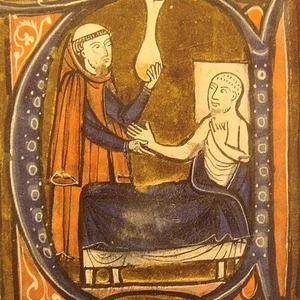

Gerard of Cremona was a 12th-century Italian translator, active in Toledo, who translated many Greek and Arabic scientific works from Arabic into Latin. He played a decisive role in transmitting ancient and Arabic knowledge to medieval Europe.
Gerard of Cremona(1114 — 1187)
Gerard of Cremona
Royaume d'Italie
5 min read
Frequently asked questions
Key Facts
- Born around 1114 in Cremona (Italy)
- Settled in Toledo to learn Arabic and gain access to scientific manuscripts
- Translated Ptolemy's Almagest from Arabic into Latin around 1175
- Said to have translated more than 70 works (astronomy, mathematics, medicine, philosophy)
- Died in 1187 in Toledo
Works & Achievements
Translation of the great Greek treatise on astronomy, transmitted through Arabic. It laid the foundation of scholarly astronomy in medieval Europe for several centuries.
Translation of the medical encyclopedia of Ibn Sina, which became the standard textbook in universities until the 17th century.
Translation of the great Greek treatise on geometry from an Arabic version. It nourished the teaching of mathematics in the Middle Ages.
Translations of Aristotle's scientific works from Arabic. They revived the study of natural philosophy in the West.
Translation of the founding treatise of Arabic algebra. It spread new methods of calculation among Latin scholars.
A collection of translations on medicine (Rhazes) and the natural sciences. They considerably enriched the Latin scholarly vocabulary.
Anecdotes
Gerard of Cremona is said to have come to Spain, to Toledo, in search of Ptolemy's *Almagest*, a work of astronomy unavailable in Latin. Amazed by the abundance of Arabic books he found there, he learned Arabic and decided to stay to translate these treasures of knowledge.
He is credited with translating more than 70 works, which probably makes him the most prolific translator of the Middle Ages. To carry out this colossal task, he surrounded himself with assistants, including Mozarabic or Jewish collaborators who were fluent in Arabic and helped him rough out the texts.
It was thanks to his translation of the *Almagest*, completed around 1175, that Ptolemy's astronomy was known to Latin Europe for centuries. Many scientific words of Arabic origin, kept as they were, entered our languages through his translations.
He also translated Avicenna's *Canon of Medicine*, which became the standard textbook in European universities until the 17th century. Generations of physicians thus studied from an Arabic text made accessible by his pen.
After his death in 1187, his students wrote a short biography accompanied by the list of his translations, so that his work would not fall into oblivion. It is largely thanks to this document that we know the extent of his work.
Primary Sources
Lest the name of so great a man remain unknown... his companions drew up the list of all the works he had translated, as is done for Saint Galen.
Translated from Arabic into Latin by Gerard of Cremona at Toledo, a work setting out the motion of the stars and the order of the celestial spheres.
Medicine is the science by which we know the states of the human body with respect to health and disease.
Key Places
City in Lombardy, in northern Italy, where Gerard was born around 1114. It gave him his name.
Former capital of learning in al-Andalus, reconquered in 1085, home to the great Arabic libraries. Gerard lived and worked here for most of his life.
The city's religious and intellectual center, where the canons and scholars of the school of translators gathered. Gerard is thought to have been connected to it as a cleric.
Christian kingdom of Spain that, after the Reconquista, fostered exchanges between Latin, Arabic, and Jewish cultures. The political setting of Gerard's work.
Typical Objects

Book copied by hand in Arabic, containing treatises on science or medicine. It is the raw material for all of Gerard's work.

An astronomical instrument of Greek origin perfected by Arab scholars, used to measure the position of the stars. It illustrates the astronomy that Gerard translated.

A sharpened bird's quill and black ink used to write translations on parchment. The everyday tool of the medieval translator.

Animal skin prepared to serve as a writing surface, the medium for the Latin copies. Sturdier and more expensive than the paper of the time.

Collections of figures used to predict the position of the planets, such as the Toledan Tables. Gerard helped spread these calculation tools.

A slanted piece of furniture on which the translator placed the Arabic manuscript and the parchment to work. A central feature of the scriptorium.
School Curriculum
Vocabulary & Tags
Key Vocabulary
Daily Life
Morning
At daybreak, Gerard would attend the religious service, for he was a cleric. Then he would take his place at his desk, where an Arabic manuscript and a blank sheet of parchment awaited him.
Afternoon
The afternoon was spent translating word by word, often with the help of a Mozarabic or Jewish collaborator who read the Arabic aloud. The work was slow and painstaking, and one sought the precise Latin word, even if it meant keeping the Arabic term.
Evening
In the evening, by the light of a candle or an oil lamp, he would reread and correct the day's pages. It was also the hour for scholarly discussions with other learned men of Toledo.
Food
His diet was that of a medieval Mediterranean cleric: bread, dried legumes, olive oil, fruit, a little fish or meat, and wine watered down. On days of religious fasting, the meals were leaner.
Clothing
He wore the long, plain robe of the clergy, made of wool, with a belt and sometimes a head covering. The colors remained subdued, in keeping with his studious station.
Housing
He lodged in a stone house in Toledo, a city of narrow streets blending Muslim and Christian heritage. A quiet room, furnished with book chests and a desk, served as his study.
Historical Timeline
Period Vocabulary
Liens externes & ressources
Références
Œuvres
Almageste de Ptolémée (traduction latine)
vers 1175
Canon de la médecine d'Avicenne (traduction)
XIIe siècle
Éléments d'Euclide (traduction)
XIIe siècle
Traités d'Aristote (Physique, Du ciel, Météorologiques)
XIIe siècle
Algèbre d'al-Khwârizmî (traduction)
XIIe siècle
Liber de aluminibus et salibus et autres traités alchimiques et médicaux
XIIe siècle