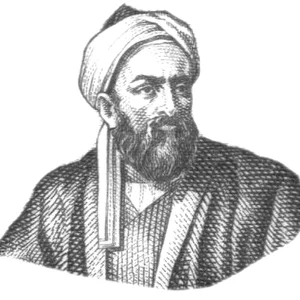

Ibn Sina, known in the West as Avicenna, was a Persian physician, philosopher, and scholar of the Islamic Golden Age. His Canon of Medicine served as a reference work in European and Arab universities for centuries.
Ibn Sina
Ibn Sina
7 min read
Frequently asked questions
Key Facts
- Born around 980 near Bukhara (present-day Uzbekistan) and died in 1037 in Hamadan (Persia)
- Wrote the Canon of Medicine (Al-Qanun fi al-Tibb), a medical encyclopedia used until the 17th century in Europe
- Author of the Book of Healing (Kitab al-Shifa), a vast philosophical and scientific compendium
- Transmitted and commented on the thought of Aristotle, influencing medieval Christian philosophy and scholasticism
- Considered one of the greatest thinkers of the Islamic Golden Age, at the crossroads of medicine, science, and metaphysics
Works & Achievements
A medical encyclopedia in five books, a major reference work in Europe and the Islamic world for centuries.
A vast philosophical and scientific encyclopedia covering logic, physics, mathematics and metaphysics.
An abridged version of the Book of Healing, meant to present the core of his philosophy in a more accessible way.
One of his most mature philosophical works, widely commented on by later Muslim thinkers.
A collection of precise definitions of philosophical concepts, reflecting his logical rigor.
An allegorical and philosophical tale in which a character symbolizes the intellect in its quest for truth.
Advanced geological observations, suggesting that mountains arise from erosion and earthquakes over long periods of time.
Anecdotes
According to his autobiography, Ibn Sina is said to have memorized the entire Quran by the age of ten, then devoured the works of logic, mathematics, and medicine of his time. By around sixteen, he was already treating the sick and claimed to have found medicine “easy” to learn.
He recounts having struggled for months with Aristotle's *Metaphysics*, which he is said to have reread forty times without understanding it. It was by chance, coming across a short commentary by al-Farabi bought from a secondhand bookseller for a few coins, that everything suddenly became clear to him.
As a young man, he cured the Samanid emir Nuh ibn Mansur of an illness that the other physicians did not know how to treat. As a reward, he was granted access to the famous royal library of Bukhara, where he was able to read rare works that he never found anywhere else.
His life was a succession of journeys and political upheavals: he had to flee several courts, was even imprisoned in the fortress of Fardajan, and he often wrote at night, after his days of service to the princes. It is said that he dictated certain chapters from memory to his students.
The *Canon of Medicine* (al-Qanun) that he composed became a reference textbook taught in the universities of Europe and the Muslim world alike for nearly six centuries, translated into Latin under the name Avicenna.
Primary Sources
“By the age of ten, I had completed the study of the Qur'an and a great part of literature, so much so that people were amazed at me.”
“Medicine is the science by which we know the states of the human body with respect to health and the absence of health, in order to preserve health when it exists and restore it when it is lost.”
“Anyone who denies the law of non-contradiction should be beaten and burned until he acknowledges that to be beaten is not the same as not to be beaten, and to be burned is not the same as not to be burned.”
Key Places
Ibn Sina's native village, in the region of Bukhara, then under Samanid rule. It was there that he spent his early childhood before settling in the city.
Samanid capital and great intellectual center where Ibn Sina studied and gained access to the famous royal library. A key city in his education.
A city in Persia, near present-day Tehran, where Ibn Sina served for a time as a physician at the Buyid court during his years of wandering.
A castle near Hamadan where Ibn Sina was imprisoned for a few months following political unrest. He nevertheless continued to write there.
A city in western Persia where Ibn Sina worked as a physician and vizier to the Buyid emirs, and where he died around 1037. His mausoleum still stands there today.
A great Persian city where Ibn Sina found refuge and protection at court, and where he completed some of his works during a more peaceful period.
Typical Objects

A vast manuscript treatise in five books cataloguing the medical knowledge of Antiquity and the Islamic world. It systematically classifies diseases, remedies, and rules of hygiene.

A cut reed and ink used to write on paper, which was then widely available throughout the Islamic world. Ibn Sina wrote hundreds of pages of his works with these tools.

Mortars, vials, and scales used to prepare remedies from plants and minerals. The physician used them to measure out the ointments, syrups, and potions described in his books.

Models and devices representing the circles of the sky, used to observe and calculate the position of the stars. Ibn Sina was also interested in astronomy and mathematics.

Arabic translations of Aristotle, Galen, and Ptolemy that scholars studied and commented upon. They were the heart of learned libraries such as the one in Bukhara.

A graduated bronze instrument used to measure the altitude of the stars and determine the time or direction. An emblem of the scientific knowledge of the Islamic Golden Age.
School Curriculum
Vocabulary & Tags
Key Vocabulary
Daily Life
Morning
Ibn Sina often began his day with study and the reading of Greek and Arabic manuscripts, or with the writing of his treatises. When he served a prince, the morning might be taken up by medical consultations and the affairs of the court.
Afternoon
In the afternoon, he visited the sick, prepared or prescribed remedies, and received his students to discuss logic, philosophy, or medicine. He also took part in the councils of the ruler, whose vizier he sometimes was.
Evening
In the evening, he continued writing by the light of an oil lamp, dictating entire chapters of his works to his disciples. It is said that he liked to prolong these sessions of work and debate late into the night.
Food
His diet, like that of well-off Persian scholars, included bread, rice, fruit (grapes, melons, pomegranates), mutton and poultry, and dishes seasoned with spices. As a good physician, he placed great importance on moderation and on a balanced intake of foods.
Clothing
He wore the garments of the scholars and high officials of the Persia of his time: a long robe or caftan, a belt, and a turban marking his rank as a learned man. The fabrics of the elites might be fine wool, cotton, or silk.
Housing
Depending on the period, he lodged in urban dwellings with an inner courtyard, in the palaces of the emirs he served, or in makeshift quarters during his flights. The houses were built of mud brick, cool in summer, and arranged around a central courtyard.
Historical Timeline
Period Vocabulary
Liens externes & ressources
Références
Œuvres
Al-Qanun fi al-Tibb (Le Canon de la médecine)
vers 1025
Kitab al-Shifa (Le Livre de la guérison)
vers 1020-1027
Kitab al-Najat (Le Livre du salut)
vers 1027
Al-Isharat wa al-Tanbihat (Le Livre des directives et remarques)
vers 1030
Risala fi al-Hudud (Le Livre des définitions)
vers 1010-1020
Hayy ibn Yaqzan (Le Vivant fils de l'Éveillé)
vers 1020
Traité sur la formation des montagnes et des minéraux
vers 1020