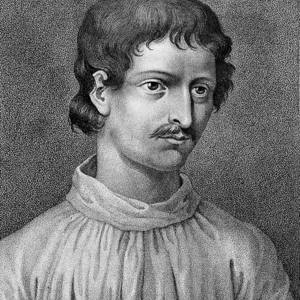

An Italian Renaissance philosopher, cosmologist, and theologian, Giordano Bruno championed the idea of an infinite universe and a plurality of worlds. Condemned for heresy by the Inquisition, he was burned at the stake in Rome in 1600.
Giordano Bruno(1548 — 1600)
Giordano Bruno
royaume de Naples
9 min read
Frequently asked questions
Famous Quotes
« Time is the father of truth, and truth is the daughter of time.»
« There is a single, infinite universe in which everything exists everywhere.»
Key Facts
- Born in 1548 in Nola, near Naples, he joined the Dominican order
- Published in 1584 'On the Infinite, the Universe and the Worlds', defending an infinite, Copernican universe
- Fled Italy and traveled across Europe (Geneva, Paris, London, Frankfurt) to spread his ideas
- Arrested by the Inquisition in Venice in 1592 and transferred to Rome
- Burned at the stake in the Campo de' Fiori in Rome on February 17, 1600, for heresy
Works & Achievements
A dialogue in five parts in which Bruno defends Copernicus's heliocentric system while proposing an infinite universe. It is one of his first major works on cosmology.
A philosophical dialogue presenting a pantheistic vision of the universe, in which God is the immanent soul of all things. A foundational work of his metaphysics.
A cosmological treatise asserting that the universe is infinite, with no center or edge, and populated by an infinity of inhabited worlds. This thesis was largely responsible for his condemnation.
An allegorical satirical dialogue in which the gods of Olympus reform the heavens by driving out vices. Bruno uses it to covertly criticize the religious institutions of his time.
A collection of sonnets and philosophical dialogues devoted to the intellectual love of the infinite and the soul's yearning for the divine. One of Bruno's most poetic works.
His first major work published in Paris, rooted in the medieval and Hermetic mnemonic tradition. It established Bruno's reputation across Europe as a master of memory techniques.
Anecdotes
Giordano Bruno joined the Dominican order in Naples at the age of fifteen, but his intellectual curiosity soon led him to read forbidden books — including the works of Erasmus, which he hid in the monastery's latrines. This thirst for knowledge earned him his first clashes with the religious hierarchy even before he abandoned his monastic habit.
Bruno was a prodigious mnemonist: he impressed King Henry III of France by presenting him with memorization techniques drawn from his art of memory. The king, convinced that this talent was a form of magic, was relieved to learn it was actually a natural method based on organized mental images.
During his stay in Oxford in 1583, Bruno attempted to teach Copernican cosmology and his own theories on the infinite universe. The Oxford professors sharply contradicted him and accused him of plagiarizing Ficino. Bruno responded with scathing pamphlets mocking English obscurantism, earning himself a reputation as brilliant as it was turbulent.
After leaving Venice following his betrayal by Giovanni Mocenigo in 1592, Bruno was transferred to Rome and imprisoned for eight years. Throughout this lengthy trial, he refused to recant his convictions about the infinity of the universe and the plurality of worlds, declaring to the judges who condemned him: 'Perhaps you pronounce this sentence against me with greater fear than I receive it.'
Bruno was burned alive at the Campo de' Fiori in Rome on February 17, 1600. According to witnesses, he turned his face away from the crucifix offered to him and died without uttering a word. Three centuries later, in 1889, a statue in his likeness was erected on that very site, hailed as a symbol of freedom of thought against dogmatism.
Primary Sources
The universe is therefore one, infinite, immovable… It has no center, because it is everywhere, or rather because its center is everywhere and its circumference nowhere.
The earth is not at the center of the universe, but revolves around the sun like the other planets; and the sun itself is but one star among many in a boundless cosmos.
He maintained that there exist infinitely many worlds, that the soul can transmigrate from one body to another, and that the stars are so many suns surrounded by inhabited worlds.
God is the cause and principle of all things; he is present in every part of the universe, not as something external to it, but as its innermost soul.
We must drive out our vices, as Jupiter drives the beasts from the sky: moral reform begins in the soul of each individual before it can manifest in society.
Key Places
Giordano Bruno's birthplace, near Naples, from which he sometimes drew his nickname 'the Nolan.' This is where he grew up before entering the Dominican order.
The Dominican convent where Bruno entered as a novice in 1563 and was ordained a priest. It was here that he began reading heterodox works and developing his first theological doubts.
Bruno stayed here from 1583 to 1585 and attempted to teach Copernican cosmology at the university. His clashes with Oxford academics inspired him to write his major Italian dialogues.
The Roman square where Bruno was executed on February 17, 1600, burned alive after refusing to recant. A statue of him was unveiled there in 1889, making the site a symbol of freedom of conscience.
It was in Venice that Bruno was arrested in 1592, denounced by his host Mocenigo. The Republic, known for its relative tolerance, nonetheless handed him over to the Roman Inquisition the following year.
Typical Objects

An astronomical instrument representing the celestial circles, the armillary sphere was the reference tool of Renaissance cosmologists. Bruno used it to present and critique Ptolemy's geocentric model.

Bruno was a voracious reader who heavily annotated his books, including forbidden works. His annotations reveal a critical mind that constantly confronted ancient texts with his own cosmological intuitions.

Bruno wore the white robe and black scapular of the preaching friars for about fifteen years before fleeing his convent. This habit symbolizes the tension between his initial belonging to the Church and his gradual break with its dogmas.

Bruno developed complex systems of wheels and visual charts to organize and memorize knowledge. These diagrams, inspired by the Hermetic tradition, served both as a pedagogical tool and a symbolic representation of the universe.

A symbol of the light of reason in the darkness of dogma, the candle evokes Bruno's long nights of study and writing across his many lodgings throughout Europe. It also appears in his work as a metaphor for the soul of the world.

The stake to which Bruno was bound at the Campo de' Fiori has become a universal symbol of intellectual martyrdom. His death by fire for refusing to recant his beliefs made him the icon of freedom of thought in the face of the Inquisition.
School Curriculum
Vocabulary & Tags
Key Vocabulary
Daily Life
Morning
Bruno rose at dawn for Matins when he lived in the convent, reciting the canonical hours before devoting the early part of the day to reading and annotating philosophical and scientific texts. During his years of wandering, he would often begin his morning by seeking out a patron or bookseller who might fund his publications.
Afternoon
Afternoons were devoted to teaching, given at universities, private academies, or in the homes of nobles who housed him. Bruno was always eager to debate with his audiences, defending his theses on the infinity of the universe with a vigor that earned him as many admirers as enemies.
Evening
By candlelight in the evenings, Bruno wrote his dialogues and treatises, sometimes working well into the night. He set down his cosmological and philosophical ideas in dense prose, weaving together rigorous argument and poetic imagery drawn from the Hermetic tradition.
Food
Like most religious men and itinerant scholars of his time, Bruno ate simply: bread, vegetables, fish on lean days, meat on others. When hosted by noble or bourgeois patrons, he shared their more generous meals; during periods of hardship, he made do with frugal fare.
Clothing
During his monastic life, Bruno wore the white habit of the Dominicans with a black mantle over it. After fleeing the convent, he adopted the plain dress of secular clergy or traveling scholars: a dark wool doublet, linen collar, and a traveling cloak. His outward appearance remained that of a churchman or man of letters.
Housing
In the convent, Bruno had a simple cell with a wooden bed, a table, and a cupboard for his books. During his long years of wandering through France, England, Germany, and Italy, he lodged in inns, university colleges, or with noble protectors who offered him room and board in exchange for lessons.
Historical Timeline
Period Vocabulary
Visual Style
Style Renaissance italienne maniériste, clair-obscur dramatique, tons ambrés et nuit étoilée infinie évoquant la tension entre lumière du savoir et ténèbres de l'Inquisition.
Sound Ambience
Ambiance sonore d'un couvent et d'une ville italienne de la Renaissance : cloches, feu crépitant, plume grattant le parchemin et rumeur de la rue pavée.
Liens externes & ressources
Références
Œuvres
La Cena de le Ceneri (Le Souper des cendres)
1584
De la causa, principio et uno
1584
De l'infinito, universo e mondi
1584
Spaccio de la bestia trionfante
1584
De gli eroici furori (Des fureurs héroïques)
1585
Ars memoriae (Art de la mémoire)
1582