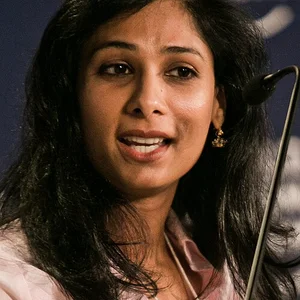

Gita Gopinath is an American economist of Indian origin, specializing in international macroeconomics, exchange rates, and trade. She became the First Deputy Managing Director of the International Monetary Fund (IMF) in 2022, having previously served as its chief economist.
Gita Gopinath(1971 — ?)
Gita Gopinath
États-Unis
5 min read
Frequently asked questions
Key Facts
- Born in 1971 in Calcutta (India), she earned a doctorate in economics from Princeton University in 2001.
- Professor of economics at Harvard University, where she held the John Zwaanstra chair from 2005.
- Appointed chief economist of the IMF in 2019, the first woman to hold the position.
- In January 2022 she became the First Deputy Managing Director of the IMF, the institution's number two.
- A recognized expert on dominant currency pricing and international macroeconomics.
Works & Achievements
Dissertation marking the start of her career as a researcher in international macroeconomics.
A body of work showing that most trade is invoiced in dollars, reshaping our understanding of exchange rates and how crises spread.
Coordination of a reference work bringing together the state of knowledge in international economics.
Responsible for the institution's economic analyses and the “World Economic Outlook,” during the Covid-19 crisis.
A costed proposal to fund global vaccination, presented as a major economic investment.
The institution's number two, overseeing the major global economic issues.
Anecdotes
Gita Gopinath was born in Calcutta and grew up in Mysore, in southern India. A brilliant student, she earned her degree from the University of Delhi before leaving for the United States to pursue a doctorate in economics at the prestigious Princeton University, which she obtained in 2001.
In 2019, she became the first woman to hold the position of Chief Economist at the International Monetary Fund (IMF), an institution created in 1944. Before her, this prestigious role had always been held by men.
During the Covid-19 pandemic, Gita Gopinath devised a “pandemic plan” costed at 50 billion dollars to speed up vaccination around the world. She argued that vaccinating the planet was not only a health issue, but also the best possible economic investment to revive the global economy.
Her research overturned a common assumption: she showed that most global trade is invoiced in U.S. dollars, rather than in the currency of the exporting country. This “dollar dominance” changes the way economists understand exchange rates and crises.
In 2022, she was promoted to First Deputy Managing Director of the IMF, the institution's number two. That same year, the Indian magazine India Today ranked her among the most influential Indian figures in the world.
Primary Sources
Gita is one of the world's outstanding economists, with impeccable academic credentials, a proven track record of practical experience, and an ability to communicate clearly.
Most of world trade is invoiced in a small number of dominant currencies, foremost among them the US dollar, which has profound consequences for how exchange-rate shocks are transmitted.
Vaccinating the world is the best public-policy investment of our time; a target of 60% of the global population vaccinated by mid-2022 could generate $9 trillion in additional output.
Key Places
Birthplace of Gita Gopinath in 1971, a major metropolis in eastern India.
Institution where she earned her bachelor's degree in economics in the early 1990s.
New Jersey university where she earned her doctorate in economics in 2001.
University where she taught economics from 2005 and became a leading researcher in international macroeconomics.
Institution where she served as chief economist and then First Deputy Managing Director from 2019.
Liens externes & ressources
Références
Œuvres
Doctorat d'économie (Princeton)
2001
Théorie de la « monnaie dominante » dans le commerce mondial
2010-2020
Direction du Handbook of International Economics (avec Helpman et Rogoff)
2014
Économiste en chef du FMI
2019-2022
Plan de sortie de la pandémie du FMI
2021
Première directrice générale adjointe du FMI
2022