
Glycerius was a Western Roman emperor who briefly reigned from 473 to 474, during the period of the Empire's collapse. Brought to power by the Burgundian general Gundobad, he was deposed by Julius Nepos and forced to become bishop of Salona.
Glycerius(430 — 480)
Glycerius
Rome antique
6 min read
Frequently asked questions
Key Facts
- Proclaimed Western Roman emperor in March 473 with the backing of the Burgundian general Gundobad
- Said to have repelled an incursion by the Visigoths and deflected an Ostrogothic threat during his reign
- Deposed in 474 by Julius Nepos, supported by the Eastern emperor Leo I
- Forced to give up the throne to become bishop of Salona in Dalmatia
Works & Achievements
Proclaimed Augustus at Ravenna thanks to the support of the Burgundian general Gundobad. His reign illustrates the grip of barbarian chieftains on Roman power.
Through diplomacy and gifts, he dissuaded Vidimir's Ostrogoths from invading Italy and steered them toward Gaul, sparing the peninsula.
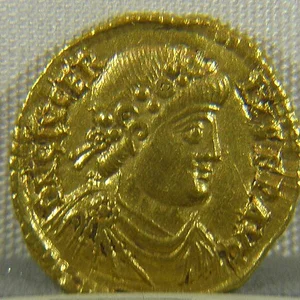
Minting of solidi and bronze coins at Ravenna and Milan, the only lasting material evidence of his very short reign.
Having become bishop of the capital of Dalmatia after his deposition, he pursued a second career in the Church.
According to John of Antioch, he was supposedly promoted to archbishop of Milan as a reward for his role in the death of Julius Nepos.
Anecdotes
Glycerius was not chosen by the Eastern Roman emperor nor by the Senate, but imposed by Gundobad, a Burgundian chieftain who had become master of the soldiers. This shows just how much, in the 5th century, real power in the West had passed into the hands of the barbarian generals who made and unmade emperors.
When Julius Nepos landed in Italy in 474 to overthrow him, Glycerius put up almost no resistance: he was captured near Rome, at Portus, and deposed without a fight. Rather than executing him, they forced him to become bishop of Salona, in Dalmatia.
Becoming a bishop was a clever way to neutralize a rival: a man of the Church could no longer reign nor raise an army. Glycerius thus passed from the imperial throne to the episcopal mitre, trading the purple for a religious office.
According to some later sources, Glycerius may have taken his revenge: in 480, it was perhaps with his complicity that Julius Nepos, the very man who had deposed him, was assassinated. Glycerius is even said to have been rewarded with the archbishopric of Milan.
Glycerius's reign lasted barely more than a year (473-474). He belongs to that long line of short-lived emperors at the end of the Western Empire, most of whom reigned only a few months before the final fall of Rome in 476.
Primary Sources
Glycerius, having become emperor at Ravenna more by usurpation than by election, was soon after driven from power and ordained bishop in the city of Salona.
Glycerius seized power at Ravenna and was soon deposed, then made bishop.
Nepos, having landed in Italy, deposed Glycerius without bloodshed and had him ordained bishop of Salona.
In the consulship of Leo, Glycerius was made emperor at Ravenna on the 3rd of March.
Key Places
Capital of the Western Roman Empire since 402, protected by its marshes. It was here that Glycerius was proclaimed emperor in March 473.
Large port at the mouth of the Tiber, near Ostia. Glycerius was captured here and then deposed by Julius Nepos in 474.
Major Roman city in Dalmatia, capital of the province. Glycerius was sent here as a bishop after his deposition.
The former capital of the Empire, which had become mainly a religious and senatorial symbol by the 5th century. Glycerius was taken nearby during his fall.
A major city in northern Italy and a former imperial residence. Glycerius is said to have obtained its archbishopric around 480 according to some sources.
Typical Objects

Band adorned with pearls and precious stones encircling the emperor's brow. By the 5th century, it had replaced the simple laurel crown as the supreme symbol of late Roman power.

Stable gold coin created by Constantine, struck in the name of each emperor, however short-lived. Solidi bearing Glycerius's likeness were minted at Ravenna and Milan during his brief reign.

Long purple cloak fastened at the shoulder, reserved for the emperor in his role as commander of the armies. “To don the purple” meant to ascend the throne.

Insignia of the office of bishop that Glycerius had to take up after his deposition. These objects symbolized his forced shift from temporal power to spiritual authority.

Long-bladed cavalry sword adopted by the late Roman army under barbarian influence. It equipped the Burgundian and Germanic soldiers on whom Glycerius's power rested.

Book made of bound leaves, which had replaced the ancient scroll. Used for imperial correspondence, edicts, and above all the Christian texts that a bishop was expected to know.
School Curriculum
Vocabulary & Tags
Key Vocabulary
Daily Life
Morning
As emperor in Ravenna, Glycerius began his day with the salutatio, the morning audience where courtiers, officers, and ambassadors came to greet him. He then dealt with the imperial correspondence and the petitions from the provinces alongside his secretaries.
Afternoon
The afternoon was devoted to affairs of state: receiving military commanders such as Gundobad, negotiating with the barbarian peoples, and dispensing justice. Real power often played out in these discussions with the generals.
Evening
In the evening, banquets brought the imperial entourage together around fine dishes and wines, occasions to weave alliances and loyalties. Once he became a bishop, his evenings changed radically, paced by prayer and the divine offices.
Food
The late imperial table offered bread, meats, fish, fruits, cheeses, and imported wines, sometimes spiced. Once he was a bishop, Glycerius adopted plainer fare, shaped by the Christian fasts.
Clothing
As emperor, he wore the purple and the diadem set with pearls, garments embroidered with gold that symbolized his rank. As bishop, he donned the tunic and the ecclesiastical insignia, casting off every sign of imperial power.
Housing
In Ravenna, he resided in the imperial palace, a sumptuous complex adorned with mosaics and marble. In Salona, he lodged in the episcopal residence, near the city's Christian basilicas.
Historical Timeline
Period Vocabulary
Liens externes & ressources
Références
Œuvres
Accession au trône impérial d'Occident
3 mars 473
Détournement de l'invasion ostrogothe
473
Émission monétaire à son effigie
473-474
Épiscopat de Salone
474-vers 480
Archevêché de Milan (attribué)
vers 480