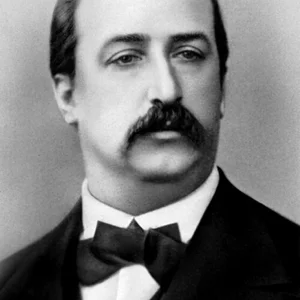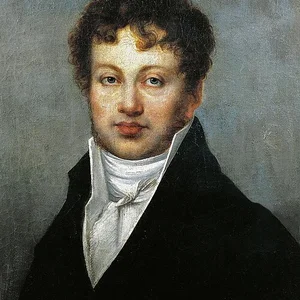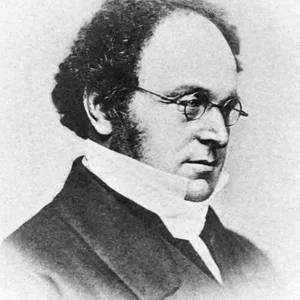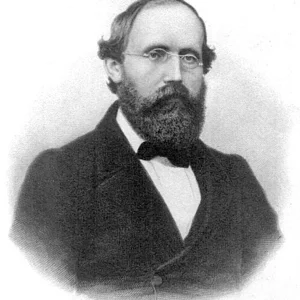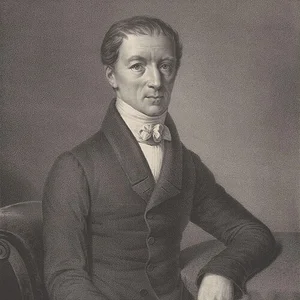

A German naturalist and physician, he was one of the first to use the term “biology” to describe the science of living things. His major work sought to unify the study of living beings into a coherent discipline.
Gottfried Reinhold Treviranus(1776 — 1837)
Gottfried Reinhold Treviranus
Allemagne
5 min read
Frequently asked questions
Key Facts
- Born in 1776 in Bremen, died in 1837 in the same city
- From 1802 onward, published his work “Biologie, oder Philosophie der lebenden Natur” (6 volumes, 1802-1822)
- Introduced and popularized the term “biology” almost simultaneously with Jean-Baptiste de Lamarck (1802)
- Professor of mathematics and medicine at the lyceum of Bremen
- Carried out research on comparative anatomy and the physiology of the nervous system
Works & Achievements
A major six-volume work that popularized the word “biology” and attempted to unify the study of all living things into a coherent science.
A collection of anatomical and physiological writings blending his research on the sense organs and the structure of animals.
A late treatise setting out his general laws of organic life and synthesizing decades of observation.
Microscope studies of the inner structure of organisms, contributing to the pre-cellular understanding of tissues.
A decisive conceptual contribution: giving a unified name to the science of living things, still used everywhere today.
Anecdotes
In 1802, Treviranus published the first volume of his great work and used the word “Biology” in it to designate the science of living things. Around the same time, the Frenchman Lamarck was also using this term: without having consulted each other, two scholars almost simultaneously named a brand-new science.
Treviranus was a professor of mathematics and medicine at the lycée of Bremen, his native city. For decades, he lived and taught in this merchant town without ever holding a chair at a great university, proving that science could be advanced far from the prestigious academic centers.
His younger brother, Ludolph Christian Treviranus, became a renowned botanist. The two brothers collaborated on questions of plant and animal physiology, forming a true scientific tandem devoted to the study of life.
Treviranus was interested in everything that lived: he dissected mollusks, studied the eyes of animals, and observed tissues under the microscope. His boundless curiosity led him to bring together plants, animals, and the human body within a single line of thought, where his predecessors had kept them apart.
In his great treatise, Treviranus defended the idea that species could transform over time to adapt to their environment. This transformist insight, formulated half a century before Darwin, made him one of the forgotten pioneers of the idea of evolution.
Primary Sources
The objects of our research will be the different forms and manifestations of life, the conditions and laws under which this phenomenon takes place, and the causes by which it is produced. The science that concerns itself with these objects we shall designate by the name of biology, or the doctrine of life.
Everything that lives forms one great whole, whose parts are linked together by the common laws of organization.
The comparative study of the sense organs in animals enlightens us about the very nature of sensation and of organic life.
The phenomena of organic life obey constant laws that science must strive to discover and to connect with one another.
Key Places
A Hanseatic city in northern Germany where Treviranus was born, taught his whole life, and died.
A prestigious university where Treviranus earned his doctorate in medicine in 1796.
The school where Treviranus was a professor of mathematics and medicine for decades.
A major port near Bremen, an intellectual and commercial hub frequented by scholars from northern Germany.
Typical Objects

Instrument for observing cells, tissues, and tiny organisms invisible to the naked eye. Treviranus used it to study the inner structure of living beings.

A set of scalpels, forceps, and needles used to open and study the bodies of animals. An indispensable tool of the comparative anatomist.

The volumes of Treviranus's Biologie, written by hand and then printed, establishing the vocabulary of a new science.

The scholar's writing tools for recording observations and theories. With them Treviranus wrote his thousands of pages analysing the living world.

Glass containers filled with alcohol preserving animals and organs for study. They made up the naturalist's reference collection.

Detailed illustrations of organs and animals accompanying scientific treatises. They made it possible to share observations without the actual specimen.
School Curriculum
Vocabulary & Tags
Key Vocabulary
Daily Life
Morning
Treviranus rose early to prepare his lessons at the Bremen secondary school. The morning was devoted to teaching mathematics and medicine to his pupils, in classrooms lit by the northern light.
Afternoon
In the afternoon, he retired to his study to dissect animals and examine tissues under the microscope. He carefully recorded each observation in his notebooks, gathering the material for his future treatises.
Evening
In the evening, by the glow of an oil lamp, he wrote the volumes of his *Biology* and kept up a correspondence with other scholars. He would sometimes discuss physiology with his botanist brother Ludolph.
Food
He shared the middle-class diet of a northern port city: rye bread, North Sea fish, meats, cabbage, and local beer. Coffee and tea, imported through the port of Bremen, accompanied his meals.
Clothing
Treviranus wore the sober attire of the early 19th-century German professor and notable: a dark frock coat, waistcoat, high-collared shirt, and knotted cravat. A dignified and understated outfit, well suited to teaching.
Housing
He lived in a middle-class town house in Bremen, a city of bricks and Hanseatic gables. His home contained his study, his library, and his collections of specimens preserved in jars.
Historical Timeline
Period Vocabulary
Liens externes & ressources
Références
Œuvres
Biologie, oder Philosophie der lebenden Natur (6 volumes)
1802-1822
Vermischte Schriften anatomischen und physiologischen Inhalts
1816-1821
Die Erscheinungen und Gesetze des organischen Lebens
1831-1833
Recherches microscopiques sur les tissus vivants
vers 1810-1820
Introduction du terme « biologie » dans le vocabulaire scientifique
1802