 flip
flipMaize Xima, the Daily Staple
Maize Xima, the Daily Staple
Why this dish? Born in Incadine, Gaza Province, Graça Machel grew up in rural Mozambique where xima is the heart of every meal. She herself readily recalls her attachment to the flavors of southern Africa: this maize porridge is the first taste of childhood, the one you find wherever you go in the world.
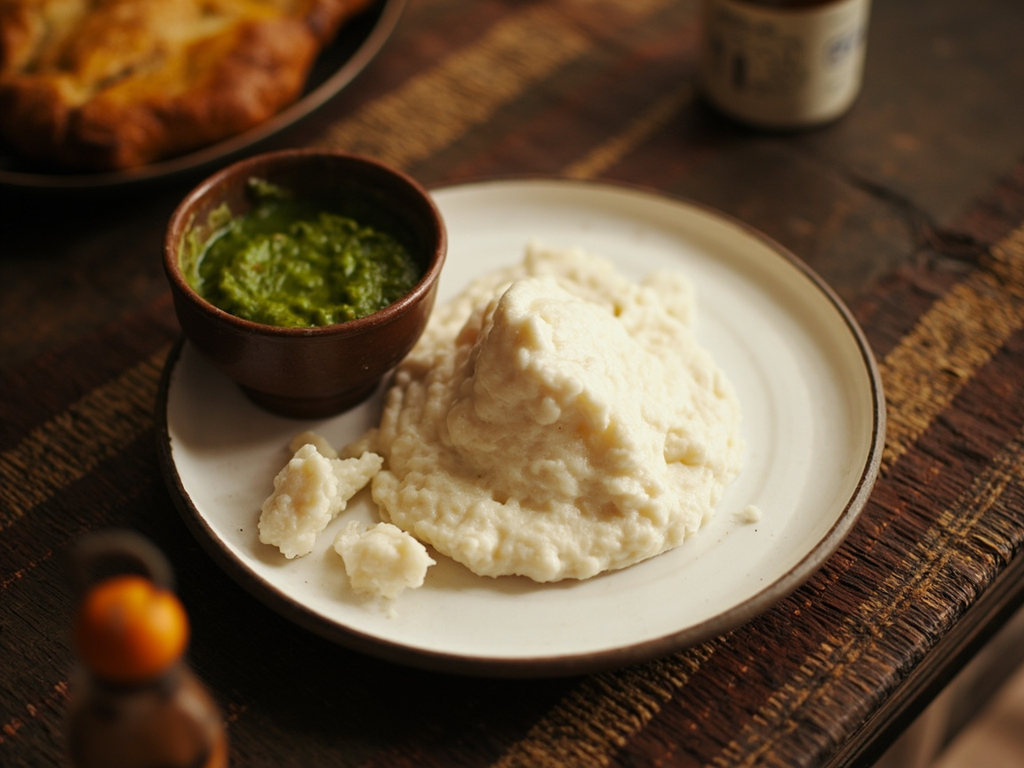
Thick porridge of white maize flour, smooth and firm, detached from the bottom of the pot and shaped into a ball to scoop up sauces. Neither sweet nor seasoned, it is the neutral, nourishing support of the whole meal.
At home, in Incadine, we didn't ask "what's for dinner?" but "is there xima?". I stir the flour into the boiling water with one hand, vigorously, until the dough pulls away from the pot and resists a little — that's when it's good. You take a piece with your fingertips, make a hollow, dip it into the sauce: that's how we learned to eat together, wasting nothing. I can dine in the greatest capitals of the world, but it's this taste that tells me I'm home.
- •White maize flour (or sorghum, depending on the year) — two handfuls per person (starch base)
- •Spring water — as needed (cooking)
- •Salt — a pinch (light seasoning)
Maize Xima, the Daily Staple
Thick porridge of white maize flour, smooth and firm, detached from the bottom of the pot and shaped into a ball to scoop up sauces. Neither sweet nor seasoned, it is the neutral, nourishing support of the whole meal.
Why this dish? Born in Incadine, Gaza Province, Graça Machel grew up in rural Mozambique where xima is the heart of every meal. She herself readily recalls her attachment to the flavors of southern Africa: this maize porridge is the first taste of childhood, the one you find wherever you go in the world.
At home, in Incadine, we didn't ask "what's for dinner?" but "is there xima?". I stir the flour into the boiling water with one hand, vigorously, until the dough pulls away from the pot and resists a little — that's when it's good. You take a piece with your fingertips, make a hollow, dip it into the sauce: that's how we learned to eat together, wasting nothing. I can dine in the greatest capitals of the world, but it's this taste that tells me I'm home.
Ingredients (period version)
- White maize flour (or sorghum, depending on the year) — two handfuls per person (starch base)
- Spring water — as needed (cooking)
- Salt — a pinch (light seasoning)
Ingredients
- Fine white maize flour (type mealie meal / fubá) — 250 g (starch base)
- Water — 1 liter (cooking)
- Salt — 1 pinch (light seasoning)
Method
- Bring 750 ml of salted water to a boil in a thick-bottomed pot.
- Mix the flour with the remaining 250 ml of cold water to avoid lumps.
- Pour this mixture into the boiling water while stirring vigorously with a wooden spoon.
- Reduce the heat, add flour little by little while stirring constantly until a thick dough that pulls away from the sides forms.
- Cover and cook on low heat for 5-10 minutes, stir one last time, then turn out into a dome on a plate.
How it was made : Before the spread of maize (arrived from the Americas after 1492 and massively adopted in southern Africa in later centuries), the same porridge was made from sorghum and millet, ancient African cereals. In the 20th century, white maize became the dominant starch in rural Mozambique.
The contemporary twist : Shape small regular balls with a wet spoon for a neat presentation, and arrange them in a crown around a shared bowl of sauce.
Graça Machel · Charactorium