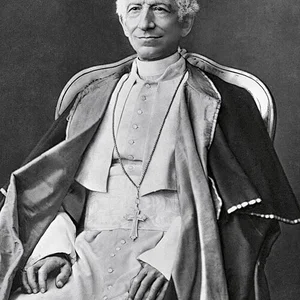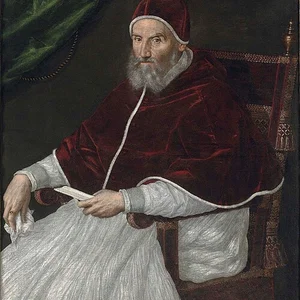

Gregory XIII was the 226th pope of the Catholic Church, from 1572 to 1585. Trained as a lawyer, he is best known for the calendar reform that bears his name, the Gregorian calendar, introduced in 1582 and still in use today.
Gregory XIII(1502 — 1585)
Gregory XIII
États pontificaux
5 min read
Frequently asked questions
Key Facts
- Elected pope in 1572, taking the name Gregory XIII
- Promulgated the Gregorian calendar through the bull Inter gravissimas in 1582, dropping ten days to correct the drift of the Julian calendar
- Implemented the decisions of the Council of Trent and supported the Catholic Counter-Reformation
- Founded and endowed numerous colleges, including the Roman College (the future Gregorian University) and several national colleges in Rome
- Died in Rome in 1585, leaving the papal finances in a weakened state
Works & Achievements
A major reform of timekeeping that corrected the Julian calendar; still used worldwide today.
Strengthening of the great Jesuit college of Rome, which became the Gregorian University, a cornerstone of clergy training.
Seminaries (English, German, Greek…) meant to train priests for the countries affected by the Reformation.
A set of cartographic frescoes of Italy, a high point of Renaissance geographical science.
An update of the official calendar of the saints and martyrs of the Catholic Church.
Backing for Catholic missions in Asia, the Americas, and Europe as part of the Counter-Reformation.
Anecdotes
In October 1582, ten days simply vanished from the calendar: the day after Thursday, October 4 was Friday, October 15. This removal was meant to correct the drift that had built up under the Julian calendar and to realign the seasons.
Gregory XIII relied on the calculations of the Calabrian astronomer and physician Luigi Lilio (Aloysius Lilius) and of the Jesuit mathematician Christopher Clavius to build his calendar reform, showing the alliance between the Church and Renaissance science.
A great builder, he had numerous colleges erected in Rome to train priests, including the famous Collegium Romanum (today's Gregorian University), which earned him the nickname of the “teaching pope” of the Counter-Reformation.
When the news of the St. Bartholomew's Day Massacre (1572) in France reached him, Gregory XIII had a Te Deum sung and a commemorative medal struck, a gesture that has remained highly controversial because it seemed to celebrate the killing of thousands of Protestants.
At the Vatican he had the Gallery of Maps decorated, a long gallery whose frescoes depict every region of Italy — a true masterpiece of Renaissance cartography.
Primary Sources
We decree that ten days be removed from the calendar, from the fourth day before the ides of October until the day after the ides, so that the spring equinox is brought back to March 21.
Inscription struck on the reverse of the papal medal celebrating the events of St. Bartholomew’s Day in France.
Scientific account justifying and explaining the structure of the new Roman calendar restored by Gregory XIII.
Key Places
Birthplace of Ugo Boncompagni, the future Gregory XIII, where he studied and taught law at the famous university.
Seat of the papacy where Gregory XIII reigned, died, and carried out his great religious and calendar reforms.
Center of papal power where he had the Gallery of Maps decorated and led the Church.
A Jesuit college richly endowed by Gregory XIII, which became the Pontifical Gregorian University.
The site of his tomb, adorned with a funerary monument evoking the reform of the calendar.
Typical Objects

A headdress with three crowns symbolizing the pope's spiritual and temporal authority. Worn during major ceremonies.

A signet ring unique to each pope, depicting Saint Peter fishing. It was used to seal official documents.

An official document sealed with a lead seal, such as the bull Inter gravissimas that established the Gregorian calendar.

A system for counting days and years reformed in 1582, still in use throughout the world today.

Tools for observing the Sun used by astronomers like Clavius to measure the exact length of the solar year.

A cross worn on the chest, an insignia of episcopal and papal dignity.
School Curriculum
Vocabulary & Tags
Key Vocabulary
Daily Life
Morning
The pope began his day with prayer and Mass, followed by the reading of the breviary. He then received his secretaries to handle correspondence and the affairs of the Church.
Afternoon
The afternoon was devoted to audiences: ambassadors, cardinals, scholars, and representatives of the religious orders. Gregory XIII, a jurist, also examined matters of canon law and reform projects.
Evening
The evening blended prayers, pious readings, and conversations with his closest advisers. There he might discuss the progress of the calendar reform with his astronomers.
Food
The papal diet, sober in principle, followed the liturgical calendar with its days of abstinence and fasting. The table featured bread, fish, meats, vegetables, and Italian wine.
Clothing
Day to day, he wore the white cassock and the zucchetto; for ceremonies, richly embroidered liturgical vestments, the tiara, and the papal insignia.
Housing
He resided in the Apostolic Palace of the Vatican, a vast complex of ceremonial halls, chapels, libraries, and private apartments adorned with frescoes.
Historical Timeline
Period Vocabulary
Liens externes & ressources
Références
Œuvres
Calendrier grégorien (bulle Inter gravissimas)
1582
Fondation et dotation du Collegium Romanum
1572-1584
Création de collèges nationaux à Rome
1573-1580
Galerie des Cartes géographiques du Vatican
1580-1581
Réforme du Martyrologe romain
1584
Soutien aux missions jésuites
1572-1585