
Guillaume de Machaut was a 14th-century French poet and composer, a leading figure of the Ars nova. Considered one of the greatest musicians of the Middle Ages, he shaped the transition toward complex polyphony.
Guillaume de Machaut(1300 — 1377)
Guillaume de Machaut
France
6 min read
Frequently asked questions
Key Facts
- Born around 1300 in Champagne, died in 1377 in Reims
- Composed the *Messe de Nostre Dame* around 1360, the first complete polyphonic mass attributed to a single composer
- A central figure of the Ars nova, the 14th-century musical movement that renewed rhythm and notation
- Secretary to John of Luxembourg, King of Bohemia, then a canon of Reims
- Author of motets, ballades, rondeaux and virelais blending poetry and music
Works & Achievements
The first complete polyphonic mass attributed to a single composer. A landmark work of Western music and a masterpiece of the *Ars nova*.
A long poem weaving together letters, verse and songs, recounting his love affair with **Péronne d'Armentières**. A rare testimony to the inner life of a medieval artist.
A palindrome-rondeau whose music reads the same forwards and backwards. A celebrated technical feat showcasing his genius for construction.
A long narrative *dit* containing examples of every lyric form of the period. A kind of poetic and musical handbook.
A verse account of the exploits of King **Peter I of Cyprus**. A historical and chivalric work from the end of his life.
A vast body of secular songs in the “fixed forms” that he perfected. They influenced all of European music that came after him.
Illuminated collections gathering his entire body of work, copied under his supervision. They allowed the exceptional preservation of his output.
Anecdotes
Guillaume de Machaut composed the “Messe de Nostre Dame” (Mass of Our Lady), one of the first complete polyphonic masses attributed to a single composer. Before him, the different parts of the mass were often written by several anonymous musicians; Machaut wanted a unified work, which was a genuine musical revolution.
Toward the end of his life, Machaut had an epistolary love affair with a young admirer named Péronne d'Armentières, when he was around 60 and she was under 20. He recounted this relationship in a long poem, the “Voir Dit” (the “True Tale”), blending letters, poems, and songs.
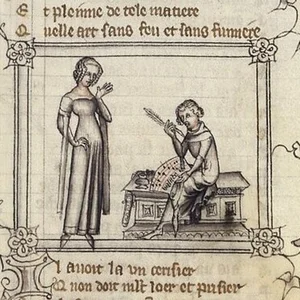
Machaut carefully oversaw the copying of his complete works into large, richly illuminated manuscripts. This was very rare for the time: most medieval composers remained anonymous, but he wanted his music and poetry to be preserved under his name for posterity.
In the service of King John of Luxembourg, King of Bohemia, Machaut traveled widely across Europe, taking part in the ruler's military campaigns. This blind king died heroically at the Battle of Crécy in 1346, but Machaut had already left his active service to devote himself to writing.
Machaut perfected musical and poetic forms known as the “formes fixes” (fixed forms): the rondeau, the ballade, and the virelai. He even wrote a rondeau, “Ma fin est mon commencement” (My end is my beginning), whose music can be read backward as well as forward, like a musical palindrome.
Primary Sources
And because I cannot see you as often as I would wish, I send you my book, in which are all the things I have made for the love of you.
Nature, who formed my person, commands me to make poems and songs in praise of ladies and of Love.
I wish to tell and recount how the good king of Cyprus conquered the city of Alexandria through his great valor.
Kyrie eleison, Christe eleison, Kyrie eleison.
Key Places
City in the Champagne region where Machaut was a canon of the cathedral and lived for most of his life. There he composed the Messe de Nostre Dame and died in 1377.
Coronation site of the kings of France, where Machaut held his office as a canon. It was in this religious setting that he created his famous polyphonic mass.
Region in northeastern France where Machaut is thought to have been born around 1300, perhaps in the village of Machault. His exact origins remain uncertain.
Heart of the kingdom of John of Luxembourg, whose secretary Machaut was. He accompanied the king on his many travels across Europe.
Capital where the French court flourished and where the Ars nova developed. Machaut had ties there with the royal family, notably the future Charles V.
Typical Objects

Large parchment book in which Machaut's music and poetry were copied by hand and decorated with colorful miniatures. He personally oversaw these collections to pass on his work.

A system for writing notes that made it possible to record complex rhythms and polyphony. The Ars nova introduced a new rhythmic precision compared with earlier music.

A small organ carried on a strap, played with one hand while the other worked the bellows. A common instrument in the court music of the 14th century.

A bowed string instrument, ancestor of the violin, widely used by minstrels and in secular medieval music. It often accompanied courtly songs.

A sharpened goose quill and ink, the tools of the clerk and poet for writing letters, poems, and musical scores. Machaut, a court secretary, used them daily.

A fur garment worn over the shoulders by canons during services at the cathedral. It marked the religious status of Machaut, a canon of Reims.
School Curriculum
Vocabulary & Tags
Key Vocabulary
Daily Life
Morning
As a canon, Machaut rose early to attend the religious services at Reims Cathedral, chanting the psalms with the other clerics. The morning was paced by the liturgical hours and prayer.
Afternoon
In the afternoon, he devoted himself to writing: composing songs, writing poems, and copying out his works. He might also receive messages from his princely patrons and work on their commissions.
Evening
In the evening, by candlelight, Machaut would reread his texts or jot down new melodies on parchment. He also kept up a correspondence, such as his letters to Péronne d'Armentières.
Food
The diet of a well-off canon included bread, Champagne wine, meat on the permitted days, and fish on days of fasting. Spices, which were expensive, added flavour to the dishes of ecclesiastical tables.
Clothing
Machaut wore the plain garments of the clergy: a long robe, a cloak, and, during services, the fur *aumusse* of the canons. At court, he could don richer clothing made of fine fabrics.
Housing
As a canon, he had a canonical house in the quarter near Reims Cathedral. This comfortable lodging provided him with the quiet and the income to devote himself to his art.