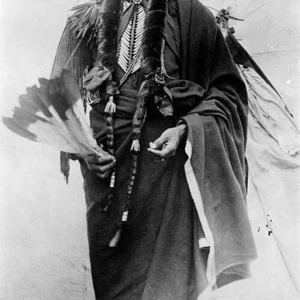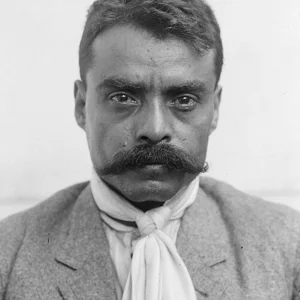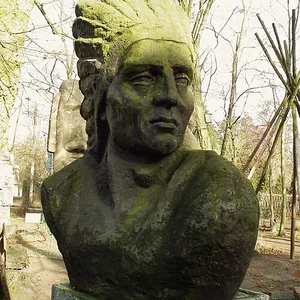

Oglala Lakota war chief and a leading figure of Native American resistance against the expansion of the United States. Victor over Custer at Little Bighorn in 1876, he was killed the following year while being held at Fort Robinson.
Crazy Horse(1849 — 1877)
Crazy Horse
6 min read
Frequently asked questions
Key Facts
- Born around 1840 among the Oglala Lakota, he became a respected warrior in his youth
- In 1876, he took part in the victory at the Rosebud (June 17) against General Crook's troops
- On June 25, 1876, he played a decisive role at the Battle of Little Bighorn, where Lieutenant Colonel Custer's 7th Cavalry was wiped out
- He surrendered to the American authorities in May 1877 in the face of military pressure and famine
- He died on September 5, 1877, at Fort Robinson, mortally wounded by a bayonet thrust during his arrest, at about 37 years of age
Works & Achievements
As a young warrior, he lured a detachment of 80 soldiers into a deadly ambush during Red Cloud's War.
He led the attack that forced General Crook to abandon his plan to join the other American columns, undermining their overall strategy.
His charge helped annihilate Custer's 7th Cavalry, the most resounding American defeat of the Indian Wars.
He sustained armed resistance through a harsh winter, despite hunger and the relentless pursuit of the army.
Having become a universal symbol of Native American resistance, he is honored by the Crazy Horse Memorial and countless books and tributes.
Anecdotes
As a child, Crazy Horse had light skin and curly, light brown hair, so much so that his people nicknamed him “Curly.” He only received his adult name, that of his father, after proving his bravery in battle.
Before each battle, Crazy Horse painted his body with white hailstones and drew a lightning bolt on his cheek, in keeping with a vision he had received during a spiritual quest. He wore a small sacred stone behind his ear and a single hawk feather, refusing the large feather headdresses worn by other chiefs.
It is said that he always refused to be photographed, asking why anyone would want to “steal his shadow” and shorten his life. To this day, no authenticated photograph of him has ever been found.
On June 25, 1876, at Little Bighorn, he led the charge against the soldiers of the 7th Cavalry. Within a few hours, the detachment of Lieutenant Colonel George Custer was wiped out: it was one of the worst defeats suffered by the U.S. Army at the hands of Native Americans.
On September 5, 1877, having just surrendered, Crazy Horse was mortally wounded by a soldier's bayonet thrust the moment he realized they meant to lock him up at Fort Robinson. He died that very night, at only about thirty years of age.
Primary Sources
Crazy Horse dreamed and went into the world where there is nothing but the spirits of all things. It was from there that his strange power came; he was present in this world, but partly somewhere else.
He Dog reports that Crazy Horse was a silent man, who never danced and did not sing in public, yet whom all the warriors wanted to follow into battle.
Wounded by a bayonet thrust, the dying chief was laid out on the floor of the agency; his old father watched over him until his death, shortly after midnight.
Crook acknowledged that the Lakota and Cheyenne warriors, led by their chiefs, attacked with unexpected boldness and coordination, forcing him to halt his advance northward.
Key Places
Sacred hills of the Lakota people, at the heart of their territory and their spirituality. Crazy Horse grew up here and fought to defend them against the gold prospectors.
Site of the battle of June 17, 1876, where Crazy Horse halted the advance of General Crook, eight days before Little Bighorn.
Site of the famous battle of June 25, 1876, where Lakota and Cheyenne warriors crushed Custer's 7th Cavalry.
Military post where Crazy Horse surrendered in May 1877 and where he was killed by a bayonet thrust on September 5 of the same year.
A colossal sculpture carved into the mountain in honor of the chief, begun in 1948 and still unfinished today.
Typical Objects

A fast, hardy mount, essential for bison hunting and warfare. Mastery of the horse was the source of Lakota military power.

A silent, reliable traditional weapon used on horseback for both hunting and battle. Warriors wielded it with fearsome accuracy at a full gallop.

A close-combat club or bludgeon, often fitted with a stone or a spike. A symbol of the status of an accomplished warrior.

A rifle obtained through trade or taken from the enemy, which modernized the weaponry of the Plains warriors against the U.S. Army.

A small amulet-stone that Crazy Horse wore behind his ear, received during a vision and believed to protect him from bullets in battle.

Patterns painted on the face and body before battle: a lightning bolt on the cheek and hail spots, inspired by his protective vision.

A collapsible conical dwelling, easy to transport during the Lakota community's seasonal migrations.

A ceremonial pipe used to seal alliances, pray, and make important decisions. A central object of Lakota spirituality.
School Curriculum
Vocabulary & Tags
Key Vocabulary
Tags
Daily Life
Morning
At dawn, the Lakota camp awoke to the rhythm of horses and fires. The warriors checked their mounts and weapons, while the women rekindled the hearths and prepared the first meal.
Afternoon
The days were devoted to buffalo hunting, target practice and horseback riding, or to councils where the chiefs discussed movements and warfare. Crazy Horse, known as a loner, often set off alone on horseback.
Evening
In the evening, around the fire, the elders recounted past exploits and sacred tales. The peace pipe was smoked during important decisions, and the great deeds of the warriors were sung.
Food
Their diet rested mainly on buffalo meat, eaten fresh or dried into pemmican mixed with berries. To this were added game, roots and wild fruits gathered with the changing seasons.
Clothing
Crazy Horse dressed simply: a deerskin shirt and leggings, moccasins, and a single hawk feather in his hair. He scorned the elaborate headdresses and showy ornaments of the other chiefs.
Housing
He lived in a tipi made of buffalo hides stretched over poles, which could be set up and taken down in a few minutes. This mobile dwelling followed the community's movements as it tracked the herds.
Historical Timeline
Period Vocabulary
Liens externes & ressources
Références
Œuvres
Rôle de leurre au combat de Fetterman
1866
Victoire de la bataille de la Rosebud
17 juin 1876
Victoire décisive de Little Bighorn
25 juin 1876
Campagne de résistance hivernale (1876-1877)
1876-1877
Figure mémorielle posthume
depuis 1877