 flip
flipTteokbokki — spicy stir-fried rice cakes
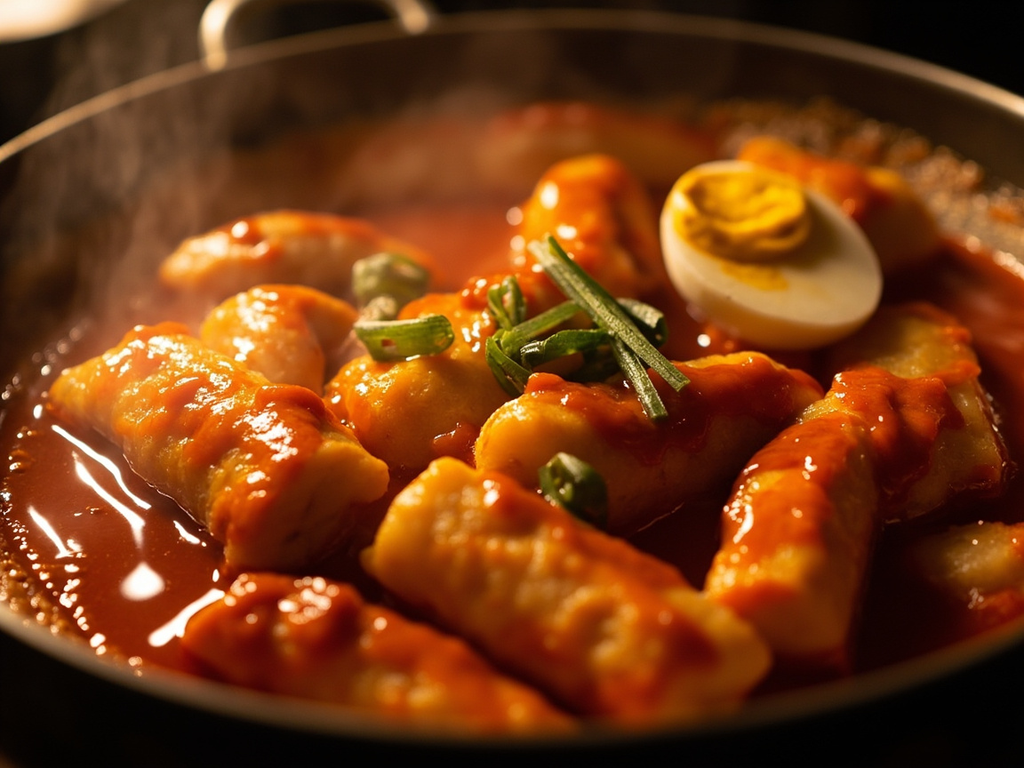
Tteokbokki — spicy stir-fried rice cakes
Why this dish? The taste of Korean student youth, eaten piping hot at street stalls (pojangmacha) after class. Chang, who studied at Seoul National University before Cambridge, belongs to the generation for whom tteokbokki became the ultimate democratic snack — cheap, filling, accessible to all.
Chewy, elastic rice cake sticks (tteok), simmered in a red sauce made from fermented chili paste (gochujang), sweet and sticky. A hot, comforting, addictive street snack.
Ah, tteokbokki! There is street economics in all its democratic splendor. For a few won, the broke student I was could eat his fill, standing in the steam of a stall, fingers reddened by the sauce. It's the dish that reminds us that the market is not just conference rooms and stock indices: it also lives on the sidewalk, in the warmth of a pojangmacha on a winter evening. The secret is in the sauce — gochujang, a cloud of sugar, and let it reduce until it coats and clings. Bite into the hot tteok: elastic, that's all the satisfaction in the world for next to nothing.
- •Garaetteok (rice cake sticks) — a good handful (chewy base)
- •Gochujang (fermented chili paste) — two spoonfuls (spicy red sauce)
- •Sugar or malt syrup (mullyeot) — a dash (sweet roundness)
- •Dried anchovy broth — a bowl (umami base)
- •Green onion — a few stalks (freshness)
Tteokbokki — spicy stir-fried rice cakes
Chewy, elastic rice cake sticks (tteok), simmered in a red sauce made from fermented chili paste (gochujang), sweet and sticky. A hot, comforting, addictive street snack.
Why this dish? The taste of Korean student youth, eaten piping hot at street stalls (pojangmacha) after class. Chang, who studied at Seoul National University before Cambridge, belongs to the generation for whom tteokbokki became the ultimate democratic snack — cheap, filling, accessible to all.
Ah, tteokbokki! There is street economics in all its democratic splendor. For a few won, the broke student I was could eat his fill, standing in the steam of a stall, fingers reddened by the sauce. It's the dish that reminds us that the market is not just conference rooms and stock indices: it also lives on the sidewalk, in the warmth of a pojangmacha on a winter evening. The secret is in the sauce — gochujang, a cloud of sugar, and let it reduce until it coats and clings. Bite into the hot tteok: elastic, that's all the satisfaction in the world for next to nothing.
Ingredients (period version)
- Garaetteok (rice cake sticks) — a good handful (chewy base)
- Gochujang (fermented chili paste) — two spoonfuls (spicy red sauce)
- Sugar or malt syrup (mullyeot) — a dash (sweet roundness)
- Dried anchovy broth — a bowl (umami base)
- Green onion — a few stalks (freshness)
Ingredients
- Tteok rice cakes (fresh or rehydrated) — 300 g (chewy base)
- Gochujang — 2 tbsp (spicy fermented sauce)
- Gochugaru (chili powder) — 1 tbsp (color and heat)
- Sugar — 1.5 tbsp (sweet balance)
- Anchovy broth (or dashi) — 400 ml (umami base)
- Eomuk (fish cake) or hard-boiled egg — 100 g or 2 eggs (garnish)
- Green onion — 2 stalks (finish)
Method
- If the tteok are hard, soak them in warm water for 10 min to soften.
- Bring the anchovy broth to a simmer and dissolve gochujang, gochugaru, and sugar.
- Add the tteok and eomuk; simmer for 8-10 min, stirring, until the sauce thickens and coats.
- When the sauce becomes glossy and sticky, add the green onion.
- Serve piping hot, optionally with a halved hard-boiled egg.
How it was made : The royal tteokbokki of old (gungjung tteokbokki) was made with soy sauce, no chili, for the Joseon dynasty court. The red gochujang version, now iconic, only appeared after the Korean War, around the 1950s, and exploded as a popular, cheap street food in Seoul in the following decades.
The contemporary twist : Rabokki: throw a sheet of instant noodles (ramyeon) into the sauce at the end — the favorite marriage of busy students.
Ha-Joon Chang · Charactorium