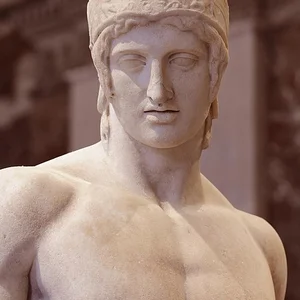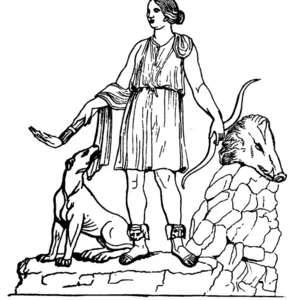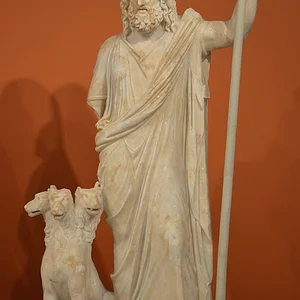

Hades is the god of the underworld and the dead in Greek mythology. Brother of Zeus and Poseidon, he rules over the realm of souls and the mineral riches of the earth. He is often portrayed as a just and unyielding god, though mortals feared him greatly.
Hades
Hades
8 min read
Frequently asked questions
Key Facts
- Hades is one of the twelve major Olympian gods of Greek mythology
- He rules over the underworld and the dead following the division of the world between the three brothers (Zeus, Poseidon, and Hades)
- The abduction of Persephone by Hades is a central myth explaining the changing of the seasons
- He is rarely depicted without his main attributes: the cornucopia or the sovereign's scepter
- Sanctuaries and cults dedicated to Hades in ancient Greece were rare, as the Greeks considered direct contact with the god of the dead to be dangerous
Works & Achievements
Hades abducts Persephone, goddess of vegetation, to make her his wife and queen of the underworld. This mythological event explains the changing of the seasons and symbolizes the cycle of death and rebirth.
Hades builds his magnificent underground kingdom, complete with palaces, mineral riches, and subterranean rivers. This palace receives and governs the souls of all deceased mortals.
Hades presides over the judgment of souls with the help of Minos and Aeacus, determining their eternal fate (Tartarus, the Elysian Fields, or the Asphodel Meadows). This system of divine justice is fundamental to Greek cosmogony.
Hades rules over precious metals and mineral resources buried within the earth. He is often invoked for blessings relating to agriculture and underground wealth.
Hades commands the rivers of the underworld (Styx, Acheron, Cocytus, Phlegethon) and Charon, who ferries souls across them. These elements embody the uncrossable boundary between the world of the living and that of the dead.
During the Titanomachy, Hades fights alongside Zeus and Poseidon against the Titans. After their victory, he receives dominion over the underworld as his shared divine domain.
Anecdotes
In Homer's Iliad, Hades is portrayed as the most feared god on Olympus, for no one can escape his realm. When the hero Achilles threatens the other gods in battle, he refuses to fight Hades himself, acknowledging that the god of the Underworld is too powerful and inescapable. This portrayal shows how the ancient Greeks saw Hades not as an evil god, but as a natural and relentless force.
The myth of Persephone, recounted by Hesiod and developed in the Homeric Hymn to Demeter, tells how Hades abducts the young goddess to make her his wife. Far from a simple tale of kidnapping, the ancient texts suggest that Persephone ultimately came to accept her role as Queen of the Underworld, dividing her time between the realm of the dead and that of the living, and becoming a fully respected deity in her own right.
The cult of Hades in ancient Greece was unusual: Athenians would never speak his name directly in sanctuaries, preferring to call him 'the Rich One' or 'the Gracious One,' for fear of drawing his attention. This religious practice reflects the superstitious reverence the Greeks held toward the god of the Dead — without demonizing him.
In Hesiod's Theogony, Hades receives his domain through a fair drawing of lots with his brothers Zeus and Poseidon, following their victory over the Titans. This equal division of power among the three Olympian brothers shows that Hades was not considered inferior, but rather a god in his own right, ruling over a domain of the highest importance.
Tartarus, the deepest underground prison within Hades's realm, was reserved for the defeated Titans and the greatest divine criminals, according to Homer and Hesiod. As guardian of Tartarus, Hades embodied eternal divine justice and cosmic order, preserving the universe from a return to primordial chaos.
Primary Sources
Zeus received the wide sky, Poseidon the grey sea, and Hades was allotted the mist and darkness.
Hades, god of the underworld, hates to be seen by mortals. He is the most terrible of the immortal gods.
Relentless Hades endlessly demands new inhabitants for his underground kingdom.
Hades, Lord of the dead, seized Persephone in his golden chariot and swept her away to the underworld.
Hades, who rules over the dead, is a just god who distributes punishments and rewards according to the deeds of souls.
Key Places
The subterranean kingdom ruled by Hades, where the souls of the dead reside. It is the seat of Hades' power and the center of his divine domain.
The mythological river marking the boundary between the world of the living and the world of the dead. Hades reigns over this river, where Charon ferries the souls of the deceased.
A sanctuary in Attica (Greece) dedicated to the Eleusinian Mysteries, where Hades was venerated as the husband of Persephone. This site was an important center of worship connected to the god.
A region of deep darkness at the gates of the Underworld, associated with Hades and his subterranean kingdom. It is a transitional zone between the mortal world and the god's divine domain.
Although Hades rules beneath the earth, he is counted among the twelve Olympians. He takes part in divine assemblies, though he prefers to remain in his underground kingdom.
An ancient temple in Epirus (Greece) dedicated to Hades and Persephone, where the ancient Greeks attempted to communicate with the dead and honor the god of the Underworld.
Typical Objects

This magical artifact, often referenced in ancient texts, was said to grant Hades the power of invisibility and symbolizes his sovereign authority over the underworld. It is one of his most recognizable attributes in Greek mythology.

Though more commonly associated with Poseidon, Hades also bears the trident as a symbol of divine power and sovereign authority over his realm. The object represents mastery over both natural and supernatural forces.

An emblem of monarchical power, the scepter embodies Hades' authority as king of the underworld. It symbolizes his role as judge and undisputed ruler over the souls of the dead.

This symbolic object represents Hades' power to hold souls and control access to the various regions of his kingdom. It embodies his role as guardian of the boundary between the world of the living and the world of the dead.

Hades' mythic vehicle, this dark chariot carries him between the underworld and the surface world. It symbolizes the journey of souls and captures the fearsome aspect of the god in the Greek imagination.

An animal associated with Hades, the owl represents wisdom and the ability to see in darkness, reflecting the god's knowledge of the secrets of the underworld and the afterlife.

A flower sacred to Hades and the realm of the dead, the white poppy symbolizes oblivion, sleep, and death. It was used in funerary rituals in ancient Greece.

A symbol of the souls bound to the underworld, the pomegranate is the magical object that seals the union between Hades and Persephone. It also represents the riches and abundance of the underworld.
School Curriculum
Vocabulary & Tags
Key Vocabulary
Daily Life
Morning
Hades presides over the arrival of new souls in his underworld kingdom, welcomed by Charon and the Furies. He consults the three judges of the dead (Minos, Aeacus, and Rhadamanthus) to weigh the merits and faults of the deceased. He oversees the organization of Tartarus and the Elysian Fields according to divine justice.
Afternoon
The god inspects the mineral wealth of the earth under his guardianship: precious metals, gems, and subterranean resources. He receives the sacrifices and prayers of mortals seeking his favor or wishing to make peace with him. He ensures that funeral rites and offerings to the dead are properly observed.
Evening
Hades shares his throne with Persephone, the wife he abducted, in his richly adorned underground palace. He takes part in divine assemblies convened by Zeus and presides over the final judgments of souls. The god maintains the implacable order of the realm of the dead and upholds the sanctity of oaths and commitments.
Food
Hades feeds on ambrosia and nectar, the divine sustenance reserved for the Olympian gods. He accepts the sacrifices and libations offered by mortals, particularly during funeral rites. Although god of the dead, he shares the divine status that exempts him from ordinary mortal food.
Clothing
Hades is depicted wearing a tunic and a long black or dark cloak, symbolizing mourning and the darkness of the underworld. He often wears a crown or diadem asserting his royal authority. He possesses a helmet of invisibility (the Helm of Darkness) that allows him to move unseen among mortals.
Housing
Hades resides in a magnificent palace situated deep beneath the earth, in the underworld. His domain is richly adorned with gold, silver, and precious stones drawn from the bowels of the earth. The palace is surrounded by Tartarus and the Elysian Fields, reflecting the complex organization of the realm of the dead.
Historical Timeline
Period Vocabulary
Visual Style
Un style inspiré de la peinture grecque antique associant la technique du vase noir à une atmosphère gothique dramatique. Les illustrations mêlent la majesté classique aux ombres profondes, avec un éclairage théâtral révélant progressivement les détails et créant une ambiance à la fois imposante et mystérieuse.
Sound Ambience
Une ambiance sonore sombre et lugubre évoquant les profondeurs du royaume souterrain : échos caverneux, chaînes qui grincent, murmures des âmes tourmentées et notes d'orgue majestueuses, entrelacées de tremblements de terre et de flammes spectrales, créant une atmosphère divine et implacable.
Liens externes & ressources
Références
Œuvres
Le Rapt de Perséphone
Mythe intemporel, fixé par Hésiode (VIIIe siècle av. J.-C.)
La construction du palais souterrain
Mythe intemporel
Le jugement des morts
Mythe intemporel, développé par les auteurs grecs classiques
Le contrôle des richesses terrestres
Mythe intemporel
La maîtrise du Styx et des fleuves souterrains
Mythe intemporel
L'alliance avec les Titans vaincus
Mythe intemporel, relaté par Hésiode (Théogonie)