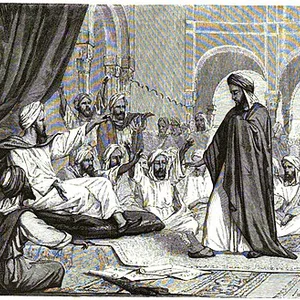

Persian Sufi mystic of the medieval Muslim world, famous for his ecstatic proclamation “Ana al-Haqq” (“I am the Truth/the Real”). Accused of blasphemy, he was imprisoned and then executed in Baghdad in 922, becoming a major figure of mystical martyrdom in Islam.
Hallaj
Hallaj
6 min read
Frequently asked questions
Famous Quotes
« Ana al-Haqq (I am the Truth)»
Key Facts
- Born around 858 in the region of Fars (Persia), in the Abbasid Empire
- A follower of Sufism, he preaches an intimate and direct union with God
- Proclaims “Ana al-Haqq” (“I am the Truth”), a phrase perceived as blasphemous
- Imprisoned in Baghdad for several years after accusations of heresy
- Publicly executed in Baghdad in 922, becoming a symbol of mystical martyrdom
Works & Achievements
His most famous work, a series of dense and enigmatic meditations on divine unity, prophethood and the mystery of the soul. Composed partly in prison.
A body of mystical poems on the love of God and the union of the lover with the Beloved, among the most frequently quoted in Sufi poetry.
An ecstatic utterance that remained famous throughout the Muslim world. It crystallizes the doctrine of the annihilation of the self (fana) in God and fueled theological debates for centuries.
A corpus of sayings, letters and fragments gathered by his disciples, forming the basis of the Akhbar al-Hallaj and of his spiritual memory.
Through his death, Hallaj became the model of the martyr of divine love, inspiring poets such as Attar and Rumi and leaving a lasting mark on Persian spirituality.
Anecdotes
In the midst of mystical ecstasy, al-Hallaj is said to have uttered the formula “Ana al-Haqq” (“I am the Truth”). Since al-Haqq is one of the names of God in Islam, his opponents saw in it a claim to divinity, while his disciples read it as the total annihilation of the self in God.
Before his arrest, he preached openly in the streets and markets of Baghdad, addressing ordinary people rather than scholarly circles alone. This popularity with the crowds alarmed the religious authorities as much as the Abbasid political power.
Tradition holds that, at the moment of his torture, the mystic forgave his executioners and prayed for them, asking God not to punish them — a gesture that strengthened his reputation as a martyr of divine love.
His execution in 922 lasted several days and was spectacular: it is said that he was flogged, mutilated, crucified, and then beheaded, and that his ashes were thrown into the Tigris. This martyrdom made him a central figure of Sufism.
The great Persian poet Rumi, three centuries later, celebrated Hallaj as a model of the lover of God, transforming his historical memory into a spiritual symbol passed down from generation to generation.
Primary Sources
If you do not recognize Him, then at least recognize His traces; I am that trace, I am the creative Truth, for through the Truth I have never ceased to be true.
I am He whom I love, and He whom I love is I; we are two spirits dwelling in a single body.
Kill me, O my faithful friends, for in my death is my life, and my death is in my life, and my life is in my death.
It is reported that al-Husayn ibn Mansur al-Hallaj was arrested, tried for his words, and that a decree was issued authorizing that he be put to death.
Key Places
Region of southwestern Persia where tradition places the birth of al-Hallaj, into a family whose grandfather is said to have been Zoroastrian.
City in Iraq where the young Hallaj memorized the Quran and began his religious training before moving on to Basra.
Great intellectual center of southern Iraq where Hallaj attended Sufi circles and was initiated into the mystical path.
Holy city of Islam where Hallaj performed several pilgrimages and long retreats of asceticism and prayer.
Capital of the Abbasid caliphate where Hallaj preached, was imprisoned for nearly nine years, tried, and executed in 922. His ashes were thrown into the Tigris.
Typical Objects

Coarse wool cloak worn by Sufi mystics, a symbol of renouncing worldly possessions. The word “Sufi” itself is said to come from “suf,” meaning wool.

The surface on which the mystic performs his prayers and his long nightly vigils. Hallaj was renowned for his prolonged prayers and his retreats.

The instrument of al-Hallaj's public execution in Baghdad. In the Sufi tradition and Persian poetry, it became the very symbol of the martyrdom of divine love.

A collection of his mystical meditations, written partly during his imprisonment. It is one of the few works that have come down to us from his own hand.

A string of prayer beads used to repeat the names of God during the dhikr, the litany-like recitation cherished by the Sufis. It set the rhythm of daily spiritual practice.

The gear of the wandering dervish: Hallaj traveled thousands of kilometers as a poor pilgrim, from Mecca to the borders of India.
School Curriculum
Vocabulary & Tags
Key Vocabulary
Tags
Daily Life
Morning
The Sufi mystic began his day before dawn with ablutions and the *fajr* prayer. Hallaj was renowned for his prolonged nocturnal vigils, spending long hours in invocation (*dhikr*) and recitation of the Quran.
Afternoon
In the afternoon, he preached in the streets, markets, and mosques of Baghdad, addressing ordinary people and scholars alike. He also received disciples who came seeking spiritual teaching.
Evening
The evening was devoted to meditation, to writing his mystical reflections, and to further prayers. The long nights of vigil and fasting were part of his ascetic discipline.
Food
As an ascetic, he fasted frequently and made do with very little: bread, dates, water. Tradition attributes extreme fasts to him during his retreats in Mecca, sometimes for several days in a row.
Clothing
He wore the coarse woolen frock (*khirqa*) of the Sufis, a garment of voluntary poverty, and sometimes the simple patched cloak of an itinerant pilgrim.
Housing
A tireless traveler, he often lived as a pilgrim with no fixed abode, lodging in mosques, *ribats* (Sufi hospices), or with disciples. In Baghdad, he ended up spending his final years in a prison cell.
Historical Timeline
Period Vocabulary
Liens externes & ressources
Références
Œuvres
Kitab al-Tawasin (Le Livre des Ta-Sin)
vers 910-920
Diwan (recueil poétique)
fin IXe - début Xe siècle
La proclamation « Ana al-Haqq »
vers 900-910
Riwayat (récits et sentences transmis)
Xe-XIe siècle
Doctrine du martyre mystique
à partir de 922