 flip
flipBaekseolgi — white steamed rice cake
Baekseolgi — white steamed rice cake
Why this dish? Han Kang was born in Gwangju and her novel 'Human Acts' carries the memory of the 1980 uprising. Among her objects: archival photographs of Gwangju. Baekseolgi, an immaculate white rice cake, is the tteok of memorial rites and mourning in Korea — a dish of evocation, inspired (not reproduced) from ancestral commemoration tables.
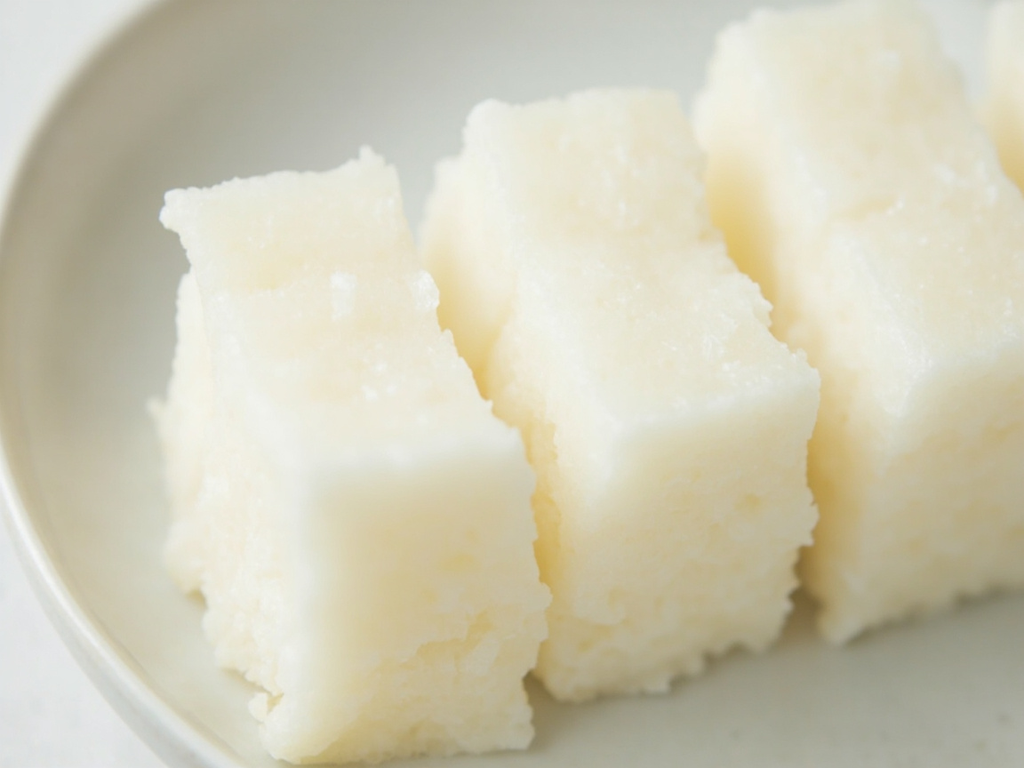
An all-white rice cake, steamed from moistened and lightly sweetened rice flour. Soft and dense texture, very sober taste. Its immaculate white makes it the cake of beginnings (a child's 100th day) as well as of memories of the departed.
White is not the absence of color, it's a presence. We put almost nothing in this cake — rice ground to powder, a little water so the flour gathers without sticking, barely any sugar. The important gesture is sifting: passing the powder again and again until it's light as fine ash, otherwise the steam doesn't penetrate and the center stays raw. I make it on days when we think of those who are no more. We place it, we bow, and only then we share it. The taste is almost nothing, and that's why we remember it.
- •Glutinous rice and regular rice ground to powder — several bowls (cake base)
- •Water — a little (moistening)
- •Salt — a pinch (seasoning)
- •Honey or rice syrup — one spoon (light sweetness)
Baekseolgi — white steamed rice cake
An all-white rice cake, steamed from moistened and lightly sweetened rice flour. Soft and dense texture, very sober taste. Its immaculate white makes it the cake of beginnings (a child's 100th day) as well as of memories of the departed.
Why this dish? Han Kang was born in Gwangju and her novel 'Human Acts' carries the memory of the 1980 uprising. Among her objects: archival photographs of Gwangju. Baekseolgi, an immaculate white rice cake, is the tteok of memorial rites and mourning in Korea — a dish of evocation, inspired (not reproduced) from ancestral commemoration tables.
White is not the absence of color, it's a presence. We put almost nothing in this cake — rice ground to powder, a little water so the flour gathers without sticking, barely any sugar. The important gesture is sifting: passing the powder again and again until it's light as fine ash, otherwise the steam doesn't penetrate and the center stays raw. I make it on days when we think of those who are no more. We place it, we bow, and only then we share it. The taste is almost nothing, and that's why we remember it.
Ingredients (period version)
- Glutinous rice and regular rice ground to powder — several bowls (cake base)
- Water — a little (moistening)
- Salt — a pinch (seasoning)
- Honey or rice syrup — one spoon (light sweetness)
Ingredients
- Mochi rice flour (short-grain wet rice, preferably not dried) — 300 g (base)
- Water — 5 to 7 tbsp (moistening)
- Salt — 1/2 tsp (seasoning)
- Sugar — 3 tbsp (sweetness)
Method
- Mix the rice flour with salt and water, using fingertips, until it reaches a damp sand texture that clumps when pressed.
- Sift this mixture 2 to 3 times through a fine sieve to aerate (key step for lightness).
- Gently fold in the sugar just before steaming (do not sift again).
- Pour into a mold or a ring placed on a cloth in a steamer, smooth the surface without pressing.
- Steam covered for 20 minutes, then let rest 5 minutes before unmolding and cutting into squares.
How it was made : Baekseolgi ('white snow cake') is a ritual tteok steamed in a siru (earthenware steamer). It is prepared for baegil (a baby's 100th day), birthdays, and jesa ancestral rites. Its chromatic purity symbolizes a sincere and spotless wish. Steaming rice powder is one of the oldest Korean pastry techniques, predating the widespread use of ovens.
The contemporary twist : Gently mark the surface with a simple pattern (a single flower, a line) using a stencil before steaming, in the minimalist spirit of contemporary tteok from Seoul's bakeries.
Han Kang · Charactorium