 flip
flipKönigsberger Klopse (Königsberg Meatballs with Caper Sauce)
Königsberger Klopse (Königsberg Meatballs with Caper Sauce)
Why this dish? Hannah Arendt was born in Königsberg, East Prussia, and spent her childhood there. The Klopse are THE emblematic dish of that city — so much so that they bear its name. It is the taste of her early years, the taste of a German table she recreated even in her New York apartment for her emigrant friends.
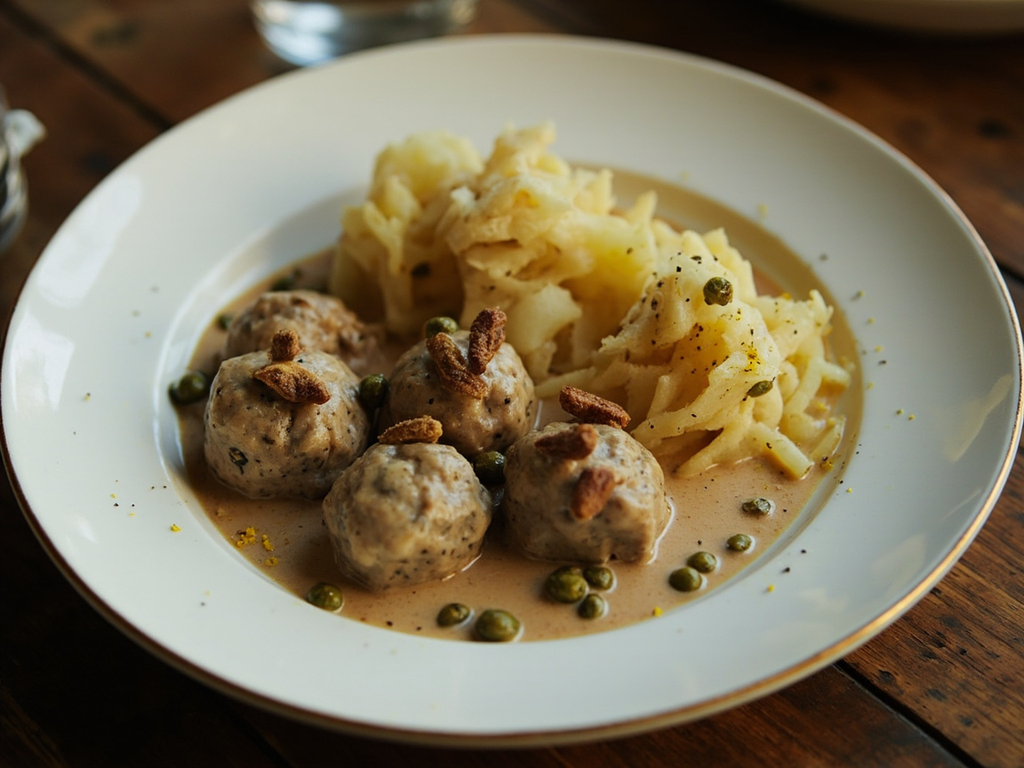
Fine poached veal meatballs, coated in a velvety white sauce brightened with capers and a squeeze of lemon. Mild and tangy at once — the roundness of the meat against the sharp acidity of capers.
You see, one never quite leaves the city where one learned to walk and think. In Königsberg, my mother poached these meatballs in a clear broth, and the whole kitchen smelled of caper and lemon — a scent I sought to find again in every apartment of my exile. The secret, I assure you, is not in the meat but in the sauce: you bind it with egg yolk off the heat, otherwise it curdles, and you are not stingy with capers. When my friends came in the evening to discuss until dawn, I served these Klopse: one thinks better, believe me, with one's belly held by something of the lost home.
- •Ground veal (or half veal, half pork) — a good pound (base of the meatballs)
- •Stale bread roll soaked in milk — one (soft binder)
- •Onion — one (aromatic)
- •Eggs — 2 (binder for meatballs and sauce)
- •Salt-packed capers — a generous handful (tart signature)
- •Butter and flour — equal parts (roux for the sauce)
- •Lemon — half (touch of acidity)
- •Anchovy or herring fillet — one (discreet umami (traditional in Königsberg))
Königsberger Klopse (Königsberg Meatballs with Caper Sauce)
Fine poached veal meatballs, coated in a velvety white sauce brightened with capers and a squeeze of lemon. Mild and tangy at once — the roundness of the meat against the sharp acidity of capers.
Why this dish? Hannah Arendt was born in Königsberg, East Prussia, and spent her childhood there. The Klopse are THE emblematic dish of that city — so much so that they bear its name. It is the taste of her early years, the taste of a German table she recreated even in her New York apartment for her emigrant friends.
You see, one never quite leaves the city where one learned to walk and think. In Königsberg, my mother poached these meatballs in a clear broth, and the whole kitchen smelled of caper and lemon — a scent I sought to find again in every apartment of my exile. The secret, I assure you, is not in the meat but in the sauce: you bind it with egg yolk off the heat, otherwise it curdles, and you are not stingy with capers. When my friends came in the evening to discuss until dawn, I served these Klopse: one thinks better, believe me, with one's belly held by something of the lost home.
Ingredients (period version)
- Ground veal (or half veal, half pork) — a good pound (base of the meatballs)
- Stale bread roll soaked in milk — one (soft binder)
- Onion — one (aromatic)
- Eggs — 2 (binder for meatballs and sauce)
- Salt-packed capers — a generous handful (tart signature)
- Butter and flour — equal parts (roux for the sauce)
- Lemon — half (touch of acidity)
- Anchovy or herring fillet — one (discreet umami (traditional in Königsberg))
Ingredients
- Ground veal — 500 g (base of the meatballs)
- Sliced bread, crust removed, soaked in 100 ml milk — 2 slices (binder)
- Finely chopped onion — 1 (aromatic)
- Eggs (1 for meatballs, 1 yolk for sauce) — 2 (binder)
- Drained capers — 3 tbsp (signature)
- Butter — 40 g (roux)
- Flour — 40 g (roux)
- Cooking broth from the meatballs — 500 ml (sauce base)
- Juice of half a lemon — 1 (final acidity)
- Mashed anchovy fillet — 1 (optional) (umami)
Method
- Mix the veal, squeezed bread, onion, one whole egg, salt and pepper. Shape into meatballs the size of a large walnut.
- Bring a light broth to a simmer (never a rolling boil) and poach the meatballs for 12–15 minutes. Set them aside, keep the broth.
- Prepare a blond roux with the butter and flour, gradually whisk in 500 ml of the poaching broth for a smooth sauce.
- Add the capers and mashed anchovy, let simmer for 5 minutes.
- Off the heat, bind with the beaten egg yolk, then the lemon juice — do not let it boil again.
- Return the meatballs to the sauce to warm gently. Serve with steamed potatoes or rice.
How it was made : In Königsberg, the sauce was always bound with egg yolk, and salted fish (herring or anchovy) was traditional, a vestige of a Baltic port city. It was served with boiled potatoes, sometimes beets. The dish was eaten at midday, the main meal of the German day.
The contemporary twist : Plate three meatballs napped with pearly sauce, scattered with crispy fried capers and a lemon zest: "Königsberg, 1910" on the menu slate.
Sources : Cuisine traditionnelle de Prusse-Orientale (Ostpreußische Küche), corpus régional allemand · Hannah Arendt / Heinrich Blücher, correspondance et témoignages sur son hospitalité
Hannah Arendt · Charactorium