 flip
flipZwetschgenkuchen (Plum Cake on Yeast Dough)
Zwetschgenkuchen (Plum Cake on Yeast Dough)
Why this dish? Afternoon Kaffee und Kuchen is the quintessential German social institution, and Arendt was renowned for her warm hospitality. The sheet pan plum cake, meant to be shared, perfectly embodies that generous table she perpetuated for her emigrant friends in New York.
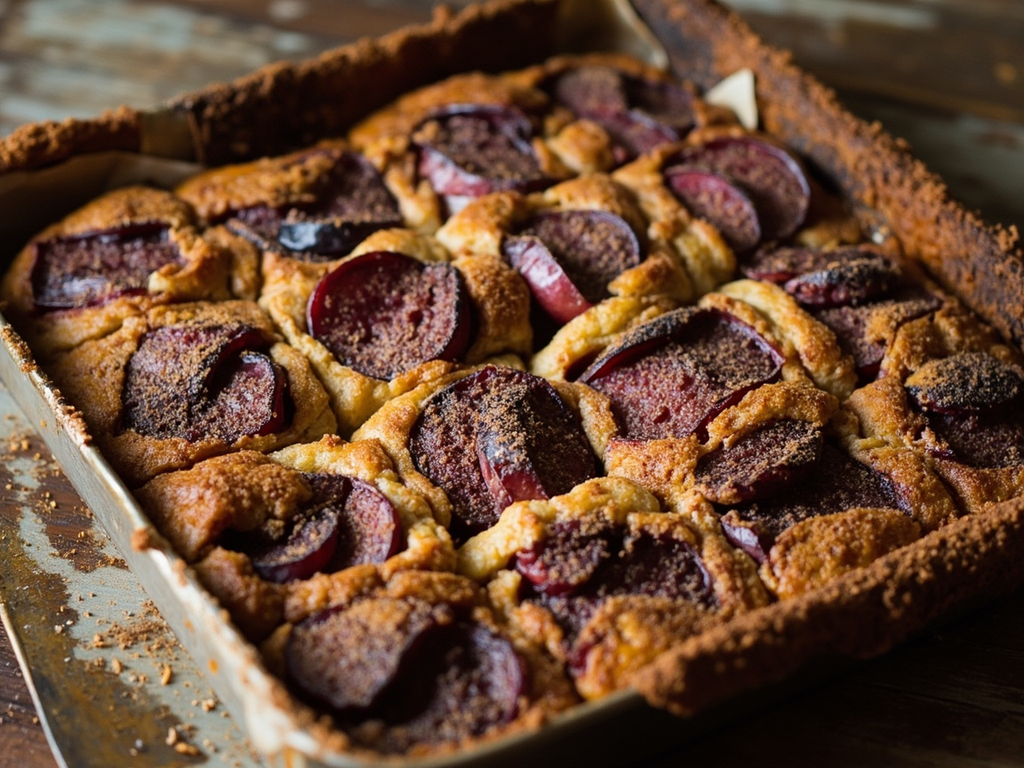
A large brioche-like flatbread covered with plums arranged in scales, which release their juice and become candied under a shower of cinnamon sugar. Tart, fragrant, comforting.
On Sundays, at the end of summer, there was always this cake — the plums ripen late, and we arranged them on the dough like tiles, tight, standing up. I am not a precise pastry chef, I freely admit: yeast dough forgives, it waits while you chat. You take it out warm, dust it with sugar and cinnamon, and make coffee — lots of coffee. It was on those afternoons, around a cake you share with your hands, that the most serious things and the funniest were said.
- •Wheat flour — a pound (yeast dough)
- •Fresh baker's yeast — a cube (leavening)
- •Warm milk — a glass (liquid)
- •Butter — a good spoonful (softness)
- •Sugar — to taste (sweetness)
- •Ripe plums (Zwetschgen) — two pounds (topping)
- •Ground cinnamon — a generous pinch (signature spice)
Zwetschgenkuchen (Plum Cake on Yeast Dough)
A large brioche-like flatbread covered with plums arranged in scales, which release their juice and become candied under a shower of cinnamon sugar. Tart, fragrant, comforting.
Why this dish? Afternoon Kaffee und Kuchen is the quintessential German social institution, and Arendt was renowned for her warm hospitality. The sheet pan plum cake, meant to be shared, perfectly embodies that generous table she perpetuated for her emigrant friends in New York.
On Sundays, at the end of summer, there was always this cake — the plums ripen late, and we arranged them on the dough like tiles, tight, standing up. I am not a precise pastry chef, I freely admit: yeast dough forgives, it waits while you chat. You take it out warm, dust it with sugar and cinnamon, and make coffee — lots of coffee. It was on those afternoons, around a cake you share with your hands, that the most serious things and the funniest were said.
Ingredients (period version)
- Wheat flour — a pound (yeast dough)
- Fresh baker's yeast — a cube (leavening)
- Warm milk — a glass (liquid)
- Butter — a good spoonful (softness)
- Sugar — to taste (sweetness)
- Ripe plums (Zwetschgen) — two pounds (topping)
- Ground cinnamon — a generous pinch (signature spice)
Ingredients
- All-purpose flour — 400 g (dough)
- Fresh yeast (or 7 g dry) — 20 g (leavening)
- Warm milk — 150 ml (liquid)
- Soft butter — 60 g (softness)
- Sugar — 50 g + 2 tbsp to finish (sweetness)
- Egg — 1 (richness of dough)
- Plums (elongated prune plums) — 800 g to 1 kg (tart topping)
- Ground cinnamon — 1 tsp (spice)
Method
- Dissolve the yeast in warm milk with a spoonful of sugar. Let it foam for 10 minutes.
- Knead the flour, sugar, egg, butter, and yeast mixture into a soft dough. Let it double in a warm place for 1 hour.
- Roll out the dough on a buttered baking sheet. Let it rise again for 20 minutes.
- Pit and halve the plums (or fan them), arrange them tightly, skin side down, in regular scales.
- Bake at 190°C (375°F) for 35–40 minutes, until the dough is golden and the fruits are candied.
- When out of the oven, sprinkle with sugar mixed with cinnamon. Serve warm, with strong coffee.
How it was made : In Germany, this cake was traditionally baked on a large sheet (Blechkuchen) in late summer when plums were abundant, and cut into squares for Sunday coffee. It was often served with whipped cream. Yeast dough rather than shortcrust: this is the oldest and most popular version.
The contemporary twist : Serve each warm square with a quenelle of barely sweetened whipped cream and a drizzle of reduced cooking juice; cinnamon dusting through a stencil.
Sources : Tradition du Blechkuchen / Pflaumenkuchen, cuisine domestique allemande · Institution sociale du Kaffee und Kuchen, Mitteleuropa, XXe siècle
Hannah Arendt · Charactorium