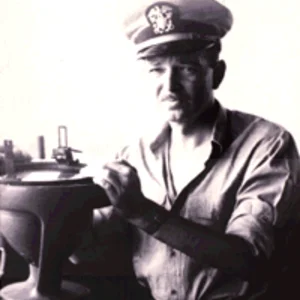

American geologist and geophysicist, and a naval officer during World War II. He is one of the founders of the theory of seafloor spreading, a decisive step toward plate tectonics.
Harry Hess(1906 — 1969)
Harry Hess
États-Unis
5 min read
Frequently asked questions
Key Facts
- Born in 1906 in New York, died in 1969
- A US Navy officer during World War II, he mapped the ocean floor using sonar and discovered the guyots
- In 1962, he published 'History of Ocean Basins', putting forward the hypothesis of seafloor spreading
- His work provided the key mechanism that led to the modern theory of plate tectonics
- Professor of geology at Princeton University for much of his career
Works & Achievements
Identification of flat-topped underwater volcanoes—former islands eroded and then submerged—named guyots.
Scientific paper describing the guyots and opening up reflection on the mobility of the ocean floor.
The idea that crust is born at the ridges, spreads outward on either side, and then plunges into the trenches—a key link toward plate tectonics.
Founding text setting out seafloor spreading, presented modestly as an “essay in geopoetry.”
A project to drill through the crust down to the mantle, of which Hess was one of the initiators; a forerunner of the great ocean drilling programs.
Leadership of the scientific committee tasked with studying the first samples brought back by Apollo 11.
Anecdotes
During World War II, Harry Hess commanded the troop transport ship USS Cape Johnson in the Pacific. Rather than switching off his echo sounder, he left it running permanently, taking advantage of every crossing to map the relief of the sea floor. This is how he discovered strange underwater mountains with flat tops.
Hess named these flattened underwater volcanoes “guyots,” in honor of Arnold Guyot, a geographer at Princeton University where he himself taught. The word is today an official scientific term used all over the world.
In 1962, aware that he lacked definitive proof, Hess presented his theory of seafloor spreading as an “essay in geopoetry.” This modest phrase concealed a revolutionary idea that would transform geology a few years later.
Hess was one of the promoters of the “Mohole project,” a bold attempt to drill through the Earth's crust down to the mantle, beneath the ocean floor where the crust is thinnest. The project, too costly, was abandoned, but it inspired the great ocean drilling expeditions of the future.
A geologist to the very end, Hess chaired the NASA scientific committee tasked with analyzing the first lunar rocks brought back by Apollo 11. He died of a heart attack in 1969, shortly afterward, while in fact leading a meeting of that very committee.
Primary Sources
The whole earth is differentiating into a thin crust, a thick mantle, and a core... I shall consider this paper an essay in geopoetry.
Flat-topped seamounts, here called guyots, are interpreted as ancient islands which have been truncated by wave erosion and subsequently submerged.
A hole drilled through the crust to the Mohorovičić discontinuity would yield samples of the mantle and answer fundamental questions about the Earth's interior.
Key Places
Hometown of Harry Hess, where he was born in 1906.
University where Hess earned his doctorate and then taught geology for decades, heading the department.
The setting of the echo-sounder surveys conducted aboard the USS Cape Johnson, where Hess discovered the guyots.
An underwater volcanic chain at the center of the Atlantic, the place where, according to Hess, new oceanic crust is born.
Oceanographic center where Hess died of a heart attack in 1969 during a scientific meeting.
Typical Objects

Device that emits sound waves toward the seafloor and measures the echo's return time to determine depth. Hess used it continuously to map the ocean floor's relief.

Instrument towed behind a ship to measure the magnetic field of the rocks on the ocean floor. It revealed the symmetrical magnetic bands that proved seafloor spreading.

Cylinder of sediment and rock taken from beneath the seafloor. The increasing age of the cores as they moved away from the ridges confirmed Hess's theory.

Map representing the relief of the seafloor through depth contour lines. Those drawn up by Hess revealed ridges, trenches, and guyots.

Outfit worn by Hess during the Second World War, which he ended with the rank of rear admiral in the reserve. His military career fueled his oceanographic research.

Polarized-light microscope used to study minerals in thin sections of rock. Hess used it notably for his work on peridotites and the Apollo lunar rocks.
School Curriculum
Vocabulary & Tags
Key Vocabulary
Tags
Daily Life
Morning
At Princeton, Hess often began his day with teaching and reading the latest geology research. He would then head to his laboratory to examine rock samples and bathymetric charts.
Afternoon
The afternoon was devoted to research: studying thin sections under the microscope, analyzing oceanographic surveys, and discussing with students and colleagues. He also prepared his publications and lectures.
Evening
In the evening, Hess continued reflecting on his major hypotheses, writing articles and correspondence. He maintained a broad network of scientists with whom he exchanged ideas and data.
Food
A 20th-century American geologist of the comfortable middle class, he shared the common diet of his time and country. At sea, during the war, he made do with the navy's standardized rations.
Clothing
In his daily university life, Hess wore the classic suit and tie of the mid-20th-century American professor. During the war, he donned a naval officer's uniform.
Housing
He lived in a comfortable house in New Jersey, near the Princeton campus. His missions also took him aboard oceanographic and military vessels.
Historical Timeline
Period Vocabulary
Liens externes & ressources
Références
Œuvres
Découverte et nomination des « guyots »
1946
Drowned Ancient Islands of the Pacific Basin
1946
Hypothèse de l'expansion des fonds océaniques (seafloor spreading)
1960
History of Ocean Basins
1962
Projet Mohole
1957-1966
Présidence du comité d'analyse des roches lunaires (NASA)
1969