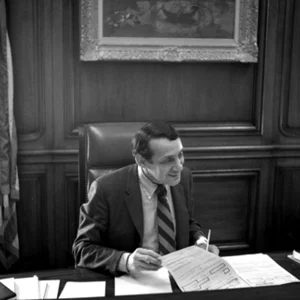

Harvey Milk was an American politician, the first openly gay person elected to a major public office in California. As a San Francisco city supervisor, he became a leading figure in the fight for LGBT rights before being assassinated in 1978.
Harvey Milk(1930 — 1978)
Harvey Milk
États-Unis
6 min read
Frequently asked questions
Famous Quotes
« If a bullet should enter my brain, let that bullet destroy every closet door.»
« You gotta give them hope. Hope for a better world.»
Key Facts
- Born on May 22, 1930, in Woodmere (New York)
- Elected to the San Francisco Board of Supervisors in 1977, one of the first openly gay elected officials in the United States
- Passed a city ordinance in 1978 banning discrimination based on sexual orientation
- Assassinated on November 27, 1978, by Dan White, a former city supervisor, along with Mayor George Moscone
- Posthumously awarded the Medal of Freedom in 2009
Works & Achievements
The first electoral victory of an openly gay candidate in San Francisco, which paved the way for the political representation of sexual minorities.
A measure he had the city council adopt, banning discrimination in employment and housing in San Francisco.
A decisive mobilization that led to the rejection of a law seeking to bar gay people from teaching in California's public schools.
A famous speech about hope that became a landmark text of the LGBT rights movement.
He encouraged Gilbert Baker to design a positive symbol for the community, which became a worldwide emblem of pride.
Anecdotes
Before entering politics, Harvey Milk opened a camera shop in 1972, Castro Camera, on Castro Street in San Francisco. The store quickly became a gathering place for the neighborhood's gay community, and Milk soon earned the nickname “the Mayor of Castro Street.”
Harvey Milk failed three times before being elected: two bids for the Board of Supervisors in 1973 and 1975, then one for the California State Assembly in 1976. He was finally elected supervisor (city councilman) only in 1977, carried by a reform that introduced election by district.
In 1978, Milk led the fight against “Proposition 6” (or the Briggs Initiative), which sought to ban gay people from teaching in California's public schools. Thanks to a massive grassroots campaign, the measure was rejected by voters, a historic victory for LGBT rights.
Aware of the threats hanging over him, Harvey Milk recorded several audio tapes to be opened only in the event of his assassination. On them he spoke a line that became famous: “If a bullet should enter my brain, let that bullet destroy every closet door,” urging gay people to live openly.
On November 27, 1978, Milk and Mayor George Moscone were assassinated at City Hall by Dan White, a former supervisor who had resigned. The lenient sentence handed down to White, based on the so-called “diminished capacity” defense, sparked the “White Night Riots” in San Francisco in May 1979.
Primary Sources
If a bullet should enter my brain, let that bullet destroy every closet door.
You have to give them hope. Hope for a better world, hope for a better tomorrow... Without hope, young people give up.
This election is not about me: it is about all the "us." All the "us" who have been left out.
Key Places
Harvey Milk's hometown, where he grew up in a Jewish American family. He received a classic education there before joining the navy.
A photography shop opened by Milk in 1972 that became the headquarters of his activism. From there he energized the political life of the gay neighborhood.
Seat of the Board of Supervisors where Milk served his term. It is also the place where he was assassinated on November 27, 1978.
The heart of San Francisco's gay community, of which Milk was nicknamed the “mayor.” He led his campaigns and rallies there.
A plaza at the entrance to the Castro subway station, named in his honor, where a giant rainbow flag flies. A place of remembrance for the LGBT community.
Liens externes & ressources
Références
Œuvres
Élection au conseil des superviseurs de San Francisco
1977
Ordonnance contre les discriminations liées à l'orientation sexuelle
1978
Campagne contre la Proposition 6 (amendement Briggs)
1978
« The Hope Speech »
1978
Soutien à la création du drapeau arc-en-ciel
1978