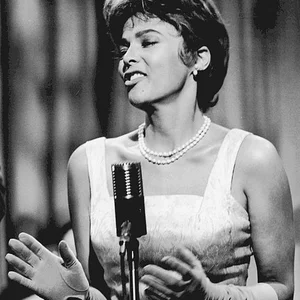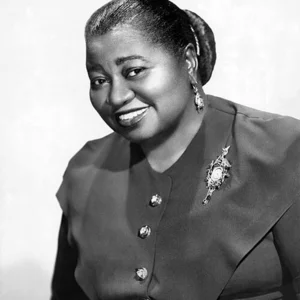

American actress (1893-1952), Hattie McDaniel was the first African American woman to win an Academy Award, for her role as Mammy in Gone with the Wind (1939). Her career illustrates the tensions between artistic success and racial segregation in the United States.
Hattie McDaniel(1893 — 1952)
Hattie McDaniel
États-Unis
9 min read
Frequently asked questions
Key Facts
- Born on June 10, 1893, in Wichita, Kansas, into an African American family
- Won the Academy Award for Best Supporting Actress in 1940 for Gone with the Wind (1939)
- First African American to win an Academy Award and to attend an Academy Awards ceremony
- During the ceremony, she was forced to sit at a segregated table, separate from her white colleagues
- Died on October 26, 1952, of breast cancer in Los Angeles
Works & Achievements
Victor Fleming's epic film in which McDaniel plays Mammy, the Black housekeeper and authority figure of the O'Hara plantation. Her powerful and nuanced performance earned her the Academy Award for Best Supporting Actress — a historic first for an African American.
John M. Stahl's drama that directly confronts the themes of racism and racial identity in the United States. McDaniel plays a supporting role in a film that was remarkable for its era in its willingness to address the contradictions of segregated American society.
A musical adaptation of Edna Ferber's novel in which McDaniel plays Queenie. The film deals directly with racial segregation in the American South and gave McDaniel one of her most significant roles before Gone with the Wind.
George Stevens's film starring Katharine Hepburn, in which McDaniel delivers a widely praised comedic performance. Her work in the film demonstrated her ability to hold her own alongside the biggest Hollywood stars of the day.
A nationally broadcast radio series in which Hattie McDaniel plays Beulah, a jovial African American domestic worker. Despite criticism over the character's stereotyping, she was one of the first Black women to hold a title role in a major nationally syndicated program.
Anecdotes
On February 29, 1940, at the Academy Awards ceremony held at the Ambassador Hotel in Los Angeles, Hattie McDaniel was not permitted to sit with her white co-stars from Gone with the Wind. Due to racial segregation, she was seated at a separate table at the back of the Coconut Grove ballroom. When she took the stage to accept her Oscar for Best Supporting Actress, she became the first African-American to win that distinction in the entire history of cinema.
The NAACP regularly criticized McDaniel's domestic servant roles, arguing they perpetuated racist stereotypes demeaning to African-Americans. She responded with pragmatic candor: “I’d rather play a maid than be one.” This line encapsulates the full ambiguity of her situation: a recognized and well-paid artist, yet confined by the Hollywood system to servant roles.
In 1945, Hattie McDaniel moved into the upscale Sugar Hill neighborhood of Los Angeles, home to several Black celebrities. White neighbors filed a lawsuit to evict her, citing deed restrictions that prohibited sales to non-white residents. McDaniel fought the case in court with determination and prevailed — a legal ruling that foreshadowed the broader civil rights struggle to come.
For the world premiere of Gone with the Wind in Atlanta in December 1939, Hattie McDaniel was forced to stay away due to the segregation laws then in force in Georgia. David O. Selznick, the producer, sent her a telegram of apology. Clark Gable himself considered boycotting the event in solidarity, but McDaniel persuaded him against it to avoid jeopardizing the film's commercial success.
Hattie McDaniel had requested to be buried at Hollywood Cemetery (now Hollywood Forever), but her wish was denied due to the racial segregation practiced there. She was interred at Rosedale Cemetery in Los Angeles. In 1999, a cenotaph was finally erected in her honor at Hollywood Forever Cemetery, granting her the posthumous tribute she had long deserved.
Primary Sources
This is one of the happiest moments of my life. I sincerely hope that I shall always be a credit to my race and to the motion picture industry.
The African-American plaintiffs, including Hattie McDaniel, challenged the racial exclusion clauses written into their property deeds, arguing their unconstitutionality under the Fourteenth Amendment.
I play the roles I am offered with every bit of talent I possess. The dignity of a performer is not measured by the title of the character she plays, but by the way she plays it.
I deeply regret that circumstances deprive us of your presence at the Atlanta premiere. Your portrayal of Mammy is one of the most valuable contributions this film has to offer.
Key Places
Birthplace of Hattie McDaniel, born on June 10, 1893. Her father Henry was a former slave and former Union Army soldier; her mother Susan Holbert was a gospel singer who passed on to her daughter a love of singing and performing.
The heart of the American film industry, where Hattie McDaniel built her entire career from the 1920s onward. She was celebrated on screen while facing segregation behind the scenes at the studios and in everyday life throughout the city.
Site of the 12th Academy Awards ceremony, on February 29, 1940, where Hattie McDaniel received her historic Oscar. Due to segregation, she was seated at a separate table away from her white co-stars — a humiliation that did nothing to diminish the seismic impact her win had on the industry.
An affluent residential neighborhood in Los Angeles where McDaniel moved in 1945, joining other prominent African American celebrities. Her legal victory against the racially restrictive covenants in this neighborhood foreshadowed the landmark civil rights legislation that would follow.
Hattie McDaniel's place of burial since 1952. Her request to be interred at Hollywood Cemetery had been denied on racial grounds. In 1999, a cenotaph was erected in her honor at Hollywood Forever Cemetery in belated recognition of her historic legacy.
Typical Objects
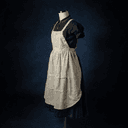
The near-universal costume of the characters Hattie McDaniel played on screen, this outfit symbolizes the limits Hollywood imposed on African American actresses, who were confined to servant roles regardless of their talent or standing.

The statuette Hattie McDaniel won in 1940 became a historic artifact symbolizing the first recognition of an African American woman by the Hollywood Academy — an achievement obtained under circumstances that laid bare the contradictions of segregated American society.
The scripts McDaniel received for productions of the 1930s and 1940s almost invariably confined her to domestic servant roles. She approached these texts with professionalism while occasionally negotiating lines to bring greater dignity to her characters.

Hattie McDaniel had a long career in radio, culminating with *The Beulah Show* from 1947 onward. The microphone embodies this dimension of her career, where her voice afforded her a freedom of expression that was sometimes greater than what she found in film.
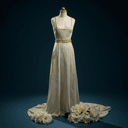
For the 1940 Oscar ceremony, McDaniel arrived wearing an elegant evening gown and a spray of white gardenias in her hair. This carefully chosen attire expressed her dignity and pride as an artist, even at a ceremony where she was nonetheless seated at a segregated table.
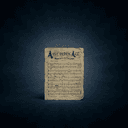
Before her film career, Hattie McDaniel was a blues singer and musician — one of the first Black women to record records in the United States. Sheet music recalls her beginnings in African American show business, at a time when music was one of the few stages accessible to Black performers.
School Curriculum
Vocabulary & Tags
Key Vocabulary
Tags
Daily Life
Morning
During Hollywood productions, Hattie McDaniel arrived at the studios early, but used dressing rooms separate from her white colleagues due to the informal segregation rules that governed the industry. She prepared her scenes with a professional rigor recognized by all, memorizing her lines and working closely with costume designers to bring her characters to life.
Afternoon
Filming afternoons were shaped by long hours of takes, often in uncomfortable maid costumes under hot studio lights. Outside the studios, McDaniel was actively involved in the African American community of Los Angeles, particularly during World War II, when she supported causes benefiting Black soldiers.
Evening
McDaniel's evenings alternated between Hollywood social events — where she was sometimes the only African American present — and the jazz and blues clubs frequented by Los Angeles's Black community. She sang regularly, drawing on her roots as a blues musician, at venues along Central Avenue, the cultural heart of Black Los Angeles.
Food
Like many African Americans from the Midwest and South, McDaniel enjoyed soul food: fried chicken, collard greens, cornbread, beans in gravy, and sweet potato pie. She often cooked for friends and colleagues at her home in Sugar Hill, keeping alive family and community culinary traditions.
Clothing
On screen, Hattie McDaniel almost always wore aprons and maid's uniforms, imposed by the roles the studio system assigned her. In everyday life, she dressed with careful elegance — quality dresses, wide-brimmed hats, and understated jewelry — asserting a personal dignity that her characters were not always free to express.
Housing
In the 1940s, Hattie McDaniel lived in a beautiful home in the Sugar Hill neighborhood of Los Angeles, one of the few areas in the city where prosperous African Americans could settle. Her house was a gathering place for Black artists and intellectuals in the city, set against a backdrop of residential segregation that pervaded major American cities.
Historical Timeline
Period Vocabulary
Liens externes & ressources
Références
Œuvres
The Beulah Show (émission radiophonique)
1947-1952