 flip
flipKässpätzle — Spätzle with cheese from Württemberg
Kässpätzle — Spätzle with cheese from Württemberg
Why this dish? Born in Stuttgart in the heart of Swabia, Hegel grew up with Spätzle as a daily staple. This is the memory-dish of his Württemberg childhood, which a bourgeois would find day after day, simple and nourishing.
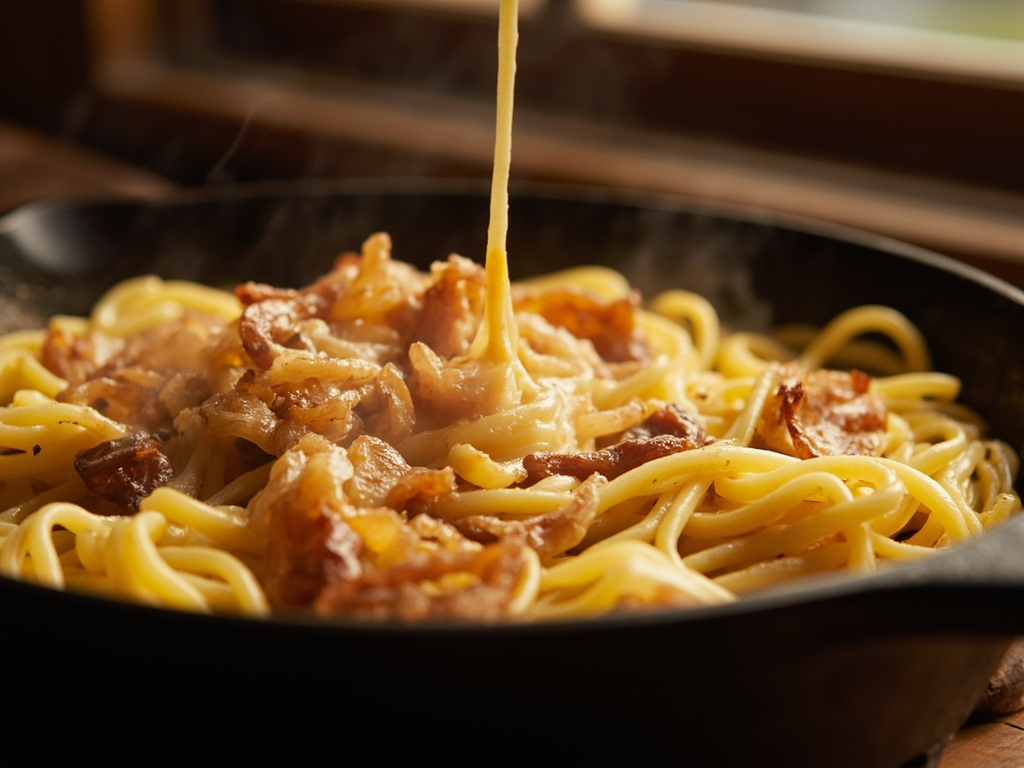
Strands of egg dough scraped into boiling water, layered with melted mountain cheese and crowned with butter-browned onions. Comforting, stretchy, deeply Swabian.
You see, this dish is to my native Swabia what the concept is to Spirit: its simplest yet truest appearance. As a child in Stuttgart, I watched the soft dough being scraped from the wet board into fine strands that set in the simmering water. They were layered with the local cheese, and onions fried in butter crowned the whole. Believe me, no Prussian fare ever consoled me like a good plate of Spätzle.
- •Wheat flour — a good measure (base of the dough)
- •Fresh farm eggs — several (binding and richness)
- •Spring water — by eye (relaxing the dough)
- •Aged mountain cheese — as much as you like (melting layer)
- •Onions — two or three (golden garnish)
- •Butter — a generous knob (for cooking the onions)
- •Salt — to taste (seasoning)
Kässpätzle — Spätzle with cheese from Württemberg
Strands of egg dough scraped into boiling water, layered with melted mountain cheese and crowned with butter-browned onions. Comforting, stretchy, deeply Swabian.
Why this dish? Born in Stuttgart in the heart of Swabia, Hegel grew up with Spätzle as a daily staple. This is the memory-dish of his Württemberg childhood, which a bourgeois would find day after day, simple and nourishing.
You see, this dish is to my native Swabia what the concept is to Spirit: its simplest yet truest appearance. As a child in Stuttgart, I watched the soft dough being scraped from the wet board into fine strands that set in the simmering water. They were layered with the local cheese, and onions fried in butter crowned the whole. Believe me, no Prussian fare ever consoled me like a good plate of Spätzle.
Ingredients (period version)
- Wheat flour — a good measure (base of the dough)
- Fresh farm eggs — several (binding and richness)
- Spring water — by eye (relaxing the dough)
- Aged mountain cheese — as much as you like (melting layer)
- Onions — two or three (golden garnish)
- Butter — a generous knob (for cooking the onions)
- Salt — to taste (seasoning)
Ingredients
- Flour — 300 g (base of the dough)
- Eggs — 3 (binding and richness)
- Water — 120 ml approx. (relaxing the dough)
- Grated Emmental or Comté (if Bergkäse unavailable) — 200 g (melting layer)
- Onions — 2 large (golden garnish)
- Butter — 40 g (for cooking the onions)
- Salt, nutmeg — to taste (seasoning)
Method
- Mix flour, eggs, salt, and water to obtain a soft, smooth, elastic dough; beat with a spoon until it bubbles.
- Slice the onions and slowly brown them in butter until amber-colored.
- Bring a large pot of salted water to a boil. Scrape the dough into fine strands from a wet board (or use a coarse-holed colander).
- Cook for 1–2 minutes: Spätzle are ready when they rise to the surface. Drain.
- In a warm dish, alternate layers of Spätzle and grated cheese to melt it.
- Top with golden onions and serve immediately.
How it was made : In the 19th century, the dough was scraped by hand from a tilted wooden board over the pot, a gesture requiring skill. The cheese used was a local aged cheese; fried onions were the festive Sunday garnish.
The contemporary twist : Serve in an individual gratinated ramekin with a dome of crispy fried onions and a twist of pepper — a 'phenomenology of comfort'.
Hegel · Charactorium