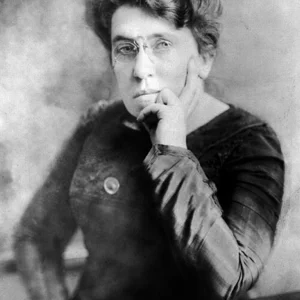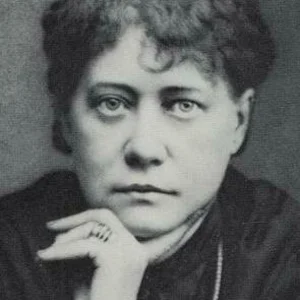

Helena Blavatsky (1831-1891) was a Russian occultist, philosopher, and writer who co-founded the Theosophical Society in 1875. A tireless traveler, she synthesized Eastern spiritualities and Western esotericism in her major works.
Helena Blavatsky(1831 — 1891)
Helena Blavatsky
États-Unis, Empire russe
7 min read
Frequently asked questions
Famous Quotes
« There is no religion higher than truth.»
« Man is his own savior as well as his own destroyer.»
Key Facts
- 1831: born in Yekaterinoslav (present-day Ukraine) into a Russian noble family
- 1875: co-founded the Theosophical Society in New York with Henry Steel Olcott
- 1877: published Isis Unveiled, the first major theosophical work
- 1888: published The Secret Doctrine, her magnum opus in two volumes
- 1891: died in London, leaving a lasting influence on modern esoteric movements
Works & Achievements
Blavatsky's first major theosophical work, in two volumes. It offers a critical synthesis of science, religion, and esoteric traditions, and was an immediate success.
Blavatsky's masterwork in two volumes, laying out her universal cosmogony and her vision of humanity's spiritual evolution. The foundational reference work of world Theosophy.
An accessible introduction to Theosophy in question-and-answer format, aimed at curious readers and newcomers. Still widely read in contemporary theosophical circles.
A short collection of spiritual maxims, translated by Blavatsky from Eastern esoteric texts. It is considered her purest spiritual work.
An encyclopedic dictionary of esoteric, Eastern, and theosophical terms, published posthumously. Essential for understanding her system of thought.
Anecdotes
In 1875, Helena Blavatsky co-founded the Theosophical Society in New York with Henry Steel Olcott and William Quan Judge. At the founding meeting, she reportedly materialized mysterious phenomena before the attendees, which helped establish her reputation as an extraordinary occultist.
Blavatsky claimed to have spent several years in Tibet studying under spiritual masters she called the 'Mahatmas.' Although this journey could not be verified, she described these sages as initiates capable of communicating by telepathy and transmitting ancient esoteric teachings.
In 1884, the Society for Psychical Research sent an investigator, Richard Hodgson, to examine her phenomena at Adyar in India. His report concluded that fraud had taken place, sending shockwaves through the Theosophical community. Blavatsky always denied the accusations, and the debate over the authenticity of her powers remained heated until her death.
Despite fragile health and limited mobility in her later years, Blavatsky wrote 'The Secret Doctrine' (1888) — two massive volumes — from her London apartment. She dictated, wrote, and revised without pause, surrounded by a community of devoted disciples who assisted her in her research.
Primary Sources
The object of this work is not to force upon the public the personal views of its writer, but simply to call attention to the existence of a body of philosophical and scientific doctrines, which have been handed down from generation to generation by the Initiates of all nations.
There is no religion higher than Truth. The object of the Theosophical Society is to form a nucleus of the universal brotherhood of humanity, without distinction of race, creed, sex, caste, or color.
Theosophy is not a religion. It is Divine Knowledge or Science. True religion is the knowledge of the Gods. And that is precisely what we teach.
Before the soul can see, the harmony within must be attained, and the fleshly eyes be rendered blind to all illusion.
Key Places
It was in New York, in 1875, that Blavatsky co-founded the Theosophical Society with Olcott and Judge. The city was then a hotbed of spiritualist and utopian ideas.
In 1882, the headquarters of the Theosophical Society was established at Adyar. It was there that the controversial phenomena investigated by Hodgson took place.
Blavatsky spent her final years in London, writing The Secret Doctrine and The Key to Theosophy surrounded by disciples. She died there in 1891.
Blavatsky was born in 1831 in Yekaterinoslav, into a cultured aristocratic family. The Russian culture of the 19th century — caught between Orthodox mysticism and openness to the West — left a deep mark on her formative years.
Blavatsky claimed to have spent time in Tibet to receive teachings from the Mahatmas. This journey — unverifiable yet foundational to her personal mythology — fueled the orientalist imagination of the era.
Typical Objects

A heavy smoker, Blavatsky was never without her oriental pipe. Smoking was for her a daily and almost ritualistic act, one that often shocked her Victorian visitors.

Blavatsky used automatic writing techniques to claim she was receiving messages from her Mahatmas. This tool symbolizes the blurry boundary between mediumship and esotericism in her work.

A tireless traveler, she owned maps and globes that bore witness to her journeys across four continents. For her, the physical geography of the world mirrored a universal spiritual map.

Blavatsky had assembled a vast library of Sanskrit, Kabbalistic, Hermetic, and Buddhist texts. These sources form the raw material of her great works of synthesis.

Her apartments featured portraits of Morya and Koot Hoomi, her supposed masters. These images served as objects of devotion for her disciples and as aids to her own meditation.

Blavatsky collected ritual objects from Egypt, India, and Central Asia. These talismans adorned her workspaces and illustrated the syncretic dimension of her thought.
School Curriculum
Vocabulary & Tags
Key Vocabulary
Tags
Daily Life
Morning
Blavatsky rose late, suffering from chronic illnesses that made her nights exhausting. She began her day with a long session of correspondence with her disciples around the world, sometimes dictating her letters from bed.
Afternoon
Afternoons were devoted to writing her works, surrounded by piles of books and handwritten notes. She regularly received visitors — curious individuals, journalists, or prospective Theosophical Society members — in a sitting room cluttered with carpets and objects brought back from her travels.
Evening
Evenings often gathered a circle of disciples around her for lively esoteric discussions, accompanied by copious amounts of cigarettes. She could talk and write well into the night, sleeping very little.
Food
A committed vegetarian in keeping with her Theosophical convictions, Blavatsky followed a simple and frugal diet. She consumed large quantities of tea, a staple during her endless working sessions.
Clothing
Blavatsky wore loose, dark garments — often Oriental or exotic in style — in sharp contrast to the corseted Victorian fashion of the day. She favored Indian shawls, rings, and esoteric jewelry bearing Theosophical symbols.
Housing
She lived in cluttered apartments in New York, Adyar, and London, transformed into veritable cabinets of curiosities. The walls were covered with portraits, maps, esoteric symbols, and ritual objects gathered from every corner of the world.
Historical Timeline
Period Vocabulary
Visual Style
Un univers visuel à mi-chemin entre le cabinet de curiosités victorien et l'antre de l'érudit orientaliste, dominé par des tonalités profondes et une lumière chaude et mystérieuse.
Sound Ambience
L'atmosphère sonore du bureau de Blavatsky mêle le silence studieux de la rédaction nocturne au bruissement des grandes villes victorienness, ponctué de voix venues du monde entier.
Liens externes & ressources
Références
Œuvres
Isis Unveiled
1877
La Doctrine Secrète
1888
La Clé de la Théosophie
1889
La Voix du Silence
1889
Le Glossaire Théosophique
1892