 flip
flipSunday Pot-au-Feu
Sunday Pot-au-Feu
Why this dish? The weekly dish of Parisian bourgeois households, the pot-au-feu brought the Bergson family together around a broth simmered for hours. In their apartment in the 16th arrondissement, Louise ran the household according to the comfortable, regulated standards of the Third Republic bourgeoisie: Sunday called for this patient, economical, and nourishing dish.
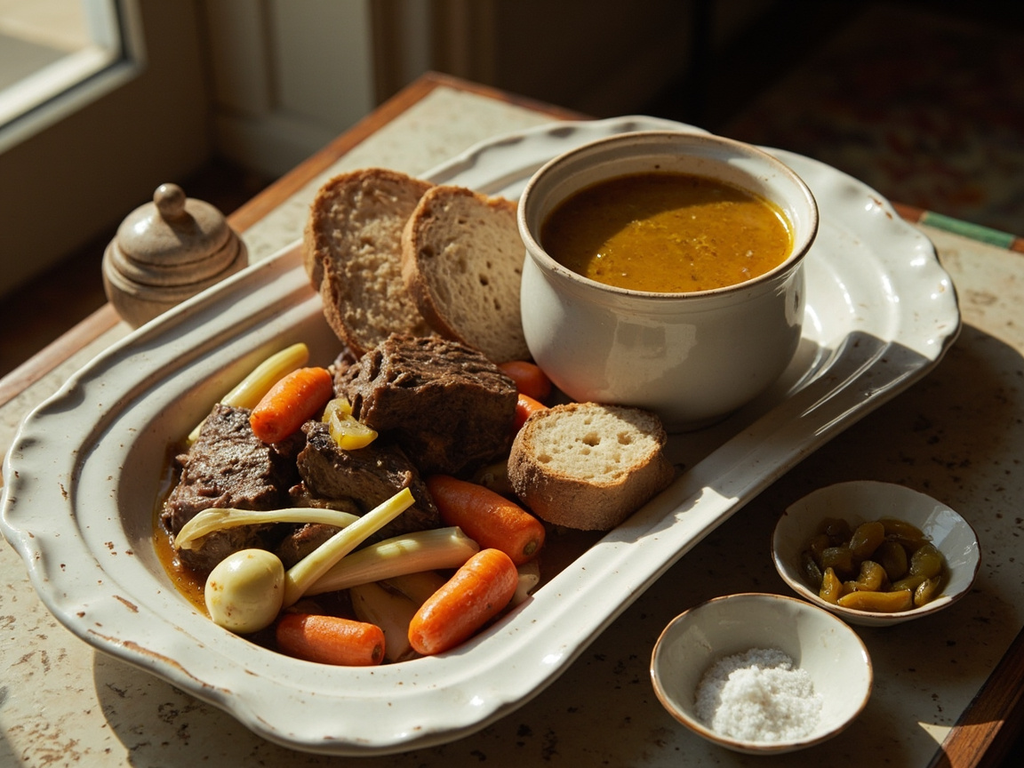
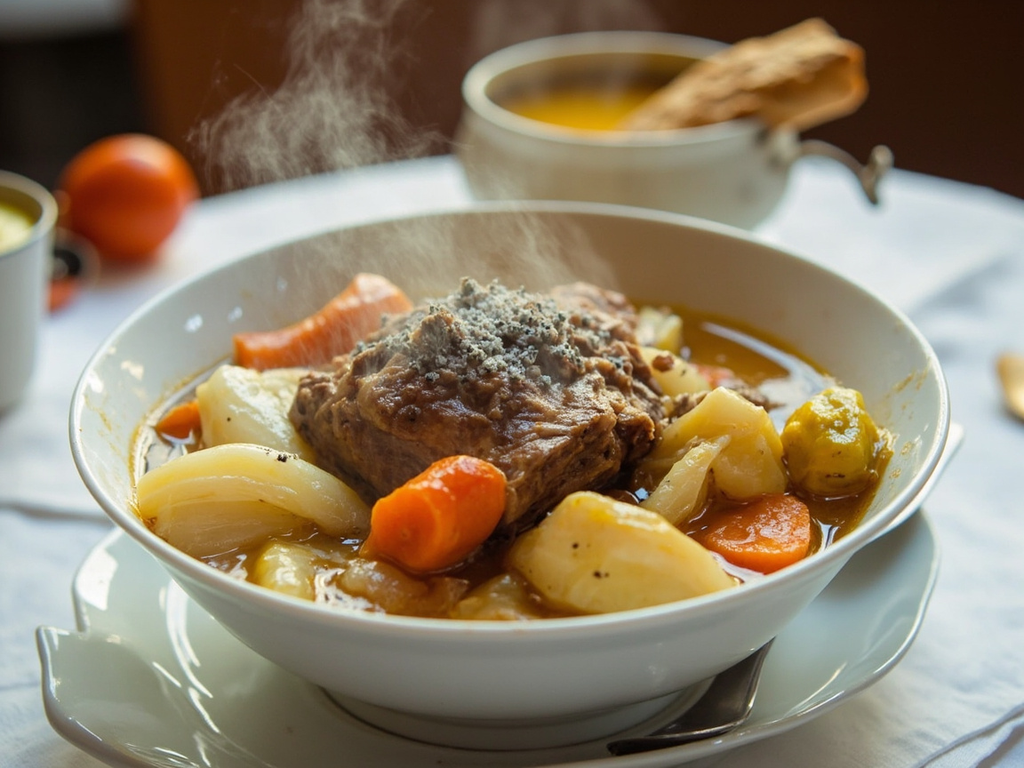
A piece of beef and a few marrow bones poached very slowly with root vegetables in a clear, fragrant broth. First the broth is served, then the meat and vegetables topped with coarse salt and enlivened with cornichons and strong mustard.
You see, I know no dish that better expresses what I call duration than this pot-au-feu. It does not hurry: you leave it by the fireside, and time itself, hour after hour, composes its flavor—nothing here is fabricated, everything ripens. At our table, we skimmed with almost religious care, for a cloudy broth would have been considered negligence; then we served the broth alone first, in deep plates, and the meat came afterward, accompanied by its coarse grey salt and a few cornichons. Believe a man of the study: the clearest thought often comes from the simplest meal.
- •Beef gîte and short ribs — a fine piece for the household (poaching meat)
- •Marrow bones — a few pieces (richness of the broth)
- •Carrots, turnips, leeks — one bunch of each (broth vegetables)
- •Onion studded with cloves — one (aromatic)
- •Coarse salt, peppercorns, bouquet garni — to taste (seasoning)
Sunday Pot-au-Feu
A piece of beef and a few marrow bones poached very slowly with root vegetables in a clear, fragrant broth. First the broth is served, then the meat and vegetables topped with coarse salt and enlivened with cornichons and strong mustard.
Why this dish? The weekly dish of Parisian bourgeois households, the pot-au-feu brought the Bergson family together around a broth simmered for hours. In their apartment in the 16th arrondissement, Louise ran the household according to the comfortable, regulated standards of the Third Republic bourgeoisie: Sunday called for this patient, economical, and nourishing dish.
You see, I know no dish that better expresses what I call duration than this pot-au-feu. It does not hurry: you leave it by the fireside, and time itself, hour after hour, composes its flavor—nothing here is fabricated, everything ripens. At our table, we skimmed with almost religious care, for a cloudy broth would have been considered negligence; then we served the broth alone first, in deep plates, and the meat came afterward, accompanied by its coarse grey salt and a few cornichons. Believe a man of the study: the clearest thought often comes from the simplest meal.
Ingredients (period version)
- Beef gîte and short ribs — a fine piece for the household (poaching meat)
- Marrow bones — a few pieces (richness of the broth)
- Carrots, turnips, leeks — one bunch of each (broth vegetables)
- Onion studded with cloves — one (aromatic)
- Coarse salt, peppercorns, bouquet garni — to taste (seasoning)
Ingredients
- Beef shank + chuck — 1.2 kg (poaching meat)
- Marrow bones — 4 pieces (richness of the broth)
- Carrots — 5 (vegetable)
- Turnips — 3 (vegetable)
- Leeks — 3 (vegetable)
- Onion + 3 cloves — 1 (aromatic)
- Bouquet garni, coarse salt, peppercorns — 1 bouquet + to taste (seasoning)
Method
- Place the meat in a large pot, cover with cold water, bring gently to a simmer, and patiently skim off any grey foam that rises.
- Add the studded onion, bouquet garni, peppercorns, and coarse salt; let simmer on very low heat for 2.5 to 3 hours, never boiling vigorously.
- One hour before the end, add carrots, turnips, and tied leeks; at the very end, poach the marrow bones for 15 minutes.
- Serve the strained broth first, piping hot, then present the meat and vegetables with coarse salt, cornichons, and strong mustard; spread the marrow on toasted bread.
How it was made : In the early 20th century, the pot-au-feu cooked on a cast-iron stove or coal range, sometimes all morning. The broth was reused the next day as consommé or to moisten a soup; nothing was wasted, a cardinal virtue of bourgeois domestic economy.
The contemporary twist : Reserve some chilled broth to make consommé ice cubes, to serve in a cup in summer—Bergson's duration in a refreshing version.
Sources : Auguste Escoffier, Le Guide culinaire, 1903 · La Cuisinière bourgeoise (tradition Menon, reprints 19th c.)
Henri Bergson · Charactorium