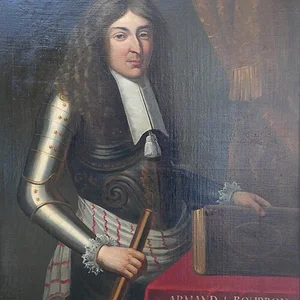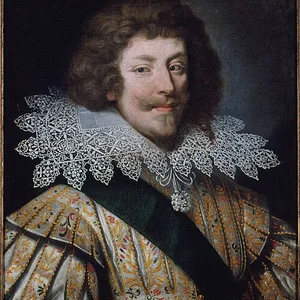

Henri II de Montmorency (1595-1632) was the last Duke of Montmorency, Governor of Languedoc, and Marshal of France. Drawn into Gaston of Orléans's revolt against Richelieu, he was captured at Castelnaudary and then beheaded in Toulouse in 1632.
Henri II de Montmorency(1595 — 1632)
Henri II de Montmorency
France
6 min read
Frequently asked questions
Key Facts
- Born in 1595, heir to the House of Montmorency, one of the most powerful in France
- Appointed Admiral of France at a very young age, then Governor of Languedoc
- Made Marshal of France in 1630 after military victories
- Joined Gaston of Orléans's revolt against Richelieu in 1632 and was defeated and captured at the Battle of Castelnaudary
- Beheaded in Toulouse on 30 October 1632 by order of Louis XIII, a symbol of the monarchy's repression of the great lords
Works & Achievements
As admiral, Montmorency defeated the Protestant fleet of Benjamin de Soubise, asserting royal naval power over the Atlantic.
His military successes in Piedmont and Montferrat during the War of the Mantuan Succession earned him the marshal's baton.
Administration of one of the richest provinces in the kingdom, where he built a lasting network of noble clients and popular devotion.
Montmorency had the gardens and buildings of the family estate laid out, continuing the splendor of his house.
A protector of artists and, together with his wife, a founder of religious establishments, he embodied the lavish great lord of his time.
Anecdotes
Henri II de Montmorency was the godson of King Henri IV, who gave him his first name. Born into one of the most powerful families in France, he became Admiral of France at just 17, in 1612, inheriting his father's offices.
At the Battle of Castelnaudary in 1632, Montmorency, carried away by his bravery, charged the royal troops alone and received seventeen wounds before being captured. It is said that his horse cleared several ditches before collapsing under the sheer number of blows.
Despite the pleas of all the European nobility and even the Pope, Richelieu and Louis XIII refused a pardon. To avoid any unrest, the execution took place not in a public square but in the courtyard of Toulouse's town hall, on 30 October 1632.
Montmorency had distinguished himself a few years earlier as a brilliant war leader, notably by defeating the Protestant fleet off the coast of Languedoc. His downfall illustrates Richelieu's determination to bring down the great feudal lords, whatever their past glory.
His death marked the end of the elder branch of the Montmorency, one of the oldest houses in France. The duchy passed through his sister to the Condé family, and his execution served as a warning to all nobles tempted to defy royal power.
Primary Sources
The king, considering that clemency on this occasion would have been a cruelty toward his State, resolved to render justice, so that the greatness of the house should not serve as a refuge for rebellion.
He received so many blows and wounds that he finally fell from his horse, half-dead, in the midst of his enemies, who raised him up with respect.
The news of his death spread a universal sorrow throughout the kingdom, for he was beloved for his generosity and his valor.
The duke was beheaded in the courtyard of the town hall of Toulouse, in the presence of a small number of people, the king having forbidden any gathering.
Key Places
Estate and château of the Montmorency family north of Paris, the cradle and residence of the family. Henri II grew up there and embellished it considerably.
Vast province in southern France of which Montmorency was the governor. There he wielded considerable power and enjoyed great popularity.
Town in the Lauragais region near which the battle of 1 September 1632 took place, where the royal army crushed the rebels and captured the duke.
Site of the imprisonment and execution of Henri II de Montmorency on 30 October 1632, carried out in the inner courtyard to avoid any gathering.
Town in the Bourbonnais region where the duke's body was taken and buried in the chapel of the Convent of the Visitation, founded by his wife Marie-Félicie des Ursins.
Typical Objects

Blue baton strewn with golden fleurs-de-lis, the supreme insignia of military command. Montmorency received it in 1629 after his campaigns in Italy.

Richly crafted cup-hilted rapier, both a weapon and a mark of noble rank. Montmorency wielded it during his fatal charge at Castelnaudary.

Breastplate armour worn by the heavy cavalry of the early 17th century. It was not enough to protect the duke from the seventeen wounds he received.

Golden collar of the knights of the kingdom's most prestigious order of chivalry, of which Montmorency was a member. It signalled one's closeness to the king.

Engraved matrix bearing the Montmorency coat of arms, used to validate deeds and correspondence in his role as governor of Languedoc.

Firearm carried in a saddle holster by cavalry officers. The wheellock mechanism made it possible to fire on horseback during a charge.
School Curriculum
Vocabulary & Tags
Key Vocabulary
Daily Life
Morning
The duke would rise in his apartments, attended by valets and gentlemen of his household. The morning blended audiences, reading the province's correspondence and, on campaign, inspecting the troops and holding councils of war.
Afternoon
The afternoon was devoted to the governing affairs of Languedoc, to hunting — the favorite pastime of the nobility — or to the practice of arms and horsemanship, indispensable to a man of war.
Evening
The evening gathered his court for lavish suppers, conversation, and sometimes music or gaming. As a great lord, Montmorency maintained a large household staff and entertained with magnificence.
Food
The table of a great lord offered roasted meats, game, fish, pâtés and wines in abundance. Spices, sugar and candied fruits marked the rank and wealth of the host.
Clothing
Montmorency wore a silk doublet, breeches, a lace collar and boots of fine leather, in keeping with the fashion of the reign of Louis XIII. On campaign, he donned the cuirass and the plumed felt hat of the cavalry officers.
Housing
He resided in vast châteaux such as Chantilly and in his town houses in the province, dwellings furnished with tapestries, paintings and precious furniture, surrounded by gardens and numerous servants.
Historical Timeline
Period Vocabulary
Liens externes & ressources
Références
Œuvres
Victoire navale contre Soubise
1625
Campagne d'Italie et secours de Casal
1629-1630
Gouvernement du Languedoc
1613-1632
Embellissement du château de Chantilly
années 1620
Mécénat artistique et religieux
années 1620-1630