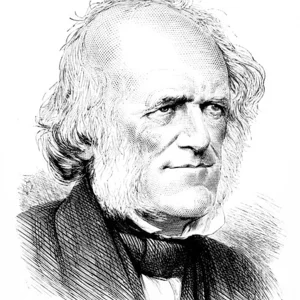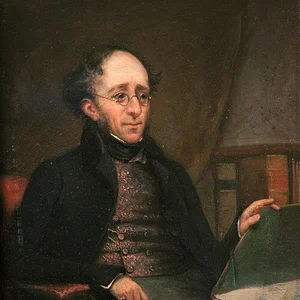

British geologist, pioneer of geological mapping. In 1835 he founded the British Geological Survey, the world's first national geological survey, and worked to establish geology as a scientific discipline in its own right.
Henry de la Beche
Sir Henry Thomas De la Beche
6 min read
Frequently asked questions
Key Facts
- Born in 1796 in London, died in 1855
- Founds the Ordnance Geological Survey (the future British Geological Survey) in 1835, the first national geological survey
- First director of the Museum of Practical Geology, opened in 1851
- Collaborated with the palaeontologist Mary Anning at Lyme Regis and produced the watercolour Duria Antiquior (1830), the first depiction of prehistoric life
- Elected a Fellow of the Royal Society in 1819 and president of the Geological Society of London
Works & Achievements
The first illustrated depiction of a prehistoric living scene, inspired by Mary Anning's fossils; a milestone in visual paleontology.
A standard geology textbook, translated and reissued, which spread the discipline's methods far and wide.
A reflective work on geological processes and the forces that shape the Earth.
A practical guide teaching amateurs and students the art of observing and surveying terrain.
The creation of the world's first national geological service, the future British Geological Survey, which he led.
A detailed geological survey of southwestern England, a model for later official maps.
A vast treatise on geological observation, the sum of his fieldwork experience.
The world's first museum and first school devoted to applied geology and the training of mining engineers.
Anecdotes
Wealthy thanks to a Jamaican sugar-cane plantation worked by enslaved people, Henry De la Beche was able to devote himself to geology without needing a job. When the abolition of slavery in 1833 caused his income to collapse, he turned his passion into a genuine profession by founding a national geological survey.
In 1830, he painted *Duria Antiquior*, the very first scientific illustration reconstructing a scene of prehistoric life, populated with ichthyosaurs and plesiosaurs. He had lithographs of the work printed and sold the copies to give financial help to his friend Mary Anning, the famous fossil hunter of Lyme Regis.
As a teenager, he was expelled from a military school for insubordination — a rebellious streak he kept all his life. As a geologist, he loved drawing biting caricatures of his fellow scholars, including one that gently mocked William Buckland and his obsession with coprolites (fossilised excrement).
For his great geological survey of Cornwall, Devon and Somerset, he himself trekked hundreds of kilometres of cliffs and mines, notebook and hammer in hand. His report, published in 1839, became authoritative and proved that a geological map could be a useful tool for the mining industry and for the nation.
In 1851, he opened the Museum of Practical Geology in London, the world's first museum entirely devoted to applied geology. That same year, he founded the Royal School of Mines there to train engineers and geologists, making geology a body of knowledge that was taught and recognised.
Primary Sources
The study of the successive layers that make up the Earth's crust reveals to us the order in which ancient populations of living beings succeeded one another on the surface of the globe.
The observer must above all learn to see: to note the nature of the rocks, their inclination, their succession, and to record faithfully what is encountered in the field.
This report is the result of a detailed examination of the terrains of these counties, undertaken for the Ordnance Geological Survey in order to map them accurately.
A well-established geological map is not a mere curiosity: it guides the miner, the engineer and the farmer in the use of the riches of the soil.
Key Places
De la Beche's birthplace, where he died and where in 1851 he founded the Museum of Practical Geology on Jermyn Street.
A small coastal town with cliffs rich in Jurassic fossils, where he studied geology and became friends with the palaeontologist Mary Anning.
Mining regions of south-west England that he surveyed for his great geological survey published in 1839.
A Welsh town at the heart of the South Wales coalfield, where the Geological Survey carried out important mapping work.
A sugar-cane plantation worked by enslaved people that De la Beche inherited; its income funded his early geological research.
The world's first museum dedicated to applied geology, which he opened in London in 1851 alongside the Royal School of Mines.
Typical Objects

The field geologist's basic tool, with a pointed pick on one side and a flat face on the other, used to detach and split rocks. De la Beche wielded it himself on the cliffs and in the mines.

An instrument combining a compass and a level to measure the orientation and inclination of geological layers. Essential for mapping the structure of the terrain.

A representation of the rocks outcropping at the surface, colour-coded by their nature and age. De la Beche made it an official tool in the service of industry and the State.

A small notebook in which the geologist draws sections, cliffs and fossils observed on site. De la Beche, an excellent draughtsman, also recorded his caricatures in it.

The spiral shell of an extinct marine mollusc, abundant in the Jurassic cliffs of Lyme Regis. These fossils were used to date and correlate rock layers.

Pans of water-based paint used to colour maps and reconstructions. De la Beche used them to paint "Duria Antiquior", the first image of prehistoric life.
School Curriculum
Vocabulary & Tags
Key Vocabulary
Daily Life
Morning
During his field campaigns, De la Beche set out early onto the cliffs or toward the mines, hammer and compass in hand. He measured the dip of the strata, collected samples, and recorded every observation in his notebook.
Afternoon
Afternoons were spent mapping the terrain, descending into the galleries to study the seams, or drawing geological cross-sections. In London, he directed the work of the Geological Survey and received colleagues and officials.
Evening
In the evening, he wrote reports and papers, coloured his maps in watercolour, or sketched caricatures of his scholarly friends. He also took part in the meetings and debates of the Geological Society of London.
Food
Like a well-off Victorian gentleman, he ate hearty meals: roast meats, game, fish, bread, cheeses, and puddings, washed down with wine or beer. In the field, he made do with a frugal snack between two outcrops.
Clothing
He wore the dress of a nineteenth-century gentleman: dark frock coat, waistcoat, high-collared shirt, and a top hat in town. For fieldwork, he adopted sturdy clothing and good boots suited to the mud of the mines and the rocks.
Housing
Born into a wealthy family, he lived in comfortable middle-class residences, at Lyme Regis and later in London. His home housed his library, his collections of fossils and rocks, and his measuring instruments.
Historical Timeline
Period Vocabulary
Liens externes & ressources
Références
Œuvres
Duria Antiquior — A More Ancient Dorset
1830
A Geological Manual
1831
Researches in Theoretical Geology
1834
How to Observe — Geology
1835
Fondation de la Ordnance Geological Survey
1835
Report on the Geology of Cornwall, Devon and West Somerset
1839
The Geological Observer
1851