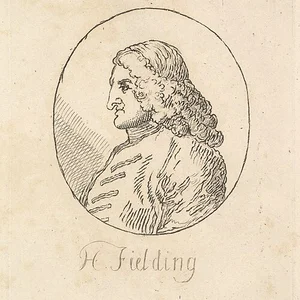

Henry Fielding (1707-1754) was an English novelist, playwright and magistrate, regarded as one of the fathers of the modern novel. His masterpiece, *Tom Jones* (1749), is a comic and moral panorama of eighteenth-century English society.
Henry Fielding(1707 — 1754)
Henry Fielding
royaume de Grande-Bretagne
6 min read
Frequently asked questions
Key Facts
- Born in 1707 in Sharpham (Somerset), died in 1754 in Lisbon
- Author of satirical plays whose virulence contributed to the Licensing Act of 1737, which established theatrical censorship
- Published *Joseph Andrews* in 1742, a parody of Richardson's *Pamela*
- Published *The History of Tom Jones, a Foundling* in 1749, considered a pinnacle of the English novel
- Became a magistrate in London and helped found the Bow Street Runners, forerunners of the modern police force
Works & Achievements
A burlesque comedy parodying the pompous tragedies of the era, one of his great theatrical successes.
A satirical parody of Richardson's novel *Pamela*, denouncing its hypocritical moralism.
Fielding's first true novel, which he defined as a “comic epic in prose,” founding a new genre.
A biting satire in which a notorious criminal becomes the ironic allegory of political “greatness.”
Fielding's masterpiece, a vast comic and moral panorama of England, considered a pinnacle of the modern novel.
His last and darker novel, depicting the struggles of a couple confronted with poverty and injustice.
A posthumous and clear-eyed account of his final voyage, undertaken to treat his illness.
Anecdotes
Before becoming a novelist, Henry Fielding was a feared satirical playwright. His plays mocked Prime Minister Robert Walpole so openly that in 1737 the government passed the Licensing Act, introducing prior censorship of the theatres. Deprived of the stage, Fielding then turned to the law and later to the novel.
In 1741, Fielding published *Shamela*, a ferocious parody of Samuel Richardson's best-selling novel *Pamela*, which he found hypocritical. In it he transforms the virtuous heroine into a calculating young woman. This literary quarrel pushed him to invent his own style of novel, more ironic and realistic.
Having become a magistrate of Westminster in 1748, Fielding founded, together with his blind half-brother John, the *Bow Street Runners*, often regarded as the ancestor of the London police. In an age without an organized police force, these paid investigators hunted down thieves in the capital.
Wracked by gout and asthma, Fielding set sail in 1754 for Lisbon in the hope that the climate would save him. He died two months after his arrival, at only 47. His travel journal, published after his death, recounts with humour this desperate voyage.
The novel *Tom Jones* (1749) is so vast that it comprises eighteen books and nearly a thousand pages. Fielding opens each of these books with a chapter in which he addresses the reader directly, commenting on his own art of storytelling — a bold novelty for the time.
Primary Sources
Human nature itself will be the true substance of our feast. No discerning reader will be surprised that we have chosen for the subject of our work a matter so common and yet so inexhaustible.
The ridiculous, and it alone, is the source of true comedy. It springs from affectation, which arises from two causes: vanity or hypocrisy.
On Wednesday, around noon, I took leave of my children for the last time — an ordeal that tested my courage more severely than anything I had ever undertaken.
Oh, what a delight it will be, once I am married to my master, to cuckold him and make a mockery of him!
Key Places
Estate in the English countryside where Henry Fielding was born in 1707, near Glastonbury.
Prestigious school where Fielding received a solid classical education, forging friendships with future men of power.
University in the United Provinces where Fielding studied law for a little over a year, before running out of money.
Court where Fielding served as a magistrate and founded the Bow Street Runners, forerunners of the London police.
London theatre where Fielding had his satirical comedies performed during the 1730s.
Portuguese capital where the ailing Fielding traveled in search of a milder climate, and where he died in October 1754.
Typical Objects

The novelist's everyday instrument, sharpened with a penknife to write the thousands of pages of his works. Handwriting was the only way to compose a novel.

Fielding's novels appeared in several small-format bound volumes, sold by subscription or in bookshops. *Tom Jones* thus appeared in six volumes.

A symbol of the judicial authority Fielding wielded as a justice of the peace at Bow Street. He dispensed justice in London's criminal cases.

Announced the satirical comedies Fielding had staged at the Haymarket Theatre in the 1730s. These plays mocked political power.

An indispensable accessory for Georgian lawyers and gentlemen, worn by Fielding as a magistrate just as it was by the barristers of his day.

A document issued by the court authorizing the Bow Street Runners to arrest a suspect. A tool of London's nascent police force.
School Curriculum
Vocabulary & Tags
Key Vocabulary
Tags
Daily Life
Morning
As a magistrate at Bow Street, Fielding often devoted his mornings to hearing plaintiffs and defendants in his courtroom. Between hearings, he dictated or wrote his texts, for illness wore him out quickly. A cup of tea or chocolate accompanied these working hours.
Afternoon
The afternoon might be spent receiving informants, organizing the patrols of the Bow Street Runners, or meeting booksellers and fellow writers. Fielding also dealt with his correspondence and his money matters, which he handled poorly.
Evening
In the evening, he happily frequented the taverns and coffee houses of London, places of conversation and debate. It was the hour of suppers, wine, and witty exchanges with other men of letters and of the theatre.
Food
The well-to-do Georgian table featured roast meats (beef, mutton, poultry), pies, bread, and cheeses. Fielding loved good wine and beer, but his gout, made worse by such excesses, caused him cruel suffering.
Clothing
As a man of the eighteenth century, Fielding wore a long skirted coat, a waistcoat, knee-tight breeches, stockings, and buckled shoes. A powdered wig and tricorne hat completed the dress of the gentleman and magistrate.
Housing
He lived in London town houses, including the one adjoining the Bow Street court. These multi-storey brick dwellings combined family home and workplace, heated by coal and lit by candlelight.
Historical Timeline
Period Vocabulary
Liens externes & ressources
Références
Œuvres
The Tragedy of Tragedies (Tom Thumb)
1730-1731
Joseph Andrews
1742
Jonathan Wild
1743
The Journal of a Voyage to Lisbon
1755