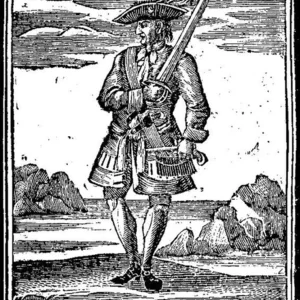

English pirate of the early 18th century, active in the Caribbean during the “Golden Age of Piracy.” He owes his fame to his flag — a skull above two crossed cutlasses — and to the presence in his crew of the female pirates Anne Bonny and Mary Read.
Calico Jack(1682 — 1720)
Jack Rackham
royaume de Grande-Bretagne
7 min read
Frequently asked questions
Key Facts
- Nicknamed “Calico Jack” because of the calico clothing (printed Indian cotton) he wore.
- In 1718, he became captain after ousting Charles Vane, who was judged too cautious during a fight.
- He accepted a royal pardon, then returned to piracy, counting the female pirates Anne Bonny and Mary Read among his crew.
- Captured in October 1720 off the coast of Jamaica by a pirate hunter.
- Tried and hanged on 18 November 1720 at Port Royal (Jamaica); his body was displayed at the harbor entrance as a warning.
Works & Achievements
The flag traditionally associated with Rackham became, long after his death, the most widespread image of the pirate flag in popular culture.
Elected captain by his crew in place of Vane, who was deemed a coward, Rackham illustrates the democratic workings and the voting that took place aboard pirate ships.
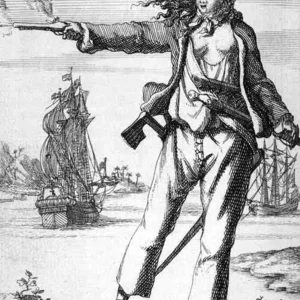
Rackham had two women pirates sailing in disguise within his crew, an exceptional case that secured his place in history.
His prizes were mostly small craft, sloops, and local fishing boats; a modest form of piracy, but one carried out as close as possible to the Caribbean trade routes.
The hijacking of this ship in the very harbour of the Bahamas' capital triggered Governor Woodes Rogers' proclamation and the manhunt that led to his capture.
Anecdotes
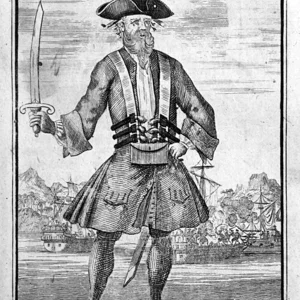
His nickname “Calico Jack” came from the calico clothing he loved to wear — a brightly patterned printed cotton imported from India (from the city of Calicut). Amid sailors dressed in coarse canvas, his colorful wardrobe made him stand out and earned him this nickname that has remained famous.
Rackham became captain in late 1718 in a typically piratical fashion: the crew voted to depose their leader Charles Vane, accused of cowardice for refusing to attack a French warship. Rackham, until then the quartermaster, was elected captain by a majority of the votes.
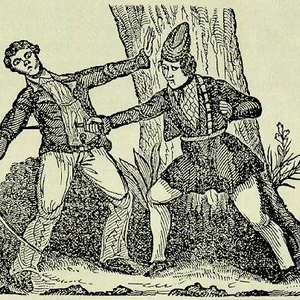
When Rackham's sloop was captured off the coast of Jamaica in 1720, two members of the crew fought fiercely on deck while the men, drunk, stayed hidden in the hold: the women pirates Anne Bonny and Mary Read. Both would escape the gallows by declaring themselves pregnant (“pleading the belly”).
According to Captain Charles Johnson's account, Anne Bonny was granted permission to see Rackham before his execution and threw him a line that has remained famous: she was sorry to see him there, but had he “fought like a man, he need not have been hanged like a dog.”
After his hanging in November 1720, Rackham's body was locked in an iron cage (a gibbet) and put on display on a small islet at the entrance to Port Royal, to serve as a warning to sailors. This little reef still bears the name “Rackham's Cay” today.
Primary Sources
She was sorry to see him there, but if he had fought like a Man, he need not have been hang'd like a Dog.
John Rackam, George Fetherston, Richard Corner [...] were severally indicted for Piracy, Robbery and Felony [...] and the Court [...] did pronounce Sentence of Death against them.
Whereas John Rackum [...] and two Women, by name Ann Fulford alias Bonny, & Mary Read, did [...] feloniously steal, take and carry away [...] a certain Sloop call'd the William.
Key Places
Main hideout of the Caribbean pirates in the early 18th century, nicknamed the “pirate republic.” Rackham lived there, received his pardon there, then stole the sloop William there in 1720.
Area where Rackham's sloop, at anchor, was surprised and boarded in October 1720 by the pirate hunter Jonathan Barnet. This is where the crew was captured.
Seat of the English colonial administration of Jamaica, where Rackham and his crew were tried for piracy in November 1720.
Major English colonial port where Rackham was hanged at Gallows Point on 18 November 1720, at the conclusion of his trial.
Small islet at the harbor entrance where Rackham's body was displayed in an iron cage to deter sailors. The reef bears his name today.
Typical Objects

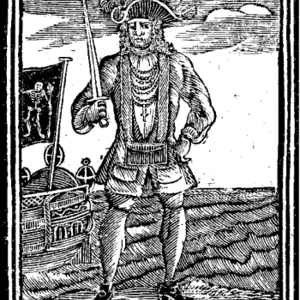
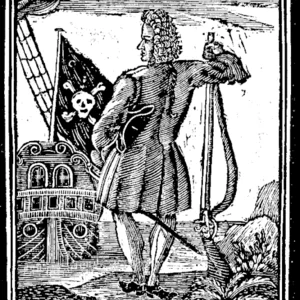
An intimidation flag traditionally attributed to Rackham: a skull above two crossed boarding cutlasses. Raised as the crew closed in on a target, it meant “surrender or perish” and became the popular image of the pirate flag.

A short, broad, slightly curved blade, ideal for tight fighting on a crowded deck. It was the pirates' weapon of choice when boarding a ship.

A single-shot personal firearm, often carried several at a time on a belt because reloading took so long. Essential for the opening shot at the moment of boarding.

Garments cut from colourful printed cotton from India, known as calico. This flashy outfit earned John Rackham his nickname “Calico Jack”.

A small, fast single-masted sailing ship, nimble and with a shallow draft, perfect for surprising targets and slipping away into the Caribbean shallows. It was aboard the William, stolen at Nassau, that Rackham was captured.

An iron hook thrown on the end of a rope to catch the enemy ship and haul it closer by force. It let the crew leap across to board.

A sugarcane spirit produced in abundance in the West Indies, the staple of the pirates' daily drink. Rackham's crew is said to have been caught drunk at the time of their capture, unable to defend themselves.

An official document by which the British Crown granted amnesty to a pirate who surrendered. Rackham received one around 1719 before returning to piracy.
School Curriculum
Vocabulary & Tags
Key Vocabulary
Tags
Daily Life
Morning
Aboard a sloop, the day began at daybreak with the changing of the watch, the inspection of the sails and rigging, and bailing out the water that had collected in the hold. A lookout scanned the horizon for a sail signaling a possible prey.
Afternoon
The afternoon was spent maintaining the ship, repairing the rigging, cleaning the weapons and, during a chase, maneuvering to catch up with the spotted vessel. When a prey was taken, the loot was transferred and the fate of the captured crew was negotiated.
Evening
In the evening, the crew shared a meal, drank rum and played dice or cards. It was during such a moment of letting their guard down, the crew drunk, that Rackham's band was reportedly surprised and captured.
Food
They mainly ate preserved provisions: hardtack, salted meat, fish, sometimes turtles and fresh fruit seized during port calls. The main drink was Caribbean rum, often watered down.
Clothing
Sailors wore a linen shirt, loose trousers or breeches and a cap or headscarf. Rackham, for his part, stood out with his colorful calico clothes, which earned him his nickname.
Housing
The pirate's “home” was the ship itself: a small, cramped sloop where one slept right on the deck or in a hammock. On land, port calls took place in the taverns and shacks of hideouts like Nassau.
Historical Timeline
Period Vocabulary
Liens externes & ressources
Références
Œuvres
Pavillon au crâne et aux sabres croisés
vers 1718-1720
Prise de commandement après la destitution de Charles Vane
novembre 1718
Recrutement d'Anne Bonny et Mary Read
1719-1720
Campagne de piraterie autour de la Jamaïque
1719-1720
Vol du sloop William à Nassau
août 1720