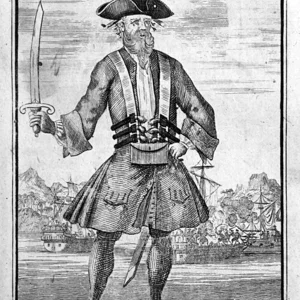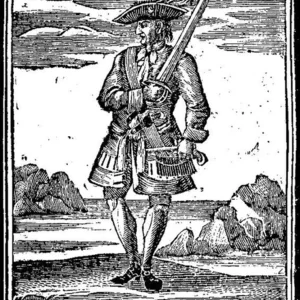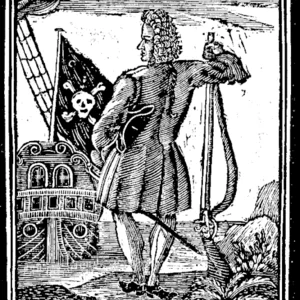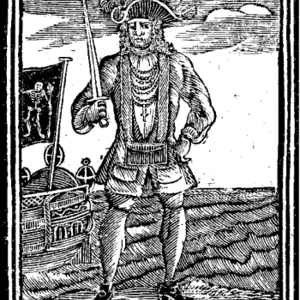

Bartholomew Roberts, known as “Black Bart,” was a Welsh pirate considered the most prolific of the Golden Age of Piracy. In barely three years (1719–1722), he captured more than 400 ships across the Atlantic and the Caribbean before being killed in battle by the Royal Navy.
Bartholomew Roberts(1682 — 1722)
Bartholomew Roberts
royaume de Grande-Bretagne, royaume d'Angleterre
7 min read
Frequently asked questions
Famous Quotes
« “A merry life and a short one shall be my motto.” (as reported by Charles Johnson in *A General History of the Pyrates*, 1724)»
Key Facts
- Born around 1682 in Casnewydd-Bach (Little Newcastle), Wales.
- In 1719, he was captured by the pirate Howell Davis; upon Davis's death, he was elected captain by the crew.
- Between 1719 and 1722, he captured more than 400 ships, a record for the Golden Age of Piracy.
- He imposed a strict code of conduct (the “articles”) on his crews and was known for his sobriety, preferring tea to alcohol.
- Killed in battle on 10 February 1722 off Cape Lopez (Gabon) by HMS Swallow under Captain Chaloner Ogle; his death is often seen as marking the end of the Golden Age of Piracy.
Works & Achievements
One of the biggest hauls in the history of piracy: 40,000 gold moidores and jewels destined for the King of Portugal, seized from the heart of a merchant fleet in the Bay of All Saints.
A written charter organizing life on board, the division of plunder, and discipline; it illustrates a form of self-government and remains one of the best-documented pirate codes.
A bold stroke in Newfoundland: with a single ship, Roberts seized an entire port and destroyed 22 vessels without any real fighting.
In barely three years, Roberts intercepted more than 400 vessels across the Atlantic, the Caribbean, and off the coast of Africa, becoming the most prolific pirate of his time.
Roberts designed flags in his own image, including the one bearing two skulls marked “ABH” and “AMH,” tools of psychological terror that have entered the legend of piracy.
The refitting of a former slave ship into a powerful warship with some forty cannons, the base for his final campaigns off the coast of West Africa.
Anecdotes
In 1719, off the coast of Brazil, Roberts dared to slip into the middle of a fleet of 42 Portuguese merchant ships protected by two warships. He picked out the most richly laden one, the galleon Sagrada Família, and seized it: aboard were 40,000 gold coins (moidores) and jewels destined for the King of Portugal. It was one of the largest hauls in the entire history of piracy.
Contrary to the cliché of the rum-soaked pirate, Roberts drank nothing but tea. He imposed strict discipline on his crew through a set of “Articles”: lights out at eight in the evening, no gambling aboard, and no quarrels — which had to be settled on land, with pistol or sword.
On the day of his final battle, in November 1722, Roberts dressed in splendor: a waistcoat and breeches of red damask, a scarlet feather in his hat, and a gold chain set with a diamond cross taken from the Portuguese plunder. He was killed by a blast of grapeshot to the throat at the very start of the clash with the Royal Navy ship.
In keeping with his wishes, his crew immediately threw his body into the sea, weighted down with cannonballs, to stop the English from putting it on display. His remains were never found. His death is often regarded as the end of the “golden age of piracy.”
In June 1720, Roberts sailed alone with his ship into the harbor of Trepassey, in Newfoundland, where 22 vessels and more than a thousand men lay at anchor. Panic-stricken, sailors and fishermen fled ashore without a fight, and the pirate seized the harbor almost without firing a single shot.
Primary Sources
In an honest service there is thin commons, low wages, and hard labour; in this, plenty and satiety, pleasure and ease, liberty and power. No: a merry life and a short one, that is my motto.
Every man has a vote in affairs of moment and an equal title to the fresh provisions and strong liquors that are seized. The lights and candles are to be put out at eight o'clock at night; any who wish to drink after that hour must do so on the open deck, in the dark.
Of the 169 men taken alive by HMS Swallow, the court condemned 52 pirates to be hanged, the rest being acquitted, transported, or sentenced to penal servitude.
Key Places
Village in Pembrokeshire where Roberts was born around 1682. A statue there now commemorates Wales's most famous pirate.
It was here, amid a Portuguese merchant fleet, that Roberts seized the galleon Sagrada Família and its fabulous treasure in 1719.
Fishing port that Roberts plundered in June 1720, sending crews and townsfolk fleeing and destroying 22 ships.
Off this cape in equatorial Africa, Roberts was killed in battle on 10 November 1722 by HMS Swallow; his crew buried his body at sea.
Slave-trading fortress where the trial of the survivors of Roberts's crew was held in 1722; 52 of them were hanged there.
Typical Objects

Roberts flew several flags of his own design, including one depicting him standing, cutlass in hand, atop two skulls marked “ABH” and “AMH” (the heads of a man from Barbados and a man from Martinique), as a sign of revenge against these two islands.

A short, broad, sturdy blade, ideal for close combat on the crowded decks during a boarding action.

Pirates often carried several of them hung from a bandolier, since each weapon fired only a single shot before a long reload.

A written charter that every member of the crew had to agree to: the division of the loot, discipline aboard, and compensation for the wounded. Roberts's code is one of the best preserved.

Roberts gave this name to several of his successive ships; the last one, a former slave ship rearmed with around forty cannons, was his flagship until his death.

A piece of jewelry taken from Portuguese loot, originally intended for the king of Portugal; Roberts wore it around his neck as a symbol of his success.

Instruments essential for fixing one's position at sea, measuring the height of the sun, and holding a course across the Atlantic.
School Curriculum
Vocabulary & Tags
Key Vocabulary
Tags
Daily Life
Morning
At dawn, the crew took turns on watch, scanning the horizon for prey. They checked the rigging, bailed water from the hold, and fixed the ship's position using compass and quadrant.
Afternoon
The afternoon was given over to maintenance: mending the sails, cleaning the cannons and weapons, and standing guard over the prisoners. The Articles forbade gambling and brawling, which had to be settled ashore.
Evening
In the evening, musicians — exempt from playing on the day of rest — entertained the deck. According to Roberts's code, lights and candles had to be put out by eight o'clock; those who still wished to drink did so outside, in the dark, while the captain made do with his tea.
Food
The usual fare rested on salted beef and pork, ship's biscuit hard as stone, and dried peas; for lack of fresh fruit, scurvy threatened on long voyages. Fresh provisions and liquor taken from captured ships were shared among all.
Clothing
The ordinary sailor wore a linen shirt, wide trousers, and a short jacket. Roberts, for his part, took care over his appearance: a waistcoat and breeches of crimson damask, a hat with a red feather, and a gold chain bearing a diamond cross, to assert his authority.
Housing
Life aboard was cramped, with men sleeping in hammocks between the cannons on low, damp decks. Only the captain had a cabin at the stern, but important decisions were made in a council of the whole crew.
Historical Timeline
Period Vocabulary
Liens externes & ressources
Références
Œuvres
Capture du galion Sagrada Família
1719
Les Articles de l'équipage (code pirate)
vers 1720
Raid sur le port de Trepassey
1720
Plus de 400 navires capturés
1719-1722
Création de ses pavillons personnels
vers 1720
Le Royal Fortune, navire amiral
1721