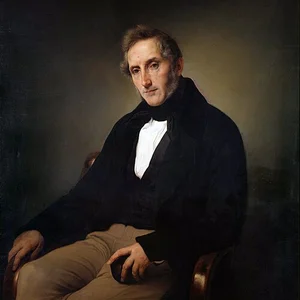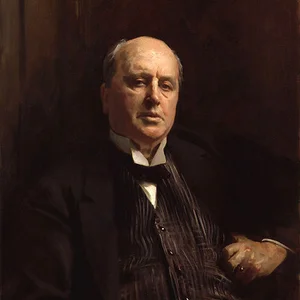

Henry James (1843-1916) was an American writer who became a naturalized British citizen in 1915. A master of the psychological novel, he explored the relationship between the European Old World and the American New World. He is the author of the celebrated novel The Portrait of a Lady (1881).
Henry James(1843 — 1916)
Henry James
États-Unis, Royaume-Uni de Grande-Bretagne et d'Irlande
7 min read
Frequently asked questions
Famous Quotes
« We work in the dark — we do what we can — we give what we have. Our doubt is our passion and our passion is our task. The rest is the madness of art.»
Key Facts
- Born on April 15, 1843, in New York into a wealthy intellectual family, brother of the philosopher William James
- Settled permanently in Europe, mainly in England, from 1876 onward
- Published The Portrait of a Lady in 1881, one of his masterpieces
- Released the supernatural novella The Turn of the Screw in 1898
- Acquired British citizenship in 1915 and died in London on February 28, 1916
Works & Achievements
This novella about a naive young American woman in Europe made James famous and set out his great theme: the clash between the Old World and the New.
A New York novel about an heiress courted for her fortune, a model of psychological subtlety and quiet cruelty.
A masterpiece in which Isabel Archer, a young American in love with freedom, finds herself trapped by a marriage in Europe. A pinnacle of the psychological novel.
A satire of Boston's reform circles and the early days of American feminism.
A landmark essay in which James defends the novel as a fully fledged art form, grounded in the personal impression of life.
A ghost story about a governess haunted by apparitions, famous for its ambiguity: are the spectres real or imagined?
The first of three great novels of his maturity, written in dense prose, about a sick and wealthy young woman who falls victim to a romantic plot.
The novel James considered his finest, about an American sent to Paris to bring home a young man, only to be overwhelmed by the seductions of the Old World.
Anecdotes
In 1915, outraged by the United States' neutrality in the First World War, Henry James took British citizenship to show his solidarity with England at war. This gesture by the 72-year-old writer caused a great stir and marked a symbolic break with his native country.
In 1895, his play *Guy Domville* was booed on its opening night in London. Called onto the stage, James was greeted by the audience's jeers; humiliated, he gave up the theatre for good to devote himself to the novel.
Suffering from cramps in his hand, James began dictating his novels to a typist, Theodora Bosanquet, who worked on a Remington machine. The rhythm of dictating aloud gave his final works their distinctively expansive style, with long, winding sentences.
A few weeks before his death, in January 1916, King George V awarded him the Order of Merit, one of the highest British distinctions, crowning a career entirely devoted to literature.
According to the testimony of his friend, the writer Edith Wharton, James, struck by a stroke, is said to have murmured: “So here it is at last, the distinguished thing,” greeting death as a guest of honour.
Primary Sources
Under certain circumstances there are few hours in life more agreeable than the hour dedicated to the ceremony known as afternoon tea.
A novel is in its broadest definition a personal, a direct impression of life.
The story had held us, round the fire, sufficiently breathless; but except the obvious remark that it was gruesome, as, on Christmas Eve in an old house, a strange tale should essentially be, I remember no comment uttered.
The house of fiction has in short not one window, but a million—a number of possible windows not to be reckoned.
Key Places
Henry James was born in 1843 in New York, near Washington Square, a neighborhood he would evoke in his novel of the same name. For him, the city embodied the American New World.
James made London his adopted city for nearly forty years and died in 1916 in his apartment at Carlyle Mansions, in Chelsea.
This eighteenth-century house, in the small town of Rye (Sussex), became his country retreat from 1898 onward. There he composed his last great novels.
James lived in Paris in 1875-1876 and there mingled with the great French realist writers such as Flaubert and Turgenev, who influenced his art.
During his Italian sojourns, James drew from the light and art of Florence the setting for major works, including part of The Portrait of a Lady.
James briefly enrolled at Harvard Law School in 1862, before turning resolutely toward literature.
Typical Objects

Suffering from his hand, James dictated his last novels to a typist who typed them out. The clatter of the keys became the daily companion of his creative work.

In his notebooks James recorded the anecdotes he heard in society, the seeds of his future stories. He also jotted down his reflections on the art of the novel there.

Before dictation, James wrote his novels by pen, in a cramped hand. The abundant correspondence he kept up throughout his life also flowed from the pen.

Around 1907-1909, James meticulously revised his collected works by correcting the printer's proofs. He added to them the famous prefaces on his method.

James took care over his man-of-the-world attire: dark frock coat, waistcoat and starched collar, in the fashion of fine London society. His imposing figure was well known in the salons.

At Lamb House, James worked in the garden pavilion (the Garden Room), at a large desk. It was there that he dictated the great novels of his maturity.
School Curriculum
Vocabulary & Tags
Key Vocabulary
Tags
Daily Life
Morning
James devoted his mornings to literary work, the most sacred part of his day. Settled in the Garden Room of Lamb House, he dictated to his secretary while pacing the room, shaping his long sentences aloud.
Afternoon
In the afternoon, he enjoyed long walks on foot or by bicycle through the Sussex countryside, and later received visitors. Walking helped him develop his plots.
Evening
A great socialite, James often dined out or entertained friends and fellow writers. In London, it was said that in certain seasons he accepted hundreds of dinner invitations, where he gathered the stories that fed his work.
Food
A lover of fine Victorian dining, James grew notably stout with age. For a time he followed a regimen of very slow chewing, fashionable in his day, to aid his digestion.
Clothing
He dressed with the care of a cosmopolitan gentleman: frock coat or dark suit, waistcoat, starched collar, and hat. His impeccable appearance reflected his attachment to the customs of high society.
Housing
After years of apartment life in London, James acquired the comfort of a Georgian residence, Lamb House in Rye, surrounded by a walled garden. There he led an existence divided between the countryside and his stays in London.
Historical Timeline
Period Vocabulary
Liens externes & ressources
Références
Œuvres
Daisy Miller
1878
Washington Square
1880
Portrait de femme (The Portrait of a Lady)
1881
Les Bostoniennes (The Bostonians)
1886
L'Art de la fiction (The Art of Fiction)
1884
Le Tour d'écrou (The Turn of the Screw)
1898
Les Ailes de la colombe (The Wings of the Dove)
1902