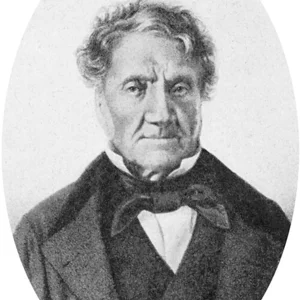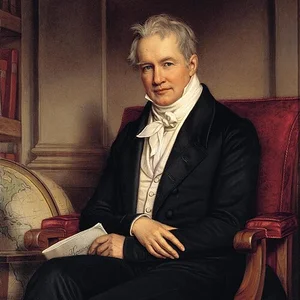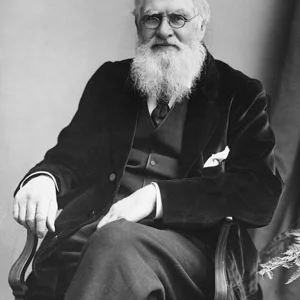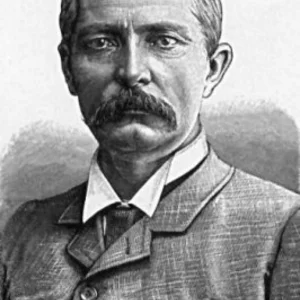

British journalist and explorer (1841–1904), famous for finding David Livingstone in central Africa in 1871. He led several major expeditions across Africa and played a significant role in the colonization of the Congo.
Henry Morton Stanley(1841 — 1904)
Henry Morton Stanley
Royaume-Uni de Grande-Bretagne et d'Irlande
8 min read
Frequently asked questions
Famous Quotes
« Dr. Livingstone, I presume?»
Key Facts
- 1871: finds David Livingstone at Ujiji, on the shores of Lake Tanganyika
- 1874–1877: crosses Africa from east to west, descending the Congo River
- 1879–1884: establishes stations in the Congo on behalf of Belgian King Leopold II
- 1887–1889: leads the Emin Pasha Relief Expedition to rescue the governor of Equatoria
- 1904: dies in London after being knighted by Queen Victoria
Works & Achievements
Account of the New York Herald's mission to find David Livingstone, who had disappeared in central Africa. A worldwide bestseller, the book made Stanley famous and launched his career as an explorer.
Record of his 1874–1877 expedition, during which he crossed Africa from east to west and descended the Congo River. This two-volume work revealed the geography of central Africa to the European public.
Account of his five years in the service of Leopold II, describing the stations established and treaties signed. The work justified Belgian colonization by presenting the European "civilizing mission."
Report on the Emin Pasha Relief Expedition (1887–1889), which took him through the Congolese equatorial rainforest. This narrative gave rise to the phrase "darkest Africa," later popularized by Joseph Conrad.
Memoirs covering his early years in America and his travels in Asia, before his great African explorations. A valuable work for understanding his formation as an individual and the shaping of his character.
Autobiography published after his death by his wife Dorothy. It reveals his concealed Welsh origins and presents his own version of his life, giving historians greater insight into the construction of his personal myth.
Anecdotes
Born John Rowlands in 1841 in Denbigh, Wales, an illegitimate child who was abandoned, Stanley was placed at the age of six in a grim workhouse. It was there that he developed an iron will and an ability to endure the harshest conditions — qualities that would serve him throughout his life on his African expeditions.
On November 10, 1871, after eight months of grueling travel through the forests and swamps of central Africa, Stanley found David Livingstone in the village of Ujiji, on the shores of Lake Tanganyika. According to his own account, he stepped forward and said simply: “Dr. Livingstone, I presume?” — a phrase that became one of the most famous in the history of exploration.
During his trans-African expedition from 1874 to 1877, Stanley descended the entire length of the Congo River — some 2,900 km — from Lake Victoria to the Atlantic. He lost more than half his men along the way, victims of disease, drowning, and clashes with local populations. His account transformed European perceptions of central Africa.
Between 1879 and 1884, Stanley was commissioned by Belgian King Leopold II to establish a European presence in the Congo basin. He signed more than 450 treaties with local chiefs who, for the most part, did not understand that they were ceding their lands. These agreements served as the legal foundation for the creation of the Congo Free State in 1885.
During the Emin Pasha Relief Expedition (1887–1889), Stanley crossed the equatorial rainforest of the Congo, nicknamed the “Forest of Darkness.” His men suffered from famine, dysentery, and attacks. The officer he was supposed to rescue, Emin Pasha, ultimately proved reluctant to be saved — an irony that the European press reported on at length.
Primary Sources
I pushed back the crowds, and, passing from the rear, walked down a living avenue of people, until I came in front of the semicircle of Arabs, in the front of which stood the white man with the grey beard. As I advanced slowly towards him I noticed he was pale, looked wearied, had a grey beard, wore a bluish cap with a faded gold band round it, had on a red-sleeved waistcoat, and a pair of grey tweed trousers.
We have attacked and destroyed 28 large towns and three or four score villages... We have had 32 battles... The natives have been very daring... We have been compelled to destroy towns and villages to keep them at a respectful distance.
I had gone to Africa resolved to submit tamely to no insult, prepared to resent every slight put upon me by the savage natives, and to crush with an iron hand any attempt at treachery or resistance.
The path wound through dense forest, where the sun had never penetrated. The soldiers, weakened by hunger, carried their rifles as if they were leaden weights. Each morning, fewer men answered to the roll call.
I have this day shaken hands with David Livingstone, the great traveller, and he is in better health than many suppose. He is not dying, as some have reported. He is in capital spirits.
Key Places
Birthplace of John Rowlands, the future Henry Morton Stanley. It was in this small Welsh town that he was born in 1841 into poverty, before being placed in a workhouse.
A trading port on the shores of Lake Tanganyika where Stanley found David Livingstone on November 10, 1871. This village has become a place of remembrance for African exploration and for the famous phrase “Dr. Livingstone, I presume?”
Stanley was the first European to navigate the entire Congo River from its source to the Atlantic (1877), and later established trading stations along it on behalf of Leopold II. For a time, it was given the European name “Stanley River” in his honor.
A station founded by Stanley in 1881 on the Congo River, named in honor of King Leopold II. It became the capital of the Congo Free State, and later the capital of what is today the DRC.
An island and port city in the Indian Ocean that served as the launching point for several of Stanley's expeditions into East Africa. It was here that he recruited his porters, guides, and soldiers.
Stanley's final home, where he spent his last years after being knighted. He died there in 1904 and was buried at Pirbright Cemetery in Surrey.
Typical Objects

A cork hat covered in khaki fabric, essential for protection against the tropical sun. Stanley wore one throughout his expeditions and helped turn it into the defining symbol of the European explorer in Africa.

An American repeating rifle that Stanley carried on his expeditions. He also armed his porters with rifles to deter attacks, and did not hesitate to use them during confrontations with local populations.

Essential navigation instruments for mapping the territories he crossed. Stanley used the sextant to determine his position by the stars and the compass to hold his bearing through dense forest where visual landmarks were scarce.

Stanley kept a meticulous logbook, recording each day's march, every incident, and every geographical observation. These notes formed the raw material for his many bestselling published accounts.

An antimalarial drug extracted from the bark of the cinchona tree, indispensable in tropical Africa. Stanley prescribed it daily to his men; malaria nonetheless remained the leading cause of death on his expeditions.

Currencies of exchange used with African populations to purchase food, negotiate passage, and sign treaties. Stanley carried hundreds of kilograms of these goods, transported by his porters.

During his 1874 expedition, Stanley brought along a steel canoe named Lady Alice, which broke down into five sections to be carried on men's backs. It enabled him to explore the great African lakes and navigate down the Congo River.
School Curriculum
Vocabulary & Tags
Key Vocabulary
Tags
Daily Life
Morning
On expedition, Stanley rose before dawn, inspected the men and their loads, then gave the signal to depart at first light. He marched at the head of the column with his officers, sextant in hand, carefully noting the directions and distances covered.
Afternoon
The afternoon was spent marching, broken by a midday halt for meals and tending to the sick. Stanley negotiated passage with local chiefs, purchased food with the beads and cloth he carried, and dictated his observations to his secretary.
Evening
In the evening, he set up camp in a defensible spot, had fires lit to keep wild animals at bay, then wrote up his journal by the light of an oil lamp. He recorded the day's events, the names of villages passed through, illnesses, and deaths.
Food
On expedition, Stanley ate whatever Africa provided: plantains, cassava, chicken, game shot along the way. When provisions ran low, the column pressed on empty-stomached. In towns, he returned to Victorian habits: strong tea in the morning, meat and bread when available.
Clothing
Stanley wore the standard kit of the Victorian explorer: a cork pith helmet, khaki canvas jacket and trousers, and tall leather boots. In photographs, he often sports a neat beard and a determined gaze that became his trademark image in the illustrated press.
Housing
In Africa, Stanley slept in a tent or in huts built by his porters. In London, he lived in comfortable middle-class houses, frequented gentlemen's clubs such as the Travellers' Club, and received journalists, geographers, and political figures.
Historical Timeline
Period Vocabulary
Liens externes & ressources
Références
Œuvres
How I Found Livingstone
1872
Through the Dark Continent
1878
The Congo and the Founding of its Free State
1885
In Darkest Africa
1890
My Early Travels and Adventures in America and Asia
1895
The Autobiography of Sir Henry Morton Stanley
1909 (posthume)