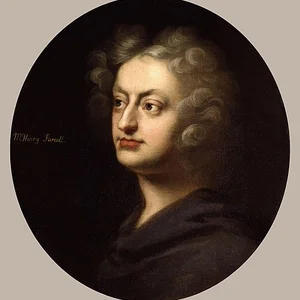

Henry Purcell was an English composer and organist of the Baroque era. Considered one of the greatest British composers, he left his mark on the music of the Stuart court and composed the opera Dido and Aeneas.
Henry Purcell(1659 — 1695)
Henry Purcell
royaume d'Angleterre
6 min read
Frequently asked questions
Key Facts
- Born in 1659 in London, died prematurely in 1695 at the age of 36
- Appointed organist of Westminster Abbey in 1679
- Became composer to the royal court and organist of the Chapel Royal in 1682
- Composed the opera Dido and Aeneas around 1689, including the famous Dido's Lament
- Author of numerous incidental scores (King Arthur, The Fairy Queen) and royal odes
Works & Achievements
Purcell's only true opera, a concentrated masterpiece whose closing Lament of Dido is famous the world over.
A semi-opera on a libretto by John Dryden, blending spoken theatre and music, containing the famous ‘Frost Scene’.
A semi-opera after Shakespeare’s ‘A Midsummer Night’s Dream’, one of his most ambitious stage scores.
Solemn funeral music composed for the obsequies of Mary II, performed again at Purcell’s own death later that same year.
A grand ode to the patron saint of musicians, celebrating the power of music.
A sacred work with trumpets for St Cecilia’s feast day, long performed at English ceremonies.
Refined instrumental pieces extending the great English tradition of the viol consort.
Anecdotes
Henry Purcell joined the choir of the Chapel Royal as a young boy chorister. When his voice broke around 1673, he left the choir but stayed at court as an organ tuner and copyist, keeping a foot in royal music while he waited to become a composer.
At only about 20 years old, in 1679, Purcell succeeded his teacher John Blow as organist of Westminster Abbey. In a rare gesture, Blow willingly handed over the post to him, a sign that he recognised the exceptional talent of his former pupil.
His only true opera, Dido and Aeneas, was probably first staged at a boarding school for young ladies in Chelsea run by Josias Priest, around 1689. The famous “Dido's Lament”, “When I am laid in earth”, built over a descending ground bass, remains one of the most moving arias in Baroque music.
Purcell composed the music for the funeral of Queen Mary II in 1695. A few months later, at his own death the same year, that same funeral music was played again for him, and he was buried with honours in Westminster Abbey, near the organ he had once played.
Purcell died on 21 November 1695, at only 36 years old. Legend has it that he caught a chill coming home late from the theatre to find the door locked by his wife, but others suggest tuberculosis; his early death deprived England of its greatest Baroque composer.
Primary Sources
When I am laid, am laid in earth, may my wrongs create no trouble, no trouble in thy breast. Remember me, but ah! forget my fate.
Here lyes Henry Purcell Esq., who left this life and is gone to that blessed place where only his harmony can be exceeded.
Music and Poetry have ever been acknowledg'd Sisters, which walking hand in hand, support each other.
Key Places
District where Purcell was born, lived and worked his entire life. The heart of English royal and religious power.
Church where Purcell served as organist from 1679 and where he was buried in 1695, near the organ.
Home of the sacred music of the Stuart court, where Purcell served as organist and composer from 1682.
District that was home to Josias Priest's boarding school, the likely setting for the premiere of Dido and Aeneas.
London theatre where several of Purcell's semi-operas premiered, such as King Arthur and The Fairy-Queen.
Typical Objects

Large church organ whose keyboards Purcell played as principal organist. A central instrument of English sacred music of the period.

A keyboard instrument whose strings are plucked, very widespread in Baroque chamber and court music. Purcell composed many suites for harpsichord.

A bowed string instrument held between the legs, prized for fantasias and English ensemble music. Purcell wrote fantasias for a consort of viols.

Sheets of music written by hand with a quill, as Purcell also worked as a copyist. Printed music engraving was developing in his time.

Writing tools used to compose and copy music on staff-ruled paper. Indispensable to the composer's daily work.

A valveless trumpet, bright and festive, used in odes and court music. Purcell employs it in his pieces for royal celebrations.
School Curriculum
Vocabulary & Tags
Key Vocabulary
Tags
Daily Life
Morning
Purcell often began his day with his duties as an organist: rehearsals with the choristers and preparation for services at Westminster Abbey or the Chapel Royal. Sacred music set the rhythm of the early hours.
Afternoon
The afternoon was devoted to composition: with a quill on ruled paper, he wrote odes for the court, incidental music for the stage, and songs. He also copied scores and corrected those intended for print.
Evening
In the evening, Purcell frequented the London theatres where his semi-operas and incidental music were performed. He also took part in private musical gatherings and in the lively scene of the taverns where musicians met.
Food
The diet of a well-off Londoner in the late 17th century included bread, roasted meats, fish, pies, and cheeses. People drank a great deal of beer (ale) and wine, and the new fashion for coffee was spreading through the coffee-houses.
Clothing
Purcell wore the dress of a Restoration gentleman: a long coat, waistcoat, breeches, a ruffled shirt, and stockings. The long, curled wig, in the French fashion, was a must for a man of the court.
Housing
He lived in the Westminster district, close to his place of work, in a typical London brick town house rebuilt after the Great Fire of 1666. The home also served as a workplace and a place of teaching.