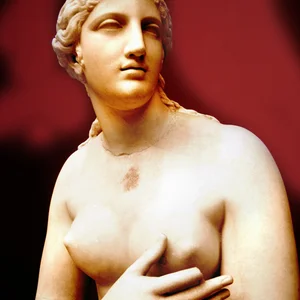

Hera is the queen of the gods and goddess of marriage in ancient Greek mythology. Wife of Zeus, she is venerated as the protector of marriage and family. Her legends reflect the values and conflicts of the Greek pantheon.
Hera
Hera
8 min read
Frequently asked questions
Key Facts
- Hera is the daughter of the Titans Cronus and Rhea, and one of the twelve Olympians of the Greek pantheon
- She is the wife of Zeus, king of the gods, according to the Homeric myths (8th century BCE)
- She is the patron goddess of marriage, the conjugal bond, and motherhood in Greek religious practice
- Her iconographic attributes include the peacock, the diadem, and the royal scepter
- Her cult was widely practiced in ancient Greece, with major sanctuaries such as the Heraion of Argos
Works & Achievements
Hera is the tutelary goddess of lawful marriage and the family institution in Greek mythology. She watches over unions and married women, establishing the social norms surrounding marriage in ancient society.
The most important sanctuary dedicated to Hera, located at Argos, which became a major religious center of ancient Greece. This temple symbolizes the significance of the Heran cult in Greek religious and political life.
The myths recounting Hera's jealousy toward Zeus's mistresses and illegitimate children, most notably her persecution of Heracles and Io. These legends reflect marital tensions and the power dynamics among the gods of the Greek pantheon.
Hera plays a central role as the antagonist in this epic legend, imposing the impossible labors on Heracles as punishment for his very existence. This series of heroic feats is directly bound to her desire for vengeance.
Hera sets the hundred-eyed giant Argus as a guardian over Io, symbolizing conjugal vigilance. After his death, she places his eyes upon the feathers of the peacock, her sacred animal, creating an enduring symbol of watchfulness.
Annual festivals and ritual ceremonies were held in her honor, most notably the Heraia. These celebrations reinforced the cultural and religious importance of Hera across the Greek city-states.
Hera and Zeus embody the sacred marriage in Greek religious ritual, serving as the divine model for human matrimony. This mythological union legitimizes and consecrates the institution of marriage in ancient Greek society.
Anecdotes
Hera had a sacred peacock in Greek mythology. According to ancient texts, she placed the hundred eyes of Argus on the peacock's feathers to keep watch. This is why the peacock became her emblematic animal, often depicted in temples and Greek works of art.
The cult of Hera was particularly important in Argos, her sacred city. A great temple dedicated to the goddess was built there in the 6th century BCE, where famous religious festivals known as the Heraia were held. These celebrations drew pilgrims from across Greece to honor the queen of the gods.
Hera is famously known in legend for her jealousy over Zeus's many romantic conquests. The myths recount how she persecuted several heroines, such as Io and Leda, whom Zeus had seduced. These stories reflect marital tensions and illustrated Greek values around marriage and fidelity.
One major mythological event placed Hera at the heart of a divine conflict: the Trojan War. She supported the Greeks against Troy because the Trojan Paris had chosen Aphrodite over her during the Judgment of the Three Goddesses. This legend shows the religious significance of Hera in understanding the great legendary events of antiquity.
Hera was honored under several sacred epithets in ancient Greek worship, most notably Hera Gamelia (protector of marriage). Greek newlyweds would invoke her name and bring offerings to her temples to seek her blessing upon their union and to hope for a happy lineage.
Primary Sources
White-armed Hera, queen of the gods, the majestic wife of Zeus, grew angry watching Achilles fight the Trojans. She sent Athena down from the heavens to support the Greek hero.
Zeus secretly united with Hera, the venerable goddess, and she bore Hebe, Ares, and Eileithyia. Hera also bore Hephaestus alone, without union with a male, in her anger against Zeus.
Hera, jealous of her husband Zeus's love affairs, relentlessly pursued his rivals. She tormented Io and Callisto, demonstrating the power and vengeful nature of the queen of the gods.
I sing of golden-throned Hera, whom Zeus bore, venerable queen, surpassing all the gods in beauty, glorious wife of the thundering king.
The Temple of Hera at Argos, one of the oldest sanctuaries in Greece, housed a chryselephantine statue of the goddess wearing a royal crown, a symbol of her authority over the pantheon.
Key Places
A major city of the Peloponnese where Hera was the object of a particularly important cult. The Heraion of Argos, a sanctuary dedicated to the goddess, was one of the most significant Greek temples in her honor.
A place traditionally associated with the birth of Hera according to some versions of the myth. Samos possessed a famous Heraion where the goddess was particularly venerated.
The mythical home of all the Greek gods, including Hera, who reigns there as queen alongside Zeus. This peak is the center of the Greek pantheon in mythological accounts.
Several Greek cities bore this name in reference to Hera and Heracles, her stepson. These cities bear witness to the importance of the Heraean cult throughout the ancient Greek world.
A city central to the legends of Hera, most notably the myth of Heracles. Hera regularly intervenes in the conflicts and fates of Theban heroes, particularly in pursuit of her vengeance against the illegitimate sons of Zeus.
Typical Objects

Hera's sacred animal, a symbol of beauty and royal dignity. The peacock was the goddess's emblematic creature and appears frequently in ancient iconography associated with her cult.

An emblem of power worn by Hera as queen of the gods. This ornate crown symbolizes her supreme authority over the Greek pantheon and her preeminent divine rank.

A symbol of power and divine authority held by Hera. The scepter represents her sovereignty and her role as queen goddess of the Olympian pantheon.

A mythic fruit associated with Hera and the Garden of the Hesperides, which she guarded. The golden apple symbolizes immortality, divine wealth, and the wonders of the ancient world.

An emblematic accessory of ancient marriage, directly linked to Hera as protector of matrimony. The veil represents her domain of guardianship over marital unions and conjugal life.

Vessels of everyday Greek life decorated with mythological scenes featuring Hera. These vases were used for storing and serving drinks at banquets, reflecting the importance of domestic worship.

A ritual fruit associated with Hera and Greek marriage cults. The pomegranate symbolized fertility, fecundity, and abundance in the context of marriage and family life.

A major religious structure dedicated to Hera in several Greek city-states, most notably the Heraion at Argos. These monumental temples illustrated the importance of civic worship of the queen goddess.
School Curriculum
Vocabulary & Tags
Key Vocabulary
Tags
Mythologie
Daily Life
Morning
Hera awakens in her palace on Mount Olympus, where she presides over the affairs of marriage and family. She dons her divine ornaments and receives the homage of the minor goddesses who attend her. She reviews the matters of mortals who invoke her protection over their unions.
Afternoon
The goddess presides over the rituals and ceremonies of marriage in the mortal world, overseeing the bonds between husbands and wives. She intervenes in marital disputes and acts of betrayal — most notably those of Zeus, which keeps her considerably occupied. She confers with the other Olympian deities on matters of religion and divine politics.
Evening
Hera takes part in the divine banquets on Olympus, where the gods gather together. She holds the seat of honor as queen of the gods. The evening concludes with libations and songs in honor of the Olympian pantheon.
Food
Like all Greek gods, Hera sustains herself on ambrosia and nectar, the food and drink of immortality. At banquets, she partakes of the meat from sacrifices offered by mortals — particularly beef and peacock, her sacred animal. Mortals also dedicate libations of wine mixed with water in her honor.
Clothing
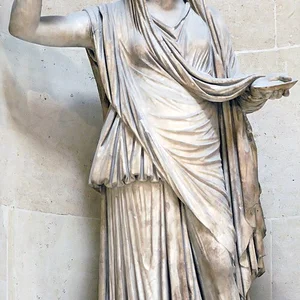
Hera wears a long, nobly draped tunic, often white or golden in color. She is crowned with a royal diadem (the stephane) and adorned with magnificent divine jewelry. She is frequently depicted with the peacock and a royal scepter, symbols of her authority.
Housing
Hera resides in the divine palace of Mount Olympus, built in the ether beyond the reach of mortals. Her dwelling is of white marble and gold, adorned with lavish chambers and paradisiacal gardens. There she hosts the divine assemblies and presides over the decisions of the pantheon.
Historical Timeline
Period Vocabulary
Visual Style
Un style artistique puisant dans l'esthétique grecque antique, combinant la majesté des sculptures classiques avec l'élégance ornementale des vases peints. Une atmosphère dorée et solennelle, reflétant le rang divin et l'autorité mariale d'Héra, enrichie par des motifs géométriques et des symboles sacrés caractéristiques de l'Antiquité grecque.
Sound Ambience
Une ambiance sonore majestueuse et sacrée mêlant le son des temples grecs antiques, avec des instruments traditionnels comme la lyre et l'aulos, des voix féminines éthérées et les échos lointains de la puissance divine de Zeus.
Liens externes & ressources
Références
Œuvres
Protectorat du mariage et de la famille
Culte attesté du VIIIe siècle av. J.-C.
Héraion d'Argos (temple principal)
VIIe-Ve siècle av. J.-C.
Cycle des légendes de jalousie conjugale
Récits mythologiques transmis oralement et par écrit
Les Douze Travaux d'Héraclès (antagoniste)
Mythes classiques, Ve-IVe siècle av. J.-C.
Mythe du Paon et des cent yeux d'Argos
Mythes classiques
Culte et fêtes religieuses (Héra)
VIIIe-IVe siècle av. J.-C.
Symbolisme du mariage sacré (hiérogamie)
Pratique religieuse antique