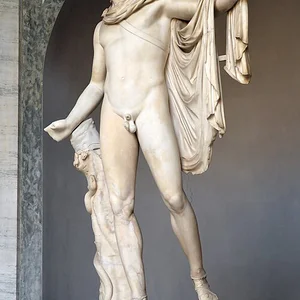

Heracles is a hero of Greek mythology, son of the god Zeus and the mortal Alcmene. Famous for completing the twelve labors imposed by the goddess Hera, he embodies strength, courage, and perseverance. His story, passed down by Greek poets, has influenced Western literature and art for millennia.
Hercules
Heracles
Thèbes
8 min read
Frequently asked questions
Key Facts
- Son of Zeus and Alcmene, he faces the wrath of the goddess Hera from the moment of his birth
- Completion of the twelve labors: the Nemean Lion, the Lernaean Hydra, the Golden-Horned Deer, the Erymanthian Boar, the Augean Stables, the Stymphalian Birds, the Cretan Bull, the Mares of Diomedes, the Belt of Hippolyta, the Apples of the Hesperides, the capture of Cerberus, and other feats
- Death on the funeral pyre of Mount Oeta and apotheosis (transformation into a god)
- Widespread cult in ancient Greece, symbol of the Olympic Games and physical excellence
- His legend transmitted by ancient poets: Hesiod, Homer, Sophocles, Euripides
Works & Achievements
A series of twelve superhuman tasks imposed by Hera as penance for his crimes, including the capture of the Nemean Lion, the Lernaean Hydra, and the theft of the golden apples of the Hesperides. These labors form the major mythological cycle demonstrating the hero's strength and perseverance.
The first labor, in which Heracles defeats a lion invulnerable to conventional weapons. He strangles it with his bare hands, establishing his superhuman strength and winning the lion's skin as his emblem.
The second labor, in which Heracles faces a multi-headed monster whose heads regenerate when cut off. He triumphs by using fire to cauterize the wounds, symbolizing cunning as the complement to brute strength.
Heracles is numbered among the most prestigious Greek heroes who sailed with Jason aboard the Argo in quest of the Golden Fleece, a testament to his standing as the supreme warrior.
Heracles is credited with establishing the Olympic Games in honor of Zeus, founding a sacred tradition that endured throughout ancient Greek civilization and lives on to this day.
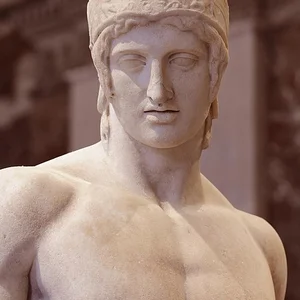
Heracles defeats the god of war in single combat during certain of his trials, demonstrating that physical strength and intelligence can surpass even divine power.
The twelfth and final labor, in which Heracles descends into the Underworld to capture Cerberus alive — the three-headed dog guarding the gates of the realm of the dead — and bring him back to the surface.
Anecdotes
The Twelve Labors of Heracles form the heart of the legend: condemned to perform impossible tasks in atonement for the murder of his family, the hero must capture the Golden-Horned Hind, slay the Nemean Lion, and complete nine other perilous feats. These labors, recounted in detail by the poet Hesiod in his Theogony, symbolize the triumph of willpower and ingenuity over insurmountable obstacles.
Heracles faced the Lernaean Hydra, a many-headed monster whose heads would grow back each time they were cut off. To defeat this creature, he had to use fire to cauterize each wound — a trial that became an emblem of courage and resourcefulness. This battle, depicted on countless Greek vase paintings, illustrates how brute strength alone is never enough: strategy is just as essential.
The cult of Heracles was widespread throughout ancient Greece and beyond: the Greeks regarded him as a protective deity of travelers and athletes, which explains his association with the Olympic Games. The Romans venerated him under the name Hercules and incorporated his cult into their own religion, a testament to the lasting influence of this mythological figure across multiple civilizations.
According to Greek mythology as transmitted by Homer and Apollodorus, Heracles was the son of the god Zeus and the mortal Alcmene, making him a demigod destined for extraordinary greatness. The jealousy of Hera, Zeus's wife, pursued Heracles throughout his life — explaining why she imposed the Twelve Labors upon him and, in some versions of the myth, drove him to madness as an infant.
After his death, Heracles was granted divine honors and deified, ascending to Mount Olympus according to several ancient sources. This rise from mortal hero to god captivated Greek and Roman writers alike, and inspired the idea that courage and virtue could elevate a man to the ranks of the immortals.
Primary Sources
Heracles, son of Zeus and Alcmene, accomplished his labors with superhuman strength. The goddess Hera, jealous of this illegitimate child, imposed twelve impossible tasks upon him to bring about his ruin, but his valor and perseverance allowed him to triumph.
Hercules, whose strength was unrivaled, had to face the Nemean Lion with its invulnerable claws, the Lernaean Hydra whose multiple heads grew back with every blow, and many other fearsome creatures.
Heracles completed his twelve labors: he slew the Nemean Lion, destroyed the Lernaean Hydra, captured the Ceryneian Hind and the Erymanthian Boar, accomplishing each task with remarkable strength and cunning.
Heracles stands as the model of the ancient hero who, through his courage and determination in the face of the most grueling trials, wins immortality and becomes the archetypal figure of virtue and strength.
Key Places
A city in Boeotia in central Greece where Heracles was born, son of Zeus and Alcmene. It was here that he performed his first great feats by slaying the lion of Cithaeron.
A region of the Peloponnese where Heracles faced the Nemean Lion, the first of his twelve labors. This lion with invulnerable claws became the hero's emblem.
A swamp in the Peloponnese where Heracles battled the Lernaean Hydra, a multi-headed monster whose heads would regenerate when cut off. This was the second of his twelve labors.
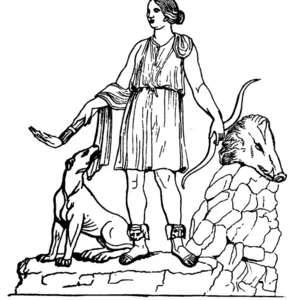
A mountain in the Peloponnese where Heracles had to capture the Erymanthian Boar as his fourth labor. This region symbolizes the seemingly impossible challenges overcome by the hero.
A citadel in the Peloponnese where King Eurystheus commanded Heracles to perform the twelve labors. This place represents the authority that imposed these trials upon the hero.
The home of the gods on Mount Olympus, where Heracles was finally apotheosized and welcomed among the gods after his death on the funeral pyre. It represents the ultimate glorification of the legendary hero.
Typical Objects

A massive weapon made of hard wood, emblematic of Heracles. It represents his raw strength and is the instrument with which he defeated many adversaries, most notably the Nemean Lion.

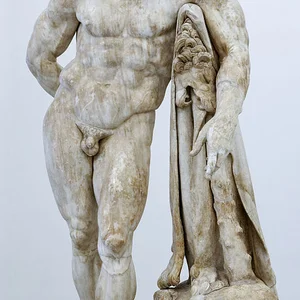
The hide from Heracles' first labor, worn as armor and a badge of glory. This garment became his most distinctive attribute, symbolizing his victories and superhuman power.

Weapons used by Heracles during several of his labors, notably to defeat the Stymphalian Birds. They demonstrate the range of his combat skills.

A typical vessel of ancient Greece, symbolizing feasting and daily life in the classical world. Amphorae were used to store wine and oil, both essential to Greek civilization.

A symbol of the servitude and bondage imposed on Heracles by King Eurystheus. They represent his ordeal and the need for redemption through labor and the completion of the Twelve Labors.

A musical instrument symbolic of ancient Greek culture and civilization. It represents harmony, poetry, and the arts — domains where Heracles also showed refinement despite his raw strength.

Military equipment characteristic of ancient Greece. It symbolizes the Greek warrior and hero, protecting Heracles throughout his many mythological battles.

The object at the center of Heracles' ninth labor — the magical belt of the queen of the Amazons. It symbolizes a particularly challenging achievement and represents access to legendary treasures.
School Curriculum
Vocabulary & Tags
Key Vocabulary
Daily Life
Morning
Heracles begins his day with an intense physical training session, honing his legendary strength through wrestling drills and weapons practice. He then purifies himself with cold water — a common ritual among Greek warriors — before eating a light meal to prepare for his labors or heroic adventures.
Afternoon
His afternoons are devoted to completing the twelve labors imposed upon him: hunting, battling monstrous creatures, or carrying out quests for King Eurystheus. These tasks consume most of his time, reflecting his role as a civilizing hero who fights the threats endangering humanity.
Evening
In the evening, Heracles shares a meal with his companions or withdraws to a place of rest. He is often depicted at a banquet, conversing with fellow heroes, or winding down the night by reviewing his past feats and planning his strategies for the challenges ahead.
Food
Heracles follows a high-protein diet, favoring meat — game and sacrificial animals — alongside barley bread, fruit, and wine diluted with water, typical of Greek warriors. His appetite is exceptionally large, in keeping with the legends that describe him eating enough for ten men.
Clothing
He wears the classic attire of the Greek hero: a short tunic (chiton), or he is often bare-chested, displaying his impressive muscular build. He is instantly recognizable by his wooden club — made from a hazel tree — and the Nemean lion's skin worn as a cloak, both symbols of his victories.
Housing
Heracles lives largely as a wanderer, traveling across Greece and its outlying regions to complete his labors. When he stops to rest, he is welcomed into royal palaces or sanctuaries, enjoying the aristocratic hospitality reserved for heroes of the highest standing.
Historical Timeline
Period Vocabulary
Visual Style
Un style visuel inspiré de l'art grec antique, mêlant la technique des poteries grecques (figures noires et rouges) à la sculpture hellénistique, avec un éclairage dramatique qui met en valeur la force et la noblesse du héros. Les tons terracotta, ocre et rouge-brun dominent, évoquant l'Antiquité méditerranéenne.
Sound Ambience
Une ambiance sonore épique et immersive mêlant les sons de l'Antiquité grecque (bruits de temple en marbre, armures de bronze), les cris des créatures mythologiques, les instruments de musique antiques (lyre, aulos) et les grondements divins, évoquant la grandeur et la lutte surhumaine du héros Héraclès.
Liens externes & ressources
Références
Œuvres
Les Douze Travaux d'Héraclès
Période légendaire (Antiquité grecque)
Victoire sur le Lion de Némée
Période légendaire
Victoire sur l'Hydre de Lerne
Période légendaire
Participation à l'expédition des Argonautes
Période légendaire
Fondation de jeux et traditions athlétiques
Période légendaire
Victoire contre Ares
Période légendaire
Capture de Cerbère
Période légendaire