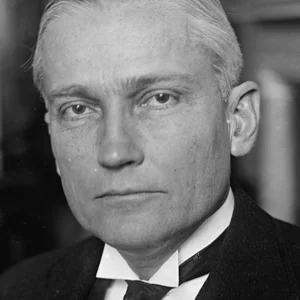

American explorer and politician (1875–1956), he rediscovered the Inca site of Machu Picchu in 1911, perched in the Peruvian Andes. A professor at Yale, he helped bring this lost city to the attention of the entire world.
Hiram Bingham(1875 — 1956)
Hiram Bingham
États-Unis
8 min read
Frequently asked questions
Key Facts
- 1875: born in Honolulu, Hawaii
- 1911: rediscovery of Machu Picchu during an expedition to Peru
- 1912–1915: archaeological excavations at Machu Picchu funded by the National Geographic Society
- 1924–1933: Republican senator from Connecticut
- 1956: died in Washington, D.C.
Works & Achievements
Bingham's first book on his South American travels, published the very year he discovered Machu Picchu. It recounts his journey retracing Simón Bolívar's footsteps and lays the groundwork for his passion for Andean archaeology.
A vivid and accessible account of his expeditions to Peru between 1911 and 1915. Bingham describes his adventures in the Andes, his encounters with Quechua communities, and his major archaeological discoveries.
A comprehensive scientific report published jointly by Yale University Press and the National Geographic Society. This reference work compiles twenty years of research, excavations, and architectural analysis of the site.
A popular work aimed at a general audience that achieved remarkable success. Bingham skillfully tells the story of his discovery and the Inca civilization, helping to turn Machu Picchu into a universal legend.
Three scientific expeditions funded by Yale and the National Geographic Society, during which Bingham mapped hundreds of kilometers of Andean terrain, discovered Machu Picchu, Vitcos, and Espíritu Pampa, and collected thousands of Inca artifacts.
Anecdotes
On July 24, 1911, Hiram Bingham was guided to Machu Picchu by a local farmer, Melchor Arteaga, and his young son of about ten years old, nicknamed Pablito. Arriving at the vegetation-covered site, he discovered that a few Quechua families already lived there and farmed the terraces. The ruins were therefore not forgotten by everyone — they were an inhabited place, simply unknown to the Western scientific world.
To fund his expeditions, Bingham secured the support of Yale University and the National Geographic Society. In return, the magazine devoted its entire April 1913 issue to his discoveries — a first in its history — featuring spectacular photographs of the site. This publishing milestone transformed Machu Picchu into a worldwide sensation overnight.
During his expeditions, Bingham shipped thousands of bones, ceramics, and Inca artifacts to Yale, with the authorization of the Peruvian government at the time. A century later, in 2012, after decades of diplomatic negotiations, Yale finally returned these 40,000 artifacts to Peru, where they are now on display in a museum in Cusco.
During the First World War, Bingham enlisted as a flight instructor for the U.S. Army, then traveled to France to train aviators. The experience captivated him: back in the United States, he became one of the pioneers of civil aviation and chaired the aeronautics committee of the U.S. Senate.
Bingham is regularly cited as one of the main inspirations for the Indiana Jones character: a university professor by day, an explorer in a wide-brimmed hat in exotic settings the rest of the time. While the filmmakers drew on several real-life figures, Bingham perfectly embodies the adventurer-scholar archetype that so fascinated the twentieth century.
Primary Sources
Suddenly I found myself confronted with the walls of ruined houses built of the finest quality of Inca stone work. It was hard to see them for they were partly covered with trees and moss, but in the dense shadow appeared here and there walls of white granite ashlars carefully cut and exquisitely fitted together.
We were not more surprised at the extent and character of the ruins than we were at the exquisite beauty of the location. The deep valley below us was a maze of tropical jungle. Above rose peak after peak, ridge after ridge, to the snow-capped summit of Mount Salcantay.
The site appears to have been both a royal estate and a religious retreat, occupied by a small group of priests, chosen women, and attendants who served the Inca emperor. Its inaccessibility was part of its charm and security.
Although I had visited more than a dozen ancient Inca sites, Machu Picchu far exceeded them all in beauty and interest. The stonework was of the finest, the setting unparalleled in grandeur, and the remains of the terraced gardens gave evidence of a past prosperity.
Key Places
An Inca city perched at 2,430 meters above sea level in the Andes, which Bingham rediscovered on July 24, 1911. He called it 'the lost city of the Incas' and turned it into the defining symbol of twentieth-century archaeology.
The birthplace of Hiram Bingham III in 1875, born into a family of Protestant missionaries. His roots on these Pacific islands predisposed him to a life of travel far from the American mainland.
Home to Yale University, where Bingham taught Latin American history and organized his scientific expeditions. The Inca artifacts he brought back were held in the university's collections for nearly a century.
The ancient capital of the Inca Empire and the logistical base for Bingham's expeditions in Peru. It was from Cusco that he set out to explore the Urubamba Valley and ultimately discovered Machu Picchu.
The U.S. federal capital, where Bingham served as a Republican senator from Connecticut from 1924 to 1933, championing the development of civil aviation. He died there in 1956.
Typical Objects

Bingham brought a Kodak panoramic camera on his expeditions to meticulously document the ruins and Andean landscapes. His photographs, published in National Geographic, revealed Machu Picchu to the world.

These essential navigation instruments allowed Bingham to accurately map Andean peaks and valleys. He measured the exact altitude of Machu Picchu, establishing the first scientific data on the site.

Indispensable for pushing through the dense jungle covering Machu Picchu's terraces, the machete allowed the team to clear Inca stone walls buried beneath tropical vegetation.

Bingham recorded detailed descriptions, architectural sketches, and ethnographic observations in his notebooks. These notes formed the basis of his later scientific publications.

The primary means of transport in the Andes, mules allowed the expedition to carry supplies, scientific equipment, and artifacts along steep paths inaccessible to motorized vehicles.

Bingham collected thousands of artifacts — ceramics, tools, bones — during his excavations. These objects, shipped to Yale, became the subject of a lengthy diplomatic controversy and were finally repatriated to Peru in 2012.

During extended stays on site, Bingham and his team camped in lightweight tents, braving cold high-altitude nights and the frequent tropical rains of the *selva alta* region.
School Curriculum
Vocabulary & Tags
Key Vocabulary
Tags
Daily Life
Morning
During his expeditions in the Andes, Bingham rises before dawn, around 5 in the morning. He eats a frugal breakfast — dry biscuits, coffee, or coca-leaf tea — before checking the photographic equipment and surveying instruments. The team sets out early to take advantage of the morning light and avoid the tropical afternoon rains.
Afternoon
The afternoon is devoted to excavations, mapping, and photographing archaeological structures. Bingham directs his team of local Quechua laborers as they clear terraces and buildings buried beneath the vegetation. He methodically measures, notes, sketches, and photographs each discovery.
Evening
In the evenings at camp, Bingham writes up his field notebooks by lantern light, recording the day's measurements, observations, and finds. He exchanges ideas with his expedition colleagues — botanists, geologists, physicians — and plans the next day's work by consulting his still-incomplete maps of the Andes.
Food
During expeditions, the food is simple and suited to the demands of altitude and jungle: rice, beans, corn, local potatoes, dried meat (*charqui*), and occasionally game. Bingham readily adapts to Andean cuisine and chews coca leaves alongside the local guides to combat altitude sickness.
Clothing
On his explorations, Bingham wears practical explorer's attire: a wide-brimmed hat to shield against sun and rain, a sturdy canvas shirt, military-cut trousers, leather gaiters, and boots suited to rugged terrain. In Yale's faculty rooms or the U.S. Senate, he dons a three-piece suit and tie, reflecting his dual role as academic and politician.
Housing
During his expeditions in Peru, Bingham sleeps in a lightweight military tent or in the basic guesthouses of Andean villages. In New Haven, he lives in a comfortable townhouse close to the Yale campus. As a senator, he keeps an apartment in Washington, D.C., dividing his time between the federal capital and his family home in Connecticut.
Historical Timeline
Period Vocabulary
Liens externes & ressources
Références
Œuvres
Across South America
1911
Inca Land: Explorations in the Highlands of Peru
1922
Machu Picchu: A Citadel of the Incas
1930
Lost City of the Incas
1948
Yale Peruvian Expeditions (trois campagnes)
1911, 1912, 1914-1915