 flip
flipKakesoba — Buckwheat Noodles in Broth, Edo-style
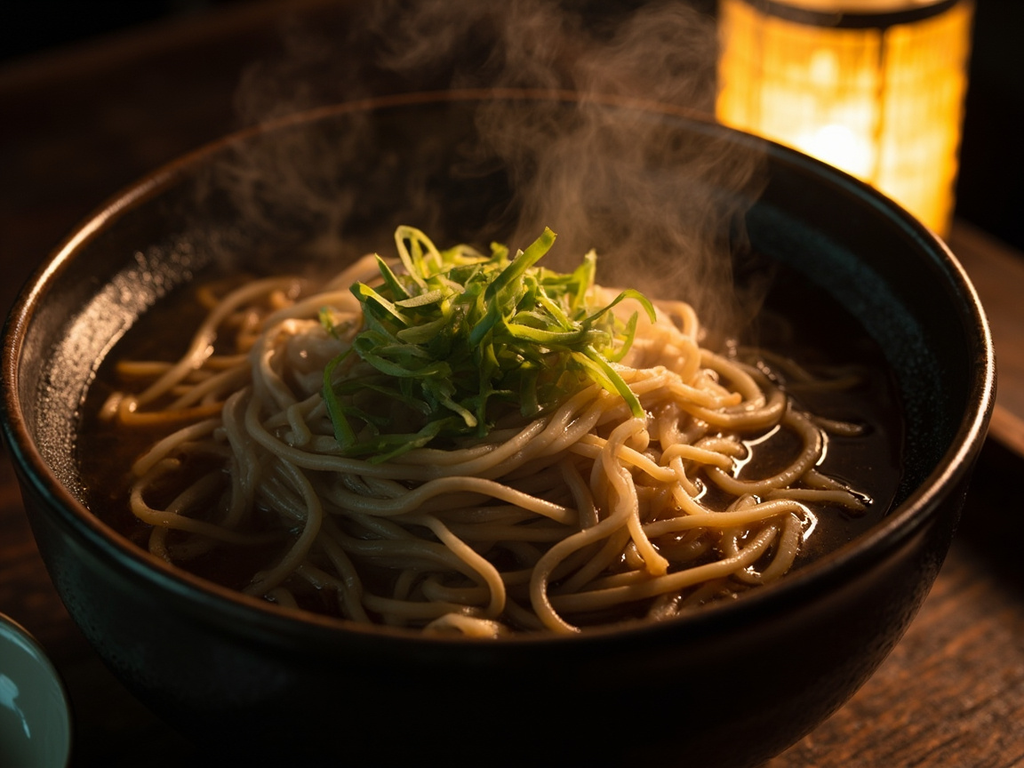
Kakesoba — Buckwheat Noodles in Broth, Edo-style
Why this dish? Edo was the city of soba: hundreds of street stalls sold it at all hours, especially in the evening. Hokusai, who moved nearly a hundred times through the alleys of Edo and worked tirelessly, was surely one of those passersby who grabbed a steaming bowl on a street corner without lingering.
Buckwheat noodles served in a dark dashi broth seasoned with soy sauce and mirin, sprinkled with scallion. The quintessential street food of the great city of Edo: quick, hot, savory.
The smell of soba broth at the corner of a Honjo alley — that could tear me away from my paper for the time it takes to eat a bowl. You slurp them loudly — that's how you truly taste them, and too bad for the delicate. A pinch of seven-spice powder on top, the broth warming your winter-chilled fingers, and off you go. I never asked more of a meal: that it be hot and that it quickly return me to my work.
- •Buckwheat noodles (soba) — one portion per bowl (base of the dish)
- •Katsuobushi dashi — one large bowl (broth)
- •Soy sauce (shoyu) — a dash (salty seasoning)
- •Mirin — a drizzle (sweetness and depth)
- •Edo scallion — sliced (garnish)
- •Shichimi togarashi (seven spices of Edo) — a pinch (spicy kick)
Kakesoba — Buckwheat Noodles in Broth, Edo-style
Buckwheat noodles served in a dark dashi broth seasoned with soy sauce and mirin, sprinkled with scallion. The quintessential street food of the great city of Edo: quick, hot, savory.
Why this dish? Edo was the city of soba: hundreds of street stalls sold it at all hours, especially in the evening. Hokusai, who moved nearly a hundred times through the alleys of Edo and worked tirelessly, was surely one of those passersby who grabbed a steaming bowl on a street corner without lingering.
The smell of soba broth at the corner of a Honjo alley — that could tear me away from my paper for the time it takes to eat a bowl. You slurp them loudly — that's how you truly taste them, and too bad for the delicate. A pinch of seven-spice powder on top, the broth warming your winter-chilled fingers, and off you go. I never asked more of a meal: that it be hot and that it quickly return me to my work.
Ingredients (period version)
- Buckwheat noodles (soba) — one portion per bowl (base of the dish)
- Katsuobushi dashi — one large bowl (broth)
- Soy sauce (shoyu) — a dash (salty seasoning)
- Mirin — a drizzle (sweetness and depth)
- Edo scallion — sliced (garnish)
- Shichimi togarashi (seven spices of Edo) — a pinch (spicy kick)
Ingredients
- Dried soba noodles — 200 g (2 portions) (base)
- Dashi — 800 ml (broth)
- Soy sauce — 4 tbsp (seasoning)
- Mirin — 3 tbsp (sweetness)
- Scallion / green onion — 2 stalks, sliced (garnish)
- Shichimi togarashi — to taste (table spice)
Method
- Prepare a dashi (see miso soup) or reheat some.
- Combine the dashi with soy sauce and mirin, bring to a simmer: this is kakejiru, the noodle broth.
- Cook the soba noodles in a large pot of unsalted boiling water according to the package time, then rinse briefly under cold water to remove excess starch.
- Plunge the noodles back into hot water for 10 seconds to reheat, then divide into bowls.
- Pour the steaming broth over the noodles, garnish with scallion. Serve immediately, with shichimi togarashi on the side.
How it was made : Shichimi togarashi, a blend of seven spices born in Edo around 1625, already accompanied soba in Hokusai's time. Street vendors (yatai) carried their kitchens on their shoulders using a balance pole and served standing up in the street — the direct ancestor of fast food.
The contemporary twist : Slurp the noodles loudly, as in Edo: the slurp is not a table faux pas, it's the authentic way to release all the aroma.
Sources : Katarzyna J. Cwiertka, Modern Japanese Cuisine: Food, Power and National Identity, Reaktion Books, 2006 · Naomichi Ishige, The History and Culture of Japanese Food, Kegan Paul, 2001
Hokusai · Charactorium