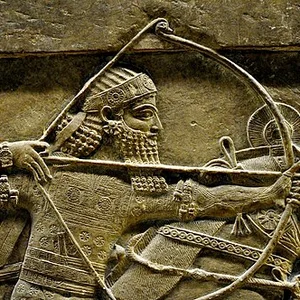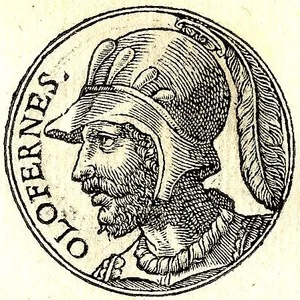

Assyrian general of Nebuchadnezzar's army, Holofernes is the central character of the Book of Judith in the Hebrew Bible. His beheading by Judith, a courageous Hebrew widow, is one of the most celebrated narratives in biblical literature.
Holofernes
Holofernes
Assyrie
8 min read
Frequently asked questions
Key Facts
- Commander-in-chief of Nebuchadnezzar II's army, king of Babylon according to the biblical account
- He besieges the city of Bethulia, putting the Hebrew people in great peril
- He is seduced by the widow Judith, who infiltrates his camp
- Judith cuts off his head while he sleeps, thereby saving her people
- The narrative of the Book of Judith is classified among the deuterocanonical books in the Catholic tradition
Works & Achievements
A foundational text recounting the siege of Bethulia, Judith's cunning stratagem, and the beheading of Holofernes. Holofernes embodies foreign tyranny laid low by the faith and courage of a lone woman facing an entire army.
A masterpiece of the Florentine Renaissance depicting Judith raising her sword over a vanquished Holofernes. Placed in the Piazza della Signoria in Florence, it became a symbol of republican freedom against Medici tyranny.
A striking painting that depicts the moment of beheading with brutal realism, bathed in dramatic chiaroscuro. Holofernes's horrified expression contrasts with Judith's calm resolve, creating an unparalleled dramatic tension.
An even more violent and visceral rendering of the scene, painted by a woman artist who had herself survived violence. The painting is now a feminist icon of the 17th century and one of the most discussed works of the Baroque period.
Two companion panels depicting Judith's return and the discovery of Holofernes's body. They showcase the formal elegance of the Florentine Renaissance and the enduring popularity of this theme in the art of the period.
A Baroque musical composition dramatizing the story of Judith and Holofernes, demonstrating how this narrative has spanned the centuries to inspire every form of artistic expression across Europe.
Anecdotes
According to the Book of Judith, Holofernes commands a colossal army of 120,000 infantry and 12,000 cavalry on behalf of Nebuchadnezzar. This overwhelming military force first subdues many peoples before laying siege to Bethulia, a small Hebrew city commanding the passage to Jerusalem.
Holofernes besieges Bethulia by cutting off its water sources, condemning the population to die of thirst and hunger. This is a classic siege strategy in Antiquity: starve the enemy rather than attack head-on, in order to spare one's own troops while counting on a swift capitulation.
The beautiful widow Judith goes to Holofernes' camp, claiming she wishes to betray her people. The general, captivated by her beauty and intelligence, invites her to a private banquet. After several days, during a night of drunkenness, Judith cuts off Holofernes' head with his own sword, thereby saving Bethulia.
Holofernes' head, carried back in a provision bag by Judith and her maidservant, is displayed on the ramparts of Bethulia the next morning. At this sight, the Assyrian army is seized with panic and flees, unable to comprehend what had become of their supposedly invincible general.
The story of Holofernes inspired countless works of art during the Renaissance and Baroque periods, notably the paintings by Caravaggio (c. 1598) and Artemisia Gentileschi (1614–1620), which depict with striking intensity the moment of the decapitation. These works are today among the most celebrated paintings in European museums.
Primary Sources
Holofernes, commander-in-chief of the army of Assyria, assembled hand-picked warriors — one hundred and twenty thousand infantry and twelve thousand cavalry. He set out to lay waste to every land that Nebuchadnezzar had ordered to be subdued.
She approached the bed and seized Holofernes by the hair. She said: 'Give me strength this day, O Lord God of Israel.' She struck his neck twice with all her might and cut off his head.
Jerome translated the Book of Judith into Latin, describing it as an edifying narrative while noting the difficulties of pinning it to historical dates. His translation became the standard version for the Catholic Church throughout the entire Middle Ages.
Josephus mentions the traditions surrounding the Book of Judith, confirming that this narrative was known in Hellenistic Jewish culture as an example of miraculous deliverance granted by God to his people in the face of an oppressive foreign power.
Key Places
Capital of the Neo-Assyrian Empire, Nineveh is the seat of the power that Holofernes serves as a military instrument. In the narrative's fiction, it is where Nebuchadnezzar resides, directing his conquests through his general.
The Hebrew city in the narrative besieged by Holofernes, whose exact location remains unknown and is likely fictional. It is often placed in the region of Dothan in northern Israel. This is where the central drama of the beheading unfolds.
The holy city of the Hebrews indirectly threatened by Holofernes's army. Judith's deliverance of Bethulia spares Jerusalem from almost certain sacking, which is why her victory is celebrated as a triumph for the entire nation.
The great plain of northern Israel where Holofernes's army is encamped according to the biblical account. Historically a corridor between Egypt and Mesopotamia, it was the site of many battles in the ancient world.
Typical Objects

The weapon symbolizing his military power, it is ironically his own sword that Judith uses to behead him. In artistic iconography, this sword wielded by Judith has been the most recognizable attribute of the scene since the Renaissance.

Holofernes' tent is described in the Book of Judith as adorned with a canopy of purple, gold, and emeralds, a symbol of Oriental splendor and Assyrian power at its height.

During the fatal banquet, Holofernes drinks heavily, captivated by Judith, until he falls into a drunken stupor. The cup symbolizes his excess and his downfall, illustrating how his vices lead to his ruin.

As general of a great imperial army, Holofernes is depicted in bronze scale armor, conical helmet, and round shield during his campaigns, embodying the military might of Assyria.

In the biblical account, Judith carries Holofernes' head in her maidservant's provisions bag — a symbolically powerful detail showing how the humble instruments of everyday life can serve divine deliverance.

Like all senior Neo-Assyrian commanders, Holofernes received and dictated military orders on clay tablets, the central tool of Assyrian military bureaucracy and logistics.
School Curriculum
Vocabulary & Tags
Key Vocabulary
Tags
Daily Life
Morning
In the morning, Holofernes holds a war council with his officers inside his large command tent. Neo-Assyrian generals began their day with troop reviews and scout reports, planning the movements of the siege. Scribes recorded the day's orders and situation reports transmitted by forward units on clay tablets.
Afternoon
The afternoon is devoted to overseeing military operations: inspecting the siege lines, monitoring the blockade of Bethulia's water sources, and receiving delegations from subjugated peoples bringing tribute and intelligence. Supplying an army of 120,000 men demands constant organization and unceasing decisions about the allocation of resources.
Evening
In the evening, Holofernes presides over lavish banquets in his tent adorned with purple and gold. The biblical account dwells on these feasts where wine flows freely — a sign of both his power and his excesses. It is at one such banquet that he will succumb to Judith's charm and to a fatal intoxication.
Food
As the general of a great imperial army, Holofernes enjoyed abundant and varied food: roasted meats, barley and wheat breads, dried fruits, olive oil, and wine imported from conquered regions. Assyrian armies lived partly off the land they crossed, requisitioning food and resources from subjugated populations.
Clothing
Holofernes wore Assyrian armor during military operations: a bronze scale cuirass, a crested helmet, greaves, and a large round shield. At receptions and banquets, he displayed embroidered linen and wool robes, purple garments reserved for the highest dignitaries, along with gold jewelry and the insignia of command bestowed upon him by Nebuchadnezzar.
Housing
Holofernes' camp was organized around his large personal tent, described in the Book of Judith as a veritable palace of canvas adorned with a canopy of purple embroidered with gold, emeralds, and precious stones. This tent symbolized the royal power of Nebuchadnezzar, of whom Holofernes was the direct representative on the battlefield.
Historical Timeline
Period Vocabulary
Liens externes & ressources
Références
Œuvres
Livre de Judith (Bible, deutérocanonique)
IVe-IIe siècle av. J.-C.
Judith et Holopherne — Donatello (sculpture en bronze)
Vers 1455-1460
Judith décapitant Holopherne — Caravage (peinture)
Vers 1598-1599
Judith décapitant Holopherne — Artemisia Gentileschi (peinture)
1614-1620
Judith et Holopherne — Botticelli (panneau de bois)
Vers 1470
Giuditta trionfante — Antonio Vivaldi (oratorio)
1716