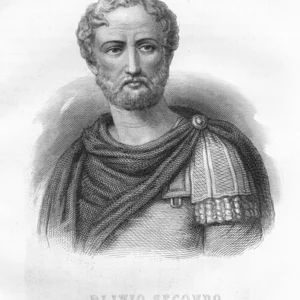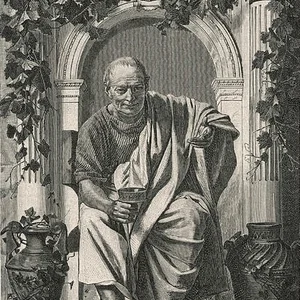

Horace is a major Latin poet of the Augustan age, born in 65 BC in Venusia. A friend of Virgil and protégé of Maecenas, he is the author of the Odes, the Satires, and the Ars Poetica. His work celebrates wisdom, friendship, and the simple pleasures of life.
Horace(64 av. J.-C. — 7 av. J.-C.)
Horace
Rome antique
8 min read
Frequently asked questions
Famous Quotes
« Carpe diem, quam minimum credula postero. (Seize the day, put very little trust in tomorrow.)»
« Aurea mediocritas. (The golden mean.)»
« Odi profanum vulgus et arceo. (I hate the uninitiated crowd and keep them away.)»
Key Facts
- Born in 65 BC in Venusia (Apulia), son of a freed slave
- Fought at Philippi (42 BC) on the side of Brutus against Octavian
- Joined the circle of Maecenas around 38 BC thanks to Virgil
- Published the four books of the Odes between 23 and 13 BC
- Died in 8 BC, just weeks after his friend Maecenas
Works & Achievements
Two books of eighteen satires in dactylic hexameters, offering both sharp and good-natured portraits of Roman society. Horace reveals himself as a clear-eyed observer of human foibles, with a gentler and more philosophical tone than his model Lucilius.
A collection of seventeen lyric poems inspired by the Greek poet Archilochus, blending invective, love, and political reflection. The Epodes mark the beginnings of Latin lyric poetry and foreshadow the great Odes.
One hundred and three poems in four books, the undisputed masterpiece of Latin poetry. Horace adapts Greek lyric meters (Alcaic, Sapphic) to celebrate love, friendship, nature, death, and moderation.
Two books of verse letters addressed to friends and to the emperor Augustus, exploring moral philosophy and literary criticism. The Epistles reveal a wise and reflective Horace, in pursuit of the golden mean (aurea mediocritas).
An official hymn commissioned by Augustus for the Secular Games, sung by a choir of young Romans on the Palatine Hill. The poem celebrates the renewal of Rome under Augustus's reign and the protection of the gods.
A lengthy verse epistle addressed to the Piso family, serving as a true treatise on literary criticism that would shape the entire European classical aesthetic tradition. Horace sets out founding principles such as ut pictura poesis and the necessity of combining instruction with pleasure.
Anecdotes
Horace was the son of a freedman — a formerly enslaved person who had been liberated. His father, despite his humble circumstances, did everything in his power to give his son the best possible education, sending him to study in Rome and then in Athens. Horace paid tribute to this sacrifice throughout his life, acknowledging that everything he achieved he owed entirely to his father.
At the Battle of Philippi in 42 BC, Horace fought on the side of Brutus against Octavian and Antony. By his own account in the Odes, he fled the battlefield and threw away his shield — an ironic allusion to the Greek poet Archilochus, who boasted of doing the same thing. This self-deprecating humor reveals both his wit and his clear-eyed honesty.
The enormously wealthy Maecenas, advisor to Augustus and great patron of the arts, gave Horace a country villa in the Sabine Hills, the lush rolling countryside northeast of Rome. This estate became the poet's favorite retreat, where he composed many of his masterworks and celebrated the simple pleasures of country life, wine, and friendship.
Horace was approached by the Emperor Augustus himself to become his personal secretary — an extraordinarily prestigious position. The poet politely declined the offer, preferring to keep his independence and the free time he needed to write. Far from taking offense, Augustus continued to hold him in high regard and to support his work.
Horace died in 8 BC, just a few weeks after his friend Maecenas, as though he could not survive the loss of him. He had himself predicted this near-simultaneous death in his poems. He was buried on the Esquiline Hill, close to his patron's tomb — faithful to that friendship to the very end.
Primary Sources
Tu ne quaesieris, scire nefas, quem mihi, quem tibi finem di dederint... Carpe diem, quam minimum credula postero. (Ask not — it is forbidden to know — what end the gods have in store for me and for you... Seize the present day, trusting as little as possible in tomorrow.)
Non ego me claro natum patre, non ego circum me Satureiano vectari rura caballo... Omnis enim res, virtus, fama, decus, divina humanaque pulchris divitiis parent. (I do not claim to have been born of a famous father... For everything — virtue, reputation, honor, things divine and human — bows before glittering wealth.)
Nullius addictus iurare in verba magistri, quo me cumque rapit tempestas, deferor hospes. (Bound to swear by the words of no master, I am carried as a guest wherever the storm sweeps me.)
Aut prodesse aut delectare poetae, aut simul et iucunda et idonea dicere vitae. (The aim of a poet is either to instruct or to delight, or to say things that are both pleasing and useful for life.)
Exegi monumentum aere perennius regalique situ pyramidum altius. (I have completed a monument more lasting than bronze, and loftier than the royal mass of the pyramids.)
Key Places
Horace's birthplace, a Roman colony on the border between Apulia and Lucania. It was in this provincial town that his freed-slave father instilled in him a love of literature and the ambition to receive a Roman education.
Horace lived in Rome on the Esquiline Hill, within the circle of Maecenas. The Forum and the public libraries were at the heart of the intellectual life he was immersed in daily.
An estate given to him by Maecenas, set in the lush hills of the Sabine country northeast of Rome. This retreat was where many of his Odes and Epistles were composed, and he celebrated it in his poetry as a haven of serenity.
Horace studied philosophy here — in particular Epicureanism and Stoicism — around 46–44 BC. This immersion in Greek culture left a deep mark on his work and his taste for Greek lyric meters.
Site of the decisive battle of 42 BC, in which Horace fought and was routed. He alludes to it with self-deprecating humor in his Odes, recasting his flight as a comic and philosophical episode.
Typical Objects

Horace composed and jotted down his verses on wax-coated tablets, scratched with a bronze or bone stylus. These cheap, reusable writing surfaces were the everyday tools of any educated Roman.

Falernian or Massic wine is a constant presence in Horace's poetry, a symbol of conviviality and Epicurean wisdom. The cup shared among friends embodies his invitation to enjoy the present moment.

Literary works circulated as hand-copied papyrus scrolls. Horace sometimes addresses his book directly as a living object, imagining its journey beyond Rome.

Roman lyric poetry drew inspiration from Greek poetry sung to the lyre. Horace often portrays himself as a poet-musician in the tradition of Alcaeus and Sappho, his avowed Greek models.

A symbol of poetic glory and victory, the laurel crowned celebrated poets and triumphant generals alike. Horace frequently invokes this wreath as the reward of literary immortality.

Horace enjoyed travelling between Rome, the Sabine hills, and Naples. In his Satires, he described a famous journey from Rome to Brindisi — a vivid portrait of life on the roads of Augustan Italy.
School Curriculum
Vocabulary & Tags
Key Vocabulary
Tags
Daily Life
Morning
Horace rose early, before dawn, shaped since childhood by the studious discipline his father had instilled in him. He devoted the first hours of the day to reading and poetic composition, his mind still fresh, making the most of the quiet at his Sabine villa before the heat set in.
Afternoon
In the afternoons, Horace walked the Sabine hills, observing the nature that constantly nourished his poetry — vines, olive trees, springs, and birds. He sometimes received friends such as Virgil or members of Maecenas's circle for philosophical conversations and shared readings.
Evening
Evening was the hour of the symposium — convivial dinners among friends over good Falernian or Massic wine. There, Horace practiced the art of Epicurean conversation, blending the pleasures of the table, lyre music, and debate on wisdom, death, and the right measure of a life well lived.
Food
Horace's diet reflected his ideal of moderation: garden vegetables, olives, cheese, bread, beans, and lentils made up his everyday fare. Wine, diluted with water in the Roman tradition, was ever-present — especially the country vintages he celebrates in his Odes: Falernian, Caecuban, and Massic.
Clothing
Like any Roman citizen of equestrian rank, Horace wore the white toga in the city for formal occasions and a simple woolen tunic for daily life. At his Sabine villa, he favored light, comfortable clothing, free of ostentation — in keeping with his ideal of the aurea mediocritas, the golden mean.
Housing
The Sabine villa given to him by Maecenas was a modest but pleasant residence, surrounded by gardens, vineyards, and springs. In Rome, Horace lived on the Esquiline Hill, close to Maecenas and the city's libraries. His two homes embodied the balance he sought between the social life of the capital and the contemplative retreat of the countryside.
Historical Timeline
Period Vocabulary
Visual Style
Direction artistique inspirée de la peinture pompéienne et de l'architecture augustéenne : lumière chaude méditerranéenne, tons ocre et terracotta, scènes de symposium élégantes et paysages de collines italiennes baignés de soleil.
Sound Ambience
L'univers sonore d'Horace mêle la sérénité bucolique de sa villa sabine — vent dans les vignes, chants d'oiseaux, ruisseau — aux doux accords d'une lyre et au crépitement d'un foyer, cadre idéal à la méditation poétique.
Liens externes & ressources
Références
Œuvres
Satires (Sermones)
vers 35-30 av. J.-C.
Épodes
vers 30 av. J.-C.
Odes (Carmina)
23 av. J.-C. (livres I-III), 13 av. J.-C. (livre IV)
Épîtres (Epistulae)
vers 20-13 av. J.-C.
Carmen Saeculare
17 av. J.-C.
Art poétique (Ars Poetica)
vers 18 av. J.-C.