
African-American activist, co-founder of the Black Panther Party in 1966 with Bobby Seale. A theorist of black nationalism and armed self-defense, he became a major figure in the struggle for civil rights and against police violence in the United States.
Huey P. Newton(1942 — 1989)
Huey P. Newton
États-Unis
6 min read
Frequently asked questions
Famous Quotes
« The revolution has always been in the hands of the young. The young always inherit the revolution.»
Key Facts
- Born on February 17, 1942, in Monroe, Louisiana
- Co-founds the Black Panther Party for Self-Defense in Oakland in October 1966 with Bobby Seale
- Arrested in 1967 after the death of a police officer, his cause becomes the slogan “Free Huey”
- Earns a doctorate in the philosophy of social consciousness from the University of California in 1980
- Assassinated on August 22, 1989, in Oakland
Works & Achievements
Co-founding, with Bobby Seale, of the party that left a lasting mark on the African American struggle and revolutionary thought.
Founding manifesto setting out the party's demands regarding rights, employment, housing, and justice.
Free breakfasts, health clinics, and schools that fed and cared for thousands of people.
Autobiography in which Newton sets out his philosophy of commitment and his journey as an activist.
Collection of his political writings and speeches, a synthesis of Panther theory.
Political concept developed by Newton that moved beyond Black nationalism toward a worldwide solidarity of the oppressed.
Academic study of the U.S. state's repression of the party, defended at Santa Cruz.
Anecdotes
In October 1966, Huey Newton and Bobby Seale drafted the Black Panther Party's Ten-Point Program, partly at a desk in an anti-poverty center in Oakland where they worked as neighborhood organizers. The text demanded housing, jobs, education, and an end to police brutality.
Newton had studied California law closely: he knew that in 1967 it was legal to carry a firearm openly. The Panthers would then follow police patrols, weapons and law book in hand, to monitor arrests in Black neighborhoods without breaking the law.
As a student, Newton was long considered a poor learner and left high school barely able to read. He taught himself to read by working through Plato's *The Republic*, and later earned a doctorate in social philosophy at the University of California, Santa Cruz, in 1980.
To fund the party, the Panthers sold Mao's *Little Red Book* to Berkeley students, buying it in bulk at low prices. With the profits, they purchased their first weapons — a trick Newton recounted with amusement.
The free breakfast program launched by the Panthers fed thousands of children every morning. The FBI saw it as such a threat that its director, J. Edgar Hoover, called it “the greatest threat” to the country's internal security.
Primary Sources
We want freedom. We want power to determine the destiny of our Black Community. (...) We want an immediate end to POLICE BRUTALITY and MURDER of Black people.
By having no family, I inherited the family of humanity. By having no possessions, I have possessed all.
The masses are the makers of history... we must educate the people in the most practical and exact manner.
We realized at a very early point in our development that revolution is a process. It is not a particular action.
Key Places
Huey Newton's birthplace, in the segregationist South. His family migrated to California when he was a child.
The city where Newton grew up and founded the Black Panther Party in 1966. The heart of the movement's activity.
The institution where Newton met Bobby Seale and developed his political thinking. The intellectual birthplace of the party.
The university where Newton earned his doctorate in social philosophy in 1980. The culmination of his self-taught journey.
The place of Newton's exile from 1974 to 1977 to escape legal prosecution. He lived there for several years.
Typical Objects

Emblematic headgear of the Black Panthers' uniform, inspired by revolutionary movements. Together with the leather jacket, it forged the party's disciplined and militant image.

Jacket worn as a uniform by Black Panther Party militants. It embodied the movement's pride, combativeness, and discipline.

Founding manifesto of the party written by Newton and Seale, listing ten demands for the Black community. A central document of the Panthers' ideology.

The party's official weekly, sold in the streets to spread its ideas and fund its programs. It printed hundreds of thousands of copies.

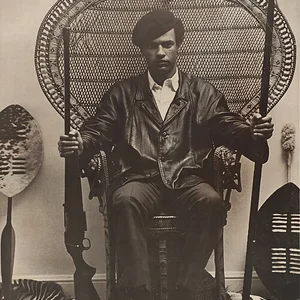
The seat from the famous 1967 portrait in which Newton poses with a rifle and a spear, flanked by African shields. This image became an icon of militant culture.

A compilation of laws that the Panthers brandished during their patrols to remind police officers of citizens' rights. A tool for the legal contestation of violence.
School Curriculum
Vocabulary & Tags
Key Vocabulary
Tags
Daily Life
Morning
In the party's early days, mornings were used to organize community programs: preparing free breakfasts for the children of Oakland's neighborhoods. Newton also devoted his mornings to reading and studying political texts.
Afternoon
Afternoons were dedicated to party meetings, planning the armed self-defense patrols, and writing articles for the newspaper. Newton met with activists and allies to coordinate their action.
Evening
Evenings were the time for study circles, where members discussed Marx, Fanon, or Mao, and prepared the next day's actions. Long ideological conversations set the rhythm of the movement's life.
Food
Newton shared the modest diet of Black working-class neighborhoods: soul food, affordable dishes based on beans, rice, leafy greens, and chicken. The party's programs aimed precisely at fighting childhood hunger.
Clothing
He wore the party's recognizable uniform: a black beret, leather jacket, and dark shirt, a symbol of discipline and pride. This outfit forged the militant image of the Panthers.
Housing
Newton lived in the modest housing of Oakland, sometimes in apartments that also served as the party's headquarters. He also endured long periods in prison and an exile in Cuba.
Historical Timeline
Period Vocabulary
Liens externes & ressources
Références
Œuvres
Fondation du Black Panther Party
1966
Programme en dix points
1966
Programmes communautaires (Survival Programs)
1968-1971
Revolutionary Suicide
1973
To Die for the People
1972
Théorie de l'« intercommunalisme »
1970-1971
Thèse de doctorat (War Against the Panthers)
1980