
Humbaba (or Huwawa) is a monstrous creature from Mesopotamian mythology, the guardian of the Cedar Forest on behalf of the god Enlil. He appears in the Epic of Gilgamesh, where he is defeated and killed by Gilgamesh and Enkidu.
Humbaba
Humbaba
6 min read
Frequently asked questions
Key Facts
- Guardian of the Cedar Forest in the service of the god Enlil, who entrusted him with the mission of protecting this sacred domain
- A central figure in the Epic of Gilgamesh, whose Akkadian versions are attested at the beginning of the 2nd millennium BC
- Killed by Gilgamesh and his companion Enkidu, who then cut down the cedars of the forest
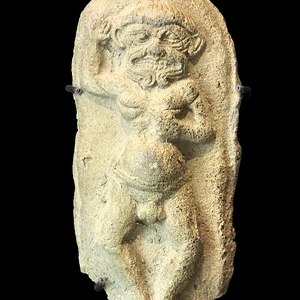
- His face is traditionally depicted as a grimacing mask made of coiled entrails, notably on Mesopotamian clay plaques
- His death draws the wrath of the gods and contributes to the tragic fate of Enkidu, who is condemned to die
Works & Achievements
The oldest Sumerian poem in which the guardian of the forest appears, then named Huwawa. It establishes the major elements of the story: the expedition, the auras of terror, and the death of the monster.
A Sumerian variant of the same episode, which emphasizes the tricks used to capture the guardian. It shows the popularity of the theme from very early times.
The heart of the Babylonian story: the crossing of the forest, the battle aided by the winds of Shamash, then the pleading and death of Humbaba. It is the most complete version that has come down to us.
Clay objects spread throughout the ancient Near East, showing that the monster went beyond the literary realm alone to enter religion and divination.
Copies preserved at Nineveh and elsewhere, which ensured the survival of the character and allowed his modern rediscovery beginning in 1872.
Anecdotes
Archaeologists have unearthed in Mesopotamia small clay masks depicting the face of **Humbaba**: his features are drawn with a single coiled line that resembles a tangle of intestines. This is no accident: Babylonian diviners read the future in the entrails of sacrificed sheep, and when the folds formed this pattern, they saw in it an omen linked to the monster.
In the *Epic of Gilgamesh*, **Humbaba** is not merely strong: he is surrounded by seven *melammu*, auras of supernatural terror that paralyze anyone who approaches him. **Gilgamesh** must tear them away one by one, as though stripping off seven invisible suits of armor, before he can confront him.
The hero would never have defeated **Humbaba** without the help of the sun god **Shamash**, who unleashes thirteen winds against the guardian (the north wind, the whirlwind, the sandstorm...). Pinned to the ground and blinded, the monster begs to be spared and promises to become **Gilgamesh**'s servant.
It is **Enkidu**, **Gilgamesh**'s wild friend, who urges him to kill **Humbaba** despite his pleas. Before dying, the guardian casts a curse upon the two companions — and indeed, soon afterward, **Enkidu** falls ill and dies, as if the monster's prophecy were coming true.
There are two great versions of the story. The Sumerians called him **Huwawa** and were already recounting his exploits more than four thousand years ago; the Babylonians, later on, named him **Humbaba** in the great *Epic of Gilgamesh*, written on clay tablets in cuneiform script.
Primary Sources
Humbaba — his voice is the Deluge, his speech is fire, and his breath is death! Why do you desire to do such a thing?
They stood marveling at the forest, gazing upon the height of the cedars... They beheld the Cedar Mountain, dwelling of the gods, throne of the goddess Irnini.
Enlil appointed Huwawa as a terror to humankind: seven cloaks of radiance envelop him, and no one can enter the Cedar Forest.
Humbaba implored Gilgamesh: “Spare my life! I will be your servant, I will cut down for you the trees of my mountain and build your house.”
Key Places
A vast sacred forest that Humbaba guards for the god Enlil, dwelling place of the gods. It is here that he faces Gilgamesh and Enkidu and loses his life.
Gilgamesh's city, the starting point of the expedition toward the distant forest. One of the greatest cities of Sumerian Mesopotamia.
The holy city of Enlil, the god who had appointed Humbaba guardian of the forest. His temple, the Ekur, receives the cedar door crafted after the victory.
A mountain famed for its majestic cedars, with which later tradition associates the forest guarded by Humbaba.
The Assyrian capital where the library of King Ashurbanipal preserved the tablets of the Epic of Gilgamesh, rediscovered in the 19th century.
Typical Objects

A clay plaque or mask depicting his face as a single coiled line evoking entrails. Diviners read it as an omen whenever the viscera of a sacrificed animal traced this pattern.

Halos of radiance and supernatural terror that envelop Humbaba and paralyze his enemies. Gilgamesh must strip them away one by one before he can reach him.

Weapons forged especially for the expedition, with which Gilgamesh and Enkidu fell the cedars and then the guardian. Their enormous weight underscores the heroic strength of the two companions.

A monumental door panel carved from the largest cedar in the forest after Humbaba's death. Enkidu dedicates it to the temple of Enlil, the very god who had set the monster there as its guardian.

The treasure of the forest guarded by Humbaba, prized by Mesopotamian kings whose plains lacked tall trees. Cedar was used to build temples and palaces.

Small clay tablets carved with wedge-shaped signs, on which the story of Humbaba has been passed down for millennia. They are our main source on the character.
School Curriculum
Vocabulary & Tags
Key Vocabulary
Tags
Daily Life
Morning
At sunrise, Humbaba walks the paths of the Cedar Forest, of which he is the guardian. Endowed with prodigious hearing and eyesight, he detects the slightest intruder who comes to cut down a sacred tree.
Afternoon
By day, he watches over the tallest cedars, those that rise toward the dwelling of the gods. His roar, compared to the Flood, echoes through the mountain to frighten anyone who draws near.
Evening
As night falls, his seven auras of terror gleam in the shadows like armor of light. No one can cross the forest's edge without being paralyzed by this supernatural presence.
Food
A mythical creature, Humbaba is not described as feeding in the manner of humans. The texts portray him as an almost elemental being, living on the very breath of the forest he protects.
Clothing
He is clad in seven “melammu,” invisible cloaks of divine radiance. These auras, rather than any garments, form his true protection.
Housing
His dwelling is the Cedar Forest itself, a sacred mountain presented as the throne of the gods. There he owns neither house nor palace: all of nature is his domain and his fortress.
Historical Timeline
Period Vocabulary
Liens externes & ressources
Références
Œuvres
Gilgamesh et Huwawa (version A)
vers 2100-1800 av. J.-C.
Gilgamesh et Huwawa (version B)
vers 2000-1800 av. J.-C.
Épopée de Gilgamesh, tablette V
vers 1200 av. J.-C.
Masques cultuels de Humbaba
vers 1800-1600 av. J.-C.
Fragments tardifs (néo-assyriens et au-delà)
VIIe s. av. J.-C. et après