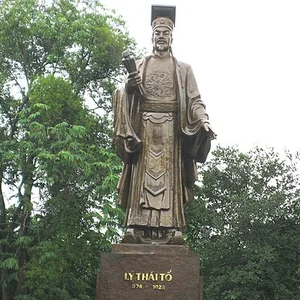

Founder of the Lý dynasty in Vietnam (1009–1028), he moved the capital from Hoa Lư to Đại La, renaming it Thăng Long (present-day Hanoi) in 1010, inaugurating over a thousand years of the Vietnamese capital's history.
Lý Thái Tổ(974 — 1028)
Lý Thái Tổ
Dai Co Viet
10 min read
Frequently asked questions
Key Facts
- 8 March 974: born in Cổ Pháp (present-day Từ Sơn, Bắc Ninh province)
- 1009: accession to the throne following the death of Lê Long Đĩnh, official founding of the Lý dynasty
- 1010: transfer of the capital from Hoa Lư to Đại La, renamed Thăng Long — the founding act of Hanoi's thousand-year history
- 1009–1028: an 18-year reign marked by internal pacification, agricultural development, and defense against Song China
- 31 March 1028: death after laying the institutional foundations consolidated by his successors
Works & Achievements
A foundational text of Vietnamese political literature, in which Lý Thái Tổ justifies the relocation of the capital from Hoa Lư to Thăng Long on geographical, strategic, and symbolic grounds. This document is still studied in Vietnam as a masterpiece of classical prose.
A landmark political and urban decision: the creation of a new capital on the Red River plain that would become the heart of Vietnam for more than a millennium and is home today to nearly ten million inhabitants.
Restructuring of the territory, redivision into administrative units, overhaul of the taxation system, and development of agriculture; these reforms laid the institutional foundations on which the subsequent Lý kings would build for two centuries.
Lý Thái Tổ had numerous Buddhist temples and monasteries built in and around the new capital, establishing Buddhism as the state religion and the cultural bedrock of medieval Vietnamese society.
A series of victorious campaigns against internal rebel leaders and neighboring kingdoms (Chiêm Thành, Đại Lý), resulting in the submission of all dissident forces and the payment of tribute by neighboring states, including Chân Lạp. The Song dynasty maintained a peaceful relationship with Đại Cồ Việt.
Anecdotes
When King Lê Long Việt (Lê Trung Tông) was assassinated by his brother Lê Long Đĩnh in 1005, all the courtiers fled in fear. Lý Công Uẩn alone stayed to hold the body of the deceased sovereign in his arms and weep. Far from punishing him, Long Đĩnh publicly praised him for his loyalty and promoted him to high military office — a scene that reveals both the courage and the political intelligence of the future founder of the Lý dynasty.
According to the Đại Việt sử ký toàn thư, the Buddhist monk Vạn Hạnh, Lý Công Uẩn's master since the age of six or seven, predicted an exceptional destiny for him: “This child is no ordinary man; as he grows, he will certainly be capable of resolving crises and governing the empire.” Decades later, this same monk secretly encouraged him to take the crown by revealing favorable omens to him, directly contributing to his accession to the throne.
Before the seizure of power, a series of troubling omens stirred the court: a dog reportedly gave birth to puppies whose fur formed the two Chinese characters meaning “Son of Heaven” (thiên tử), and a cotton-rose tree in Lý Công Uẩn's home region was struck by lightning, revealing prophetic verses announcing the rise of the Lý clan. Lê Long Đĩnh, having been warned, sought to eliminate all members of the Lý clan, but Lý Công Uẩn was spared.
The accession to the throne in 1009 was not a coup by force: it was the official Đào Cam Mộc who convinced both the queen mother and the senior officers of the exceptional merit of Lý Công Uẩn, commander of the palace guards. Đào Cam Mộc had first quietly sounded out Lý Công Uẩn, who feigned threatening him with denunciation — before admitting that he only feared their exchanges might be betrayed. The dignitaries solemnly escorted Lý Công Uẩn to the throne, thus founding the first great lasting dynasty of Vietnam, the Lý dynasty, which reigned for 216 years.
In 1010, Lý Thái Tổ made the momentous decision to transfer the royal residence from the citadel of Hoa Lư to the plain of Đại La, on the banks of the Red River. He renamed the site Thăng Long — “Rising Dragon” — inaugurating more than a thousand years of history of what is now Hanoi. This decision was set out in a solemn edict, the Chiếu dời đô, which is still studied in Vietnam today as a masterpiece of classical political prose.
Primary Sources
Lý Công Uẩn, a native of Cổ Pháp, was raised by the monk Lý Khánh Văn and later instructed by the venerable Vạn Hạnh. When Lê Long Đĩnh died, the court dignitaries elevated him to the supreme rank; he thus founded the Lý dynasty, the first great and lasting dynasty of Vietnam.
Lý Công Uẩn had an elder brother (later Prince Vũ Uy) and a younger brother (Prince Dực Thánh). He served under the Lê before being raised to the throne by the courtiers upon the death of Lê Long Đĩnh.
Lý Công Uẩn joined the Lê court around the middle of the Ứng Thiên reign (994–1005); he rose to the rank of Commander of the Left Palace Guards before ascending to imperial dignity.
A man of Giao Châu gifted with military and strategic talent, he was employed as a senior general by Lê Chí Trung, who placed complete trust in him.
Xưa nhà Thương đến vua Bàn Canh năm lần dời đô [...] Trẫm muốn dựa vào sự thuận lợi đó để định chỗ ở. Các khanh nghĩ thế nào ? — "In ancient times, the Shang moved their capital five times [...] I wish to draw upon these advantages to establish our seat of power. What do my ministers think?"
Key Places
Birthplace of Lý Công Uẩn, now part of the Từ Sơn district in Bắc Ninh province. This is where the Cổ Pháp Pagoda (Ứng Tâm tự) once stood — the monastery to which he was entrusted at the age of three to the monk Lý Khánh Văn.
The ancient fortified capital of Đại Cồ Việt under the Đinh and Early Lê dynasties, nestled among limestone gorges. It was here that Lý Công Uẩn served as commander of the palace guard before deciding, once crowned, to move the capital to the plains.
The capital founded by Lý Thái Tổ in 1010 on the site of the former city of Đại La, renamed "The Rising Dragon." It remained the political and cultural heart of Vietnam for over a thousand years and is today the capital of the Socialist Republic of Vietnam.
A Buddhist monastery where Lý Công Uẩn had his master Vạn Hạnh hidden when prophecies favoring the Lý clan risked being discovered by King Lê Long Đĩnh. This place was the setting for the secret strategy that preceded the seizure of power in 1009.
The monastery where Lý Công Uẩn, at the age of six or seven, was sent to study under the great scholar-monk Vạn Hạnh, who foretold his extraordinary destiny and shaped his political and spiritual intelligence.
Typical Objects

Imperial seat of gold-lacquered wood adorned with carved dragons, symbol of the celestial authority of the Son of Heaven. Lý Thái Tổ inaugurated his throne at Thăng Long upon his accession to power in 1009–1010.

A stamp of precious metal engraved with the reign name, affixed to royal edicts to give them the force of absolute law. Indispensable to any official act, it embodied sovereign authority at the proclamation of the Chiếu dời đô in 1010.

A court garment of yellow silk embroidered with five-clawed dragons, a color and motif reserved exclusively for the emperor under the Sino-Vietnamese codes of the era. A visible symbol of the Mandate of Heaven.

A sandalwood bead necklace used for the recitation of sutras. Lý Thái Tổ, deeply devout since his monastic upbringing under the master Vạn Hạnh, practiced Buddhism daily and had numerous pagodas erected.

Parchment or silk upon which the imperial decree was inscribed, read aloud publicly by a herald. The Chiếu dời đô of 1010, justifying the transfer of the capital to Thăng Long, is the most celebrated example of this type of document under the Lý dynasty.

A large bronze bell suspended in the royal pagodas of Thăng Long, rung during Buddhist services. Lý Thái Tổ had numerous temples erected, and their bells marked the rhythm of the court's spiritual life.

A large wooden drum stretched with buffalo hide, struck to signal the attack or retreat during military campaigns. The armies of Lý Thái Tổ used it during expeditions against internal rebels and the Champa.
School Curriculum
Vocabulary & Tags
Key Vocabulary
Daily Life
Morning
The sovereign rose before dawn for Buddhist devotions inherited from his monastic education under the master Vạn Hạnh: reciting sutras and burning incense in the palace prayer hall. He then presided over the morning audience, where ministers reported the kingdom's urgent affairs.
Afternoon
Afternoons were devoted to official audiences in the great throne room of Thăng Long, where disputes were settled, ambassadors received, and imperial edicts signed. Lý Thái Tổ also oversaw construction works on the new capital, as palaces and pagodas rose simultaneously across the Red River plain.
Evening
In the evenings, the sovereign withdrew with his closest advisors — and often with learned monks — to deliberate on matters of secret state. His deep Buddhist devotion, judged excessive by later historians, shaped these hours of meditation and spiritual consultation.
Food
Imperial Vietnamese cuisine in the 11th century centered on white and glutinous rice, accompanied by Red River fish, fermented vegetables, and bamboo shoots. Court meals included rarer dishes — buffalo meat, mountain game, and tropical fruits — served in glazed ceramic bowls characteristic of the Lý period.
Clothing
During official ceremonies, Lý Thái Tổ wore the yellow imperial robe embroidered with five-clawed dragons, paired with a rigid-winged court cap following Sino-Vietnamese codes. Outside formal audiences, he wore silk garments in more subdued tones; during his Buddhist devotions, a simple robe recalled the monastic habit of his upbringing.
Housing
The palace of Thăng Long, built from 1010 on the site of the former Đại La citadel, comprised an inner forbidden city (*cấm thành*) reserved for the emperor and his immediate family, surrounded by an administrative enclosure. The timber buildings with glazed-tile roofs were arranged along the north-south axis of Sino-Vietnamese geomancy, with meditation pavilions set within the inner gardens.
Historical Timeline
Period Vocabulary
Liens externes & ressources
Références
Œuvres
Chiếu dời đô (Édit du transfert de capitale)
1010
Fondation de Thăng Long (Hanoï)
1010
Réforme administrative et fiscale du Đại Cồ Việt
1009–1028
Construction des pagodes royales de Thăng Long
1010–1028
Unification militaire et politique du royaume
1009–1028