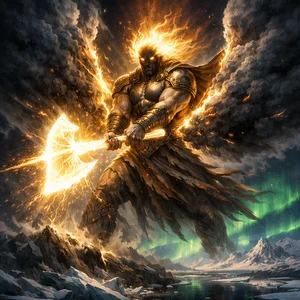

Titan of light in Greek mythology, son of Ouranos and Gaia. Husband of Theia, he is the father of Helios (the Sun), Selene (the Moon), and Eos (the Dawn). His name means "the one who walks above" in ancient Greek.
Hyperion
Hyperion
9 min read
Frequently asked questions
Key Facts
- Hyperion is one of the twelve Titans, born of Ouranos (the Sky) and Gaia (the Earth), according to Hesiod's Theogony (8th–7th century BC)
- His name means "the one who walks above" or "the high-walker" in ancient Greek (ὑπερίων)
- Husband of his sister Theia, Titaness of sight and light, with whom he fathered the luminous triad
- Father of Helios (personification of the Sun), Selene (personification of the Moon), and Eos (personification of the Dawn)
- Defeated by Zeus during the Titanomachy, he was cast into Tartarus along with the other Titans
Works & Achievements
Hyperion's main contribution was fathering, together with Theia, the three great celestial bodies: Helios, Selene, and Eos. This mythical “creation” explains the origin of all heavenly light in Greek cosmogony.
According to Diodorus Siculus, Hyperion was the first to observe and transmit knowledge of the cycles of the Sun, Moon, and stars, laying the foundations of astronomical observation for future generations.
Hyperion took part in the cosmic conflict between the Titans and the Olympians. His defeat and imprisonment in Tartarus mark the end of the Age of Titans and the beginning of Zeus's reign.
It is in this cosmogonic poem that Hyperion is most clearly described and placed within the divine genealogy. This text establishes for posterity his role as Titan of light and father of the celestial bodies.
The English Romantic poet John Keats drew on the myth of Hyperion to write an epic poem about the fall of the Titans, illustrating the extraordinary longevity of this myth in European culture.
Anecdotes
Hyperion is one of the twelve original Titans, children of Sky (Ouranos) and Earth (Gaia). In Hesiod's *Theogony*, he is presented as the Titan of heavenly light, whose very essence is bound to the movement of the celestial bodies across the sky. Long before the Olympian gods existed, Hyperion already embodied the luminous power that reigns over the world.
His union with his sister Theia, goddess of clarity and brilliance, gave birth to the three great luminaries of Greek mythology: Helios (the Sun), Selene (the Moon), and Eos (the Dawn). These three deities carried within them the legacy of primordial light passed down by Hyperion, making him the ancestor of all celestial light.
His Greek name, Ὑπερίων (Hyperíōn), literally means “he who goes above” or “he who watches from on high.” This etymology perfectly reflects his cosmic role: he personifies the light that looms over the world and guides the celestial bodies along their course from the heights of the Aether.
In Homer's *Odyssey*, the name “Hyperion” is sometimes used as an epithet for Helios, the Sun god himself. This merging of father and son reflects the central place Hyperion holds in the Greek oral tradition: he is the very source of all solar light.
According to Diodorus of Sicily, a Greek historian of the 1st century BC, Hyperion was said to have been the first being to observe and understand the order of celestial movements — the Sun, the Moon, and the stars. This rationalized interpretation makes Hyperion the first mythical astronomer, the one who revealed the cycles of time and seasons to humankind.
Primary Sources
And Theia, submitting to the love of Hyperion, bore great Helios, bright Selene, and Eos the Dawn who illuminates all mortals and the immortal gods who dwell in the vast sky.
The cattle of the Sun, Hyperion, grazed in that place: seven herds of oxen, seven fine flocks of sheep, fifty head in each...
Sing of Helios, born of radiant Hyperion and divine Theia [...] who illumines mortals and immortals alike with his undying brilliance.
Hyperion, it is said, was the first to understand through careful observation the courses of the Sun and Moon, and to teach his sons the regular order of the stars and of time.
Hyperion, most radiant among the Titans, whose race ruled the sky before Zeus seized the sceptre and cast the ancient ones into the abyss of Tartarus.
Key Places
In Greek mythology, Hyperion is associated with the East, where the Sun rises each morning. It is from this celestial eastern horizon that his primordial light bursts forth and illuminates the world.
A luminous and pure realm situated above the clouds, the Aether is Hyperion's natural domain. His very name — “he who walks on high” — evokes this elevated place from which he watches over and governs the light of the world.
Home of the Olympian gods, Mount Olympus is the symbolic seat of the power that the Titans — including Hyperion — lost during the Titanomachy. It is from this sacred mountain that Zeus has reigned since the defeat of the ancient Titans.
An abyss located at the deepest reaches of the Earth, Tartarus is the prison into which Zeus cast the defeated Titans. Hyperion — who embodied light itself — was chained there in eternal darkness, a punishment of striking symbolic cruelty.
The sacred mountain of the Muses, where Hesiod is said by tradition to have received divine inspiration to compose the *Theogony*. It is in this foundational text that Hyperion and his luminous lineage are most precisely described for posterity.
Typical Objects

Hyperion is depicted crowned with a radiant halo, a symbol of his primordial luminous nature. This crown of light sets him apart from the other Titans and marks his dominion over celestial radiance.

A symbolic attribute of the Titan of light, the torch represents the celestial fire that Hyperion passes on to his children Helios, Selene, and Eos. It evokes the transmission of cosmic light from generation to generation.

Although the Sun's chariot belongs to his son Helios, it is Hyperion's direct legacy. Drawn by four blazing horses, this chariot crosses the sky each day, carrying the light of which Hyperion is the ultimate source.

A symbol associated with Selene, daughter of Hyperion, the crescent moon represents the nocturnal light brought forth by the Titan. It is a reminder that the light of night is also a fruit of Hyperion's luminous lineage.

After the defeat of the Titans in the Titanomachy, Hyperion was bound in chains and cast into Tartarus by Zeus. These shackles symbolize the victory of the Olympians over the old order and the imprisonment of primordial forces in darkness.

The food and drink of the immortals, ambrosia and nectar sustain the divine nature of the Titans. Before his fall, Hyperion partook of these sacred substances that distinguish gods from mortals.
School Curriculum
Vocabulary & Tags
Key Vocabulary
Daily Life
Morning
At the break of day, Hyperion presides over the departure of Eos, the rosy-fingered Dawn, who flings open the gates of heaven. From the heights of the Aether he gazes upon the eastern horizon blazing with light, while his son Helios harnesses his four fiery horses to begin his daily crossing of the sky. The light of the world is born each morning from this cosmic act that Hyperion first set in motion.
Afternoon
At the heart of the day, Hyperion reigns in the fullness of his luminous power, his son Helios having reached the zenith of the sky. In mythological tradition, Hyperion watches from the celestial heights over the order of the cosmos, guardian of the enduring cycles of light that govern the lives of mortals. His presence merges with the very light that floods the world.
Evening
At dusk, Hyperion witnesses the descent of Helios below the western horizon, while Selene, the Moon, takes over to illuminate the night. The perpetual alternation of day and night is the very rhythm of Hyperion's existence: a cosmic ballet that he and his children have sustained since the dawn of time.
Food
As a divine Titan, Hyperion feeds on ambrosia and drinks nectar, the substances reserved for immortals in Greek mythology that bestow upon them their divine nature and immortality. His nourishment is not earthly but celestial, befitting his dwelling in the heights of the luminous Aether.
Clothing
In the rare surviving artistic depictions from antiquity, Hyperion appears draped in a cloak of gold and light, a symbolic garment evoking the rays of the sun. A radiant crown adorns his head, a reminder of his nature as a primordial deity of light and a mark of a magnificence more archaic than that of the Olympian gods.
Housing
Hyperion dwells in the upper regions of the cosmos, in the luminous Aether above the clouds and the stars. Before his defeat in the Titanomachy, his home was a celestial palace from which he oversaw the courses of the heavenly bodies. After his fall, he was cast into the dark depths of Tartarus, the prison of the vanquished Titans — the absolute antipode of his luminous nature.
Historical Timeline
Period Vocabulary
Liens externes & ressources
Références
Œuvres
La génération des astres lumineux
Temps primordiaux (mythique)
L'établissement de l'ordre des cycles célestes
Temps primordiaux (mythique)
Participation à la Titanomachie
Ère des Titans (mythique)
Théogonie (mention fondatrice), Hésiode
vers 700 av. J.-C.
Hyperion (poème épique inachevé), John Keats
1818-1819