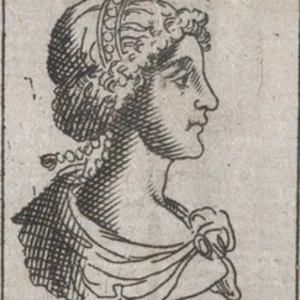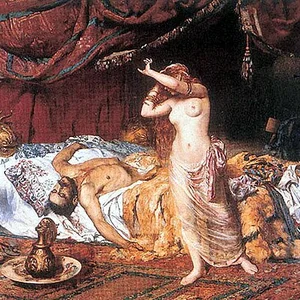

Ildico was the last wife of Attila, King of the Huns, whom she married in 453. She was found in tears beside her husband's body the morning after their wedding night, his death remaining shrouded in mystery.
Ildico(500 — ?)
Ildico
Empire hunnique
8 min read
Frequently asked questions
Key Facts
- 453: Ildico married Attila at a grand feast
- Wedding night: Attila was found dead, presumably from an internal hemorrhage caused by heavy drinking
- Ildico was discovered veiled and in tears beside Attila's body
- His death is sometimes presented as suspicious in ancient sources (Jordanes, Priscus)
- She disappears from historical sources after Attila's death
Works & Achievements
The primary historical source on Ildico, this text describes her as the sole witness to Attila's death and the only person found weeping beside his body. Without this account, even her name would have fallen into oblivion.
This medieval Germanic epic features Kriemhild, a queen who kills her husband Etzel (Attila) to avenge her first husband Siegfried. The character is often linked to Ildico, whose mysterious story may have inspired this motif of bridal vengeance.
A Norse saga in which Gudrun (the counterpart of Kriemhild) kills Atli (Attila) after their marriage to avenge her brothers. This Scandinavian text keeps alive the memory of a vengeful wife that tradition associates with the enigmatic fate of Ildico.
Anecdotes
On the night of her wedding to Attila in 453, Ildico found herself alone with her husband's corpse. The next morning, the guards, alarmed by Attila's failure to emerge, broke down the door and discovered the King of the Huns dead in his bed, while Ildico, still veiled, sobbed in a corner. This unsettling scene immediately fueled the wildest rumors about her possible guilt.
According to the historian Jordanes, Attila died of a nosebleed that struck him while he lay asleep, drunk after his wedding feast. The blood, instead of flowing through his nostrils, reportedly flowed back and suffocated him in his sleep. This mundane, accidental death stood in cruel contrast to the terror that the “Scourge of God” had sown across Europe for decades.
Ildico is never described in the sources as a woman of the Hunnic people. Her name, of Germanic etymology, suggests she was of Gothic or Burgundian origin — perhaps a princess offered as a pledge of peace or captured during a conquest. She thus embodied the many peoples subjected to Hunnic domination, forced to hand over their daughters to the conquerors.
Attila's funeral was both secret and magnificent: his body was placed in three nested coffins — one of gold, one of silver, one of iron — symbols of his conquests and his power. The slaves who had dug his tomb were killed so that its location would remain forever unknown. Ildico survived these events, but the sources say nothing more about her after that fateful night.
The great medieval German epic, the *Nibelungenlied*, may have drawn on Ildico for the character of Kriemhild, a vengeful queen who kills Attila (called Etzel in the saga). In historical reality, nothing proves that Ildico committed murder, but the proximity of the events — Attila's death on the very night of their wedding — fed this legend for centuries across Europe.
Primary Sources
After countless wives, as was the custom of his people, he took as wife a young girl named Ildico, of remarkable beauty. Worn out by excessive joy at his wedding, he lay on his back, heavy with wine; a flow of blood, which ordinarily issued from his nostrils, was blocked in its usual channels and took a fatal course down his throat, choking him.
Attila, king of the Huns and devastator of the provinces of Europe, was pierced by the hand and knife of his own wife.
The Huns mourned their king with unaccustomed lamentations, cutting their cheeks according to their custom, so that the greatest of warriors should be mourned not by the tears of women, but by the blood of men.
Key Places
The heart of the Hunnic empire, this vast plain was the main residence of Attila and his itinerant court. It was here that Ildico married Attila in 453 and that his body was discovered the following morning.
Site of the battle of 451 where the Huns were halted by the coalition of Aetius and the Visigoths. This defeat marked the beginning of the decline of Hunnic power, the context in which Ildico's marriage took place two years later.
Capital of the Eastern Roman Empire, threatened several times by Attila, who extorted heavy tribute from it. Attila's sudden death on the night of his wedding to Ildico may have spared the city from yet another devastating campaign.
A great Roman city destroyed by Attila during his Italian campaign in 452, a year before the king's death. Tradition holds that its inhabitants, who had taken refuge in the coastal lagoons, went on to found Venice.
According to medieval tradition, Attila was secretly buried in the bed of this river, which was diverted for the burial and then restored to its course. Ildico may have been one of the few people to know the exact location of this tomb, which has never been found.
Typical Objects

Jordanes notes that Ildico was still veiled when she was found in tears beside Attila's body. The veil symbolized both her newly acquired status as a wife and her distress, concealing her face from the Hunnic warriors who broke down the door.

Hunnic feasts made ostentatious use of precious gold and silver tableware, much of it looted from Roman treasuries. The wedding cup from which Attila drank to excess before his death symbolized the wealth and power accumulated by the King of the Huns.

High-ranking women in nomadic courts wore heavy necklaces, bracelets, and fibulae crafted from precious metal adorned with cloisonné garnets, a style widespread among the Goths and Germanic peoples. If Ildico was of Germanic origin, her jewelry would have blended steppe goldsmithing with Gothic influences.

The Huns lived primarily in richly decorated felt tents hung with carpets and draperies, even within the royal court. Ildico and Attila's wedding night most likely took place in a ceremonial tent erected at the heart of the royal encampment on the Pannonian plain.

The chronicler Marcellinus Comes mentions a knife as the murder weapon in Attila's death, lending weight to the theory that he was killed by Ildico. High-ranking women in steppe societies could carry small daggers for ritual purposes or personal protection.

Ildico may have been the last person to see Attila's body before his secret burial rites. According to Jordanes, the three nested coffins — of gold, silver, and iron — symbolized the three dimensions of Attila's power: wealth, strength, and war.
School Curriculum
Vocabulary & Tags
Key Vocabulary
Daily Life
Morning
In the royal Hun encampment, the day began early, shaped by the tending of horses and the preparation of meals. As the king's wife, Ildico had servants to help her dress; noblewomen oversaw the domestic activities of the royal tent and managed food stores from dawn.
Afternoon
The afternoon was devoted to camp management: overseeing provisions, weaving or embroidery for noblewomen, and occasionally receiving ambassadors or visitors. The Hun court brought together highly diverse peoples and cultures — Goths, Romans, Alans — creating a cosmopolitan environment despite its nomadic character.
Evening
Nightly feasts held a central place in Hun social life. Warriors gathered around tables laden with roasted meats, bread, and fermented drinks or Roman wine. Ildico's wedding night was preceded by one such banquet, during which Attila drank heavily before retiring with her.
Food
The Hun diet was based on horse, beef, and mutton, often boiled or dried for preservation on campaign. Conquests brought wheat, wine, and refined goods plundered from Roman provinces to the royal table. Fermented mare's milk (kumiss) remained the traditional drink of the steppes, consumed even at court.
Clothing
Noblewomen of the Huns wore long dresses of wool or linen, adorned with embroidery and precious metal jewelry. Cloisonné fibulae, pearl necklaces, and ornate gold belts marked social status. Ildico, likely of Germanic origin, probably wore clothing blending steppe traditions with Gothic fashions.
Housing
Attila's court resided in vast felt tents richly decorated with carpets and hangings, pitched across the great Pannonian plain. The diplomat Priscus of Panium, who visited the court in 449, also describes wooden structures for the more permanent buildings, and notes that the chiefs' halls surpassed Roman cities in the beauty of their interior decoration.
Historical Timeline
Period Vocabulary
Liens externes & ressources
Références
Œuvres
Getica — Jordanès
vers 551 apr. J.-C.
Nibelungenlied (Chanson des Nibelungen)
vers 1200
Völsunga saga
XIIIe siècle