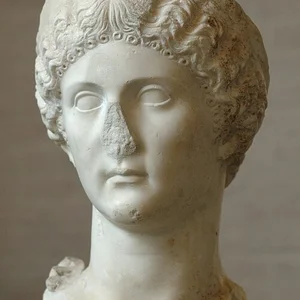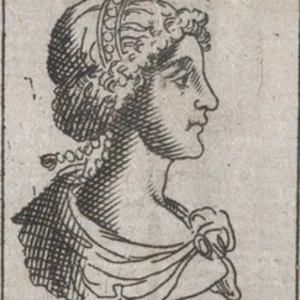

Poppaea Sabina (c. 30–65 AD) was the second wife of Emperor Nero. An ambitious woman of great beauty, she wielded considerable influence over Roman imperial politics.
Poppaea Sabina
Poppaea Sabina
8 min read
Frequently asked questions
Key Facts
- c. 30 AD: born in Pompeii into an aristocratic family
- 58 AD: becomes Nero's mistress, while he is still married to Octavia
- 62 AD: Nero repudiates Octavia and marries Poppaea
- 63 AD: birth of their daughter Claudia, who died at four months old
- 65 AD: death of Poppaea — according to Tacitus, struck by Nero during a quarrel
Works & Achievements
Flavius Josephus attests that Poppaea repeatedly interceded with Nero to defend the interests of Rome's Jewish community, going so far as to secure the release of priests held as hostages. Her role as mediator between the imperial court and Jewish circles is unique in Julio-Claudian history.
After Poppaea's death, Nero obtained from the Senate that she be officially deified under the name Diva Poppaea Augusta. She thus joined the imperial pantheon — an exceedingly rare honor granted to a woman who was not a birth member of the Augustan family.
Pliny the Elder and other ancient authors mention cosmetic preparations associated with Poppaea's name, notably a golden-blonde hair treatment nicknamed 'Poppaea color.' Her beauty practices spread new aesthetic standards among Rome's female aristocracy.
Poppaea skillfully maneuvered to obtain Nero's divorce from Octavia, daughter of Emperor Claudius, thereby clearing the path to her own elevation to the rank of Augusta. This politico-matrimonial strategy, documented by Tacitus, illustrates her mastery of the workings of imperial power.
Anecdotes
According to Pliny the Elder, Poppaea traveled with a herd of five hundred she-donkeys whose milk she used for her daily baths, convinced that it preserved the whiteness and softness of her skin. This lavish practice became one of the defining symbols of the extravagance of Nero's court.
Tacitus reports that Poppaea used all of her influence to push Nero into having his own mother, Agrippina the Younger, murdered in AD 59. She reportedly taunted Nero for still being under his mother's thumb, goading him until he ordered the act of matricide that shocked the entire Empire.
Flavius Josephus mentions that Poppaea interceded with Nero on behalf of the Jews of Rome on several occasions, notably to defend priests who had been sent to Rome as envoys. Josephus describes her as 'theosebēs' — God-fearing — which suggests a genuine sympathy for Judaism, a rare quality at the imperial court.
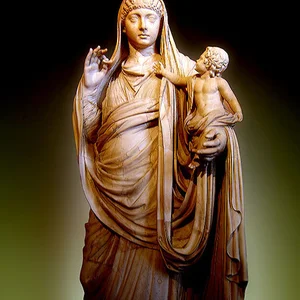
In AD 63, Poppaea gave birth to a daughter, Claudia, who was immediately honored with the title of Augusta by an overjoyed Nero. The infant died just four months later, however, and a devastated Nero had divine honors decreed for the child — an unprecedented gesture for a newborn.
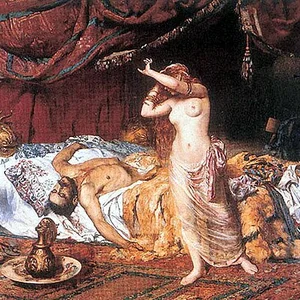
Both Tacitus and Suetonius report that Poppaea died in AD 65 as a result of a kick Nero reportedly dealt her while she was pregnant, in a fit of rage. Consumed by remorse, Nero had her body embalmed according to Eastern rites — rather than cremated, as was the Roman custom — and had her deified under the name diva Poppaea.
Primary Sources
Poppaea Sabina huic cuncta alia fuere praeter honestum animum. Matrem insigni pulchritudine fuit, fortunae, nisi quod ei breuis aeui fuit, non refragante... Potentiam per libidinem exercuit.
Poppaeam Sabinam... morte multauit, calcibus in eius uentrem grauidam irato impactu.
Quingentas asinas secum trahere Poppaea Neronis princeps solebat, in quarum lacte corpus suum mergebat, extendi quoque cutem credens.
Poppaea autem erat theosebès et beneficia Judaeis fecit... rogavit Neronem ut sacerdotibus dimissis ignosceret.
Poppaeam, cum esset gravida, calce percussit Nero eamque ex eo vulnere extinxit; ac post mortem eam consecravit.
Key Places
The Palatine was the imperial hill par excellence, home to the palaces of the Julio-Claudian emperors. Poppaea lived there as Nero's wife from 62 AD, at the heart of Roman power.
Pompeii is considered the hometown of Poppaea's family, several members of which held notable positions there. Electoral inscriptions found on the city's walls mention the name of the Poppaei, attesting to their local influence.
A spa and seaside resort on the Bay of Naples, Baiae was the favorite retreat of the Roman aristocracy. Nero stayed there on several occasions with Poppaea, and it was in this region that the assassination attempt on Agrippina was staged in 59 AD.
A coastal town in Latium, birthplace of Nero and secondary imperial residence. Poppaea regularly accompanied the emperor there, and it was most likely in this villa that she gave birth to Claudia Augusta in 63 AD.
The magnificent palace Nero had built after the fire of 64 AD, covering several dozen hectares. Although Poppaea died before its completion, this palace embodies the policy of imperial magnificence she had helped inspire.
Typical Objects

An indispensable attribute of Roman aristocratic women, the silver mirror was a symbol of vanity and personal grooming. Poppaea, renowned for her obsession with beauty, used one daily to tend to her hairstyle and makeup.

Pliny the Elder reports that Poppaea traveled with five hundred donkeys to ensure a constant supply of their milk, in which she bathed to maintain the whiteness of her skin. This extravagant luxury became one of the most famous symbols of her vanity and wealth.

High-ranking Roman women used perfumes imported from the Orient (nard, incense, myrrh) kept in delicate glass vials. Poppaea was renowned for her pronounced taste for rare essences, which contributed to her image as a woman of opulence.

The stola (a long dress of wool or silk) and the palla (a large draped veil) made up the distinguished feminine attire in Rome. Poppaea wore fabrics dyed in Tyrian purple — a color reserved for the wealthiest — and adorned with gold embroidery for grand ceremonies.

Pearls from the seas of Arabia and India were the most prized jewels of wealthy Roman women. As empress, Poppaea wore pearl necklaces, earrings, and bracelets at banquets and official audiences.

Women of imperial rank traveled in a closed litter carried by slaves, a symbol of exceptional social standing. Poppaea used this mode of transport daily throughout Rome, surrounded by her personal escort.

A common tool for private correspondence in Roman antiquity, wax tablets could be smoothed over and rewritten as needed. Poppaea, a woman of networks and influence, must have relied on them extensively to manage her relationships at court.
School Curriculum
Vocabulary & Tags
Key Vocabulary
Daily Life
Morning
Poppaea rose early, surrounded by her cosmetes (slaves who specialized in body care and beauty). The morning toilette lasted several hours: baths in donkey's milk, application of creams made from animal fat and honey, and the meticulous arrangement of her hair in elaborate curls held in place by bone or ivory pins.
Afternoon
The afternoon was devoted to court obligations: receiving ambassadors, granting audiences to clients and petitioners, or accompanying Nero during his artistic pursuits (he performed in concerts and poetry competitions). Poppaea also kept a close watch on political affairs, receiving informants and forging alliances within the imperial entourage.
Evening
Imperial evenings unfolded around long banquets (convivia) on tricliniums, where guests reclined while dining, served by dozens of slaves. Music, poetry readings, and philosophical discussions enlivened these meals, which could last until dawn. Poppaea, as Augusta, presided over these gatherings alongside Nero.
Food
The diet of the Roman aristocracy was rich and varied: saltwater fish (mullet, sea bream), oysters from Baiae, game, exotic fruits (dates, figs), vegetables preserved in garum (fermented fish sauce). Wine, diluted with water, was served in abundance, sometimes flavored with honey (mulsum). Imported products from the East — spices, rare condiments — signaled the wealth of the imperial table.
Clothing
Poppaea wore the stola, a long sleeveless gown in silk or fine wool, draped with a palla embroidered in gold for grand occasions. Tyrian purple, extracted from murex shellfish, dyed her most precious fabrics. Her dyed-leather shoes (calcei) and her jewelry in gold, pearls, and precious stones completed a carefully staged wardrobe designed to assert her rank as Augusta.
Housing
Poppaea resided in the imperial apartments on the Palatine, a vast complex of reception halls, colonnaded gardens, private baths, and libraries. Mosaic floors, walls covered in colorful frescoes, marble fountains, and sculptures created a setting of extraordinary luxury. In summer, the court moved to the coastal villae at Baiae or Antium, where life centered around the baths, gardens, and boat excursions on the bay.
Historical Timeline
Period Vocabulary
Liens externes & ressources
Références
Œuvres
Influence sur la politique religieuse — protection des Juifs de Rome
62-65 ap. J.-C.
Consecratio — déification posthume
65 ap. J.-C.
Modèle esthétique et cosmétique — les 'nuages de Poppée' (Poppaeana)
v. 60-65 ap. J.-C.
Rôle dans la chute d'Octavie
62 ap. J.-C.