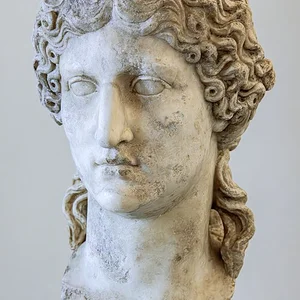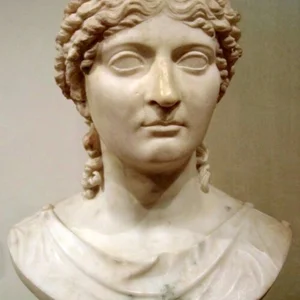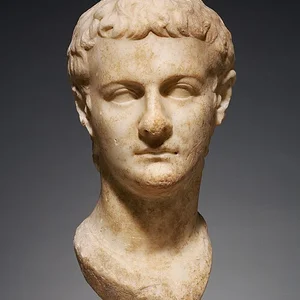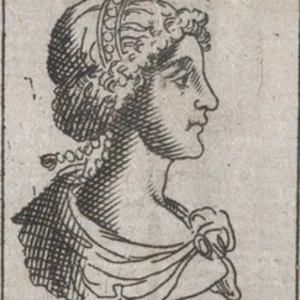

Vipsania Agrippina was a Roman citizen of the Augustan age, daughter of the general Agrippa and of Caecilia Pomponia Attica. The first wife of Tiberius, whom she loved, she was forced to divorce by Augustus for dynastic reasons. Her life illustrates the burden of imperial marriage politics.
Vipsania
Vipsania
Rome antique
6 min read
Frequently asked questions
Key Facts
- Born around 33 BC, daughter of Marcus Vipsanius Agrippa, the right-hand man of Augustus
- Married Tiberius around 19 BC and bore him a son, Drusus the Younger
- Forced to divorce around 12-11 BC by order of Augustus, so that Tiberius could marry Julia, the emperor's daughter
- Later remarried Asinius Gallus, with whom she had several children
- Died in AD 20, while Tiberius had been emperor since AD 14
Works & Achievements
A marriage that bound Agrippa's family to the house of Augustus, placing Vipsania at the heart of imperial succession strategy.
Vipsania gave birth to Tiberius's only son, a major heir of the early Empire and a central figure of the Julio-Claudian dynasty.
A new alliance with a leading senator, by whom she had several sons; this union fed a lasting enmity in Tiberius.
Through her children, Vipsania became the ancestor of several senators and figures of the Roman aristocracy of the 1st century.
Anecdotes
Vipsania Agrippina was the daughter of Agrippa, the right-hand man and finest general of the emperor Augustus. Betrothed to Tiberius while still a very young child, she grew up knowing that one day she would marry the stepson of the most powerful emperor in the Roman world.
According to ancient sources, Tiberius and Vipsania were a devoted and happy couple. But Augustus forced Tiberius to divorce her in order to marry Julia, the emperor's own daughter, so as to strengthen the dynastic succession: politics came before feelings.
The historian Suetonius recounts that Tiberius, after this forced divorce, once crossed paths with Vipsania by chance in the street. He followed her with his gaze, his eyes brimming with tears, so distraught that steps were taken to ensure they would never meet again.
Vipsania was the mother of Drusus the Younger, the only son of Tiberius. Her child became a major figure of the early Empire and the presumed heir to the throne, which makes her the ancestor of a branch of the imperial family.
After her divorce, Vipsania remarried Asinius Gallus, an influential senator, with whom she had several sons. This new union poisoned the relationship between Gallus and Tiberius, who never forgave the man for marrying the woman he had loved.
Primary Sources
He loved Vipsania with a singular and constant devotion; but, having been ordered to divorce her, he felt such keen grief that, when he chanced one day to meet her, he followed her with a gaze so fixed and so brimming with tears that care was taken to ensure she should never again appear before his eyes.
Asinius Gallus, who had married Vipsania, daughter of M. Agrippa and former wife of Tiberius, and who therefore believed himself an object of suspicion to the emperor...
Around the same time died Vipsania, mother of Drusus, alone among all of Agrippa's children to know a peaceful death; for the others perished, it is said, by the sword, by starvation, or by poison.
Key Places
Capital of the Empire and the center of Vipsania's political and family life. She lived here at the heart of the dynastic intrigues of the house of Augustus.
Hill in Rome where the imperial family resided and where decisions about dynastic marriages and divorces were made. Vipsania's marital fate was decided here.
The political heart of Rome where the alliances of the great families were on display and where public men such as Asinius Gallus, Vipsania's second husband, moved about.
A vast area of Rome developed by her father Agrippa, who had the Pantheon and great baths built there. Agrippa's name remained associated with prestigious monuments here.
Typical Objects

Long draped gown worn over the tunic, a garment reserved for free-born married Roman women. It marked the status of a respectable matron.

Large rectangular woollen cloak that women draped around the body and sometimes over the head when going out. A symbol of feminine modesty and dignity.

Ring exchanged at Roman betrothal and marriage, often made of iron and later of gold. It sealed the marriage commitment, central to the life of Vipsania, marked by dynastic alliances.

Wedding tablets on which the marriage contract was inscribed and signed before witnesses. They made the union official along with its clauses, including the dowry.

Small handheld mirror of polished bronze or silver, a grooming accessory of well-to-do Roman ladies. It accompanied the elaborate hairstyles and make-up of matrons.

Metal brooch used to fasten the palla or the folds of draped garments. It was often decorated for women of the aristocracy.
School Curriculum
Vocabulary & Tags
Key Vocabulary
Daily Life
Morning
As the matron of a great family, Vipsania began her day with the salutatio, receiving the clients and visitors who came to greet her father and then her husband. Servants helped her dress, arrange her hair in an elaborate style, and adorn herself with jewels.
Afternoon
The afternoon was devoted to managing the household (domus): supervising the slaves, the weaving, and the education of the children such as young Drusus. A Roman matron of her rank oversaw a vast domestic staff.
Evening
In the evening, the family gathered for the cena, the main meal, sometimes in the company of distinguished guests. The women of the Augustan aristocracy could now share the meal reclining alongside the men.
Food
Her diet, rich and varied, included bread, olives, fish, fruit, honey, and wine cut with water. The banquets of the elite offered meats, sauces seasoned with garum, and refined delicacies imported from across the Empire.
Clothing
She wore a linen tunic, covered by the stola of married women, and the palla when going out. Gold jewelry, finely crafted brooches, and sophisticated hairstyles marked her belonging to the highest aristocracy.
Housing
Vipsania lived in a vast aristocratic domus in Rome, organized around the atrium and the peristyle, decorated with frescoes, mosaics, and marble. These residences contained many rooms and a large staff of servants.
Historical Timeline
Period Vocabulary
Liens externes & ressources
Références
Œuvres
Union dynastique avec Tibère
-19
Naissance et éducation de Drusus le Jeune
-13
Remariage avec Asinius Gallus
-11
Lignée et descendance
fin du Ier s. av. J.-C.