
Roman empress and third wife of Emperor Claudius (41–48 AD), Messalina wielded considerable political influence in Rome. She is remembered in antiquity for her palace intrigues and violent death, ordered by Claudius himself.
Messalina(20 — 48)
Messalina
Rome antique
6 min read
Frequently asked questions
Key Facts
- Born around 17–20 AD, from an aristocratic family close to Augustus
- Married Emperor Claudius around 38–39 AD; they had two children, Octavia and Britannicus
- Exercised real influence over political decisions and court appointments at the imperial palace
- Publicly married Gaius Silius in 48 AD, triggering a major political crisis
- Executed in 48 AD on Claudius's orders, at the instigation of the freedman Narcissus
Works & Achievements
Having acquired these gardens through the condemnation of their owner, Messalina had them redesigned and expanded to create a prestigious imperial residence. The gardens remained imperial property for several decades after her death.
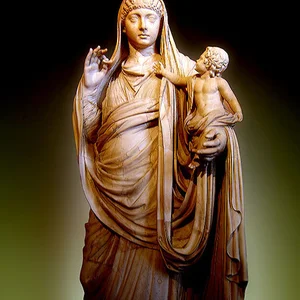
By giving Claudius two legitimate heirs, Octavia and Britannicus, Messalina secured the continuity of the Julio-Claudian line. Her participation in official ceremonies and in coin issues bearing Britannicus's name reflected a deliberate dynastic strategy.
Messalina played an active role in eliminating political rivals and in determining who was granted access to the emperor. Her interventions in trials and exiles — those of Seneca, Valerius Asiaticus, and Julia Livilla — attest to a genuine influence over imperial governance.
Anecdotes
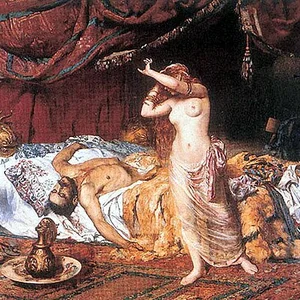
In 48 AD, while still the official wife of Emperor Claudius, Messalina publicly married Gaius Silius, one of Rome's designated consuls, in a formal ceremony. This act of bigamy, recorded by the historian Tacitus, astonished contemporaries and hastened her downfall: alerted by his freedmen, Claudius ordered her execution.
Messalina coveted the magnificent gardens of Valerius Asiaticus on the Pincian Hill. To acquire them, she maneuvered at court to have their owner condemned to death in 47 AD. Tacitus and Cassius Dio report that these gardens — the famous *Horti Luculliani* — subsequently became imperial property.
At the very start of Claudius's reign, Messalina had the philosopher Seneca exiled to Corsica in 41 AD: he was accused of adultery with Julia Livilla, Claudius's niece. This episode illustrates her ability to eliminate rivals by wielding Roman legal procedures as a political weapon.
When her enemies revealed to Claudius the clandestine marriage to Silius, Messalina tried to reach him to defend herself, but the imperial freedmen blocked her way. She was caught in the Gardens of Lucullus and, as she hesitated to take her own life, a military tribune dealt her the fatal blow. Claudius, informed during a dinner, showed no visible reaction, according to Tacitus.
Primary Sources
Messalina, with unparalleled shamelessness, abandoned even the usual precautions of adultery: she hurried to Silius's house accompanied by a train of her closest companions, lingered there, flocked there from all sides, and made herself visible throughout Rome.
Messalina, having abused his patience beyond all measure, had gone so far as to marry Gaius Silius publicly, signing a marriage contract in the presence of witnesses.
She wielded considerable power and committed acts of extreme audacity; she brought about the deaths of many people and seized their property.
Consider what a rival Octavia must endure: the Augusta herself, who steals away by night, daring to swap her imperial headdress for a common hood.
Key Places
The hill in Rome where the imperial palace stood, and the daily living space of Messalina as wife of Claudius. It was from the Palatine that she wielded her influence over the court and over the emperor's decisions.
Magnificent gardens on the Pincian Hill, coveted and then seized by Messalina following the condemnation of their owner Valerius Asiaticus in 47 AD. It was in these gardens that she was executed the following year.
The political and ceremonial heart of Rome, where the great public events in which the empress took part were held. Messalina attended the triumph of Claudius celebrating the conquest of Britain in 44 AD.
Rome's main port, through which the capital's supplies flowed; Claudius undertook major construction works there. Messalina was associated with her husband's prestige policy, of which these great building projects formed a part.
Typical Objects
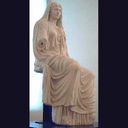
Long tunic worn by high-ranking Roman women, a symbol of their status as matrons. As empress, Messalina wore stolae of silk or fine linen, often dyed in precious colors.
📷 Domaine public · Wikimedia Commons ↗
Common writing surfaces in Rome, used for correspondence and notes carried by messengers. At the heart of court intrigues, Messalina would have instructions and messages recorded on them for her trusted freedmen.

A carrier-borne vehicle for traveling through Rome without walking, reserved for high-ranking figures. The empress traveled by litter surrounded by a large retinue, a visible mark of her rank.

Necklaces, bracelets, and gold rings adorned with gems were an indispensable mark of status for women of the imperial family. Ancient sources mention the magnificence of Messalina's adornments during official ceremonies.

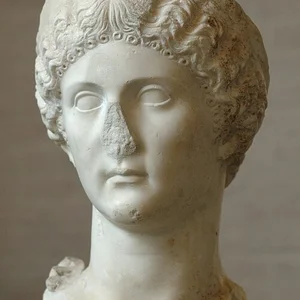
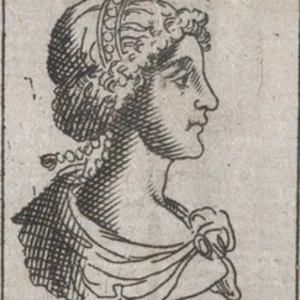
Like other members of the Julio-Claudian family, Messalina was represented in busts distributed throughout the Empire. Several portraits showing her with her characteristic hairstyle of symmetrical curls have been identified in European museums.

Coin issues were struck depicting Britannicus, son of Messalina and Claudius, symbolizing dynastic continuity. These coins served as a propaganda instrument associating Messalina with the future of Rome.
School Curriculum
Vocabulary & Tags
Key Vocabulary
Daily Life
Morning
Messalina's day began early in the imperial apartments on the Palatine, where handmaids and slaves helped style her hair in the Roman fashion of symmetrical curls. She would then receive the imperial freedmen responsible for administration and review the court matters that concerned her.
Afternoon
The afternoon was devoted to audiences, visits, and official ceremonies at which the empress was expected in her capacity as Augusta. Messalina kept a close watch on court intrigues, relaying her instructions through her trusted freedmen.
Evening
On banquet evenings, Messalina presided alongside Claudius at dinners attended by senators, generals, and dignitaries. These meals, accompanied by Italian and Greek wines, were essential occasions for consolidating alliances and keeping a close eye on her rivals.
Food
The empress's diet reflected that of Rome's great families: white wheat bread, vegetables, fresh fish, meats (wild boar, poultry), fruits, and honey cakes. Everything was served on silver and gold tableware at meals that could last several hours.
Clothing
Messalina wore the stola, a long linen or silk tunic, covered by a palla draped over the shoulders. Her garments were dyed purple, a color reserved for the imperial family, and her adornments of gold and precious stones underscored her rank as Augusta.
Housing
Messalina lived in the vast apartments of the imperial palace on the Palatine Hill, which overlooks the Roman Forum. These residences included audience halls, interior gardens, private baths, and galleries decorated with frescoes and sumptuous mosaics.
Historical Timeline
Period Vocabulary
Liens externes & ressources
Références
Œuvres
Réaménagement des jardins de Lucullus (Horti Luculliani)
47-48 ap. J.-C.
Soutien à la politique dynastique de Claude
41-48 ap. J.-C.
Exercice de l'influence impériale sur les nominations et les procès
41-48 ap. J.-C.