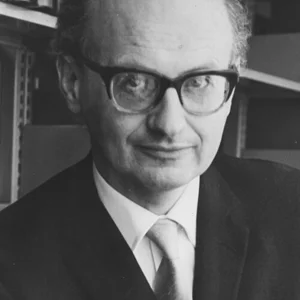

Imre Lakatos (1922-1974) was a Hungarian philosopher of science and mathematics who became a naturalized British citizen. A professor at the London School of Economics, he is famous for his theory of “scientific research programmes,” an attempt to move beyond the debate between Popper and Kuhn.
Imre Lakatos(1922 — 1974)
Imre Lakatos
Hongrie, Royaume-Uni
6 min read
Frequently asked questions
Famous Quotes
« Philosophy of science without history of science is empty; history of science without philosophy of science is blind.»
Key Facts
- Born in 1922 in Debrecen (Hungary) under the name Imre Lipschitz, into a Jewish family; he escaped deportation during the Second World War.
- Fled Hungary after the 1956 uprising and settled in England.
- Published “Proofs and Refutations” (1963-1964), an analysis of mathematical reasoning through the case of Euler's polyhedron.
- Developed in the 1960s and 1970s the methodology of “scientific research programmes,” distinguishing between the hard core and heuristics.
- Taught at the London School of Economics alongside Karl Popper until his death in 1974 in London.
Works & Achievements
His masterpiece: a dialogued history of Euler's conjecture showing that mathematics advances through criticism and counter-examples, not through certainties.
Founding text in which he coins the notion of a “research programme,” with a “hard core” protected by a “protective belt” of hypotheses.
Major collection from the 1965 London colloquium, where Popper, Kuhn, Feyerabend, and Lakatos clashed.
Article in which he connects the philosophy and history of science, distinguishing rational “internal” history from “external” history.
Posthumous collection of his essays on epistemology, which became a landmark in the philosophy of science.
Second volume gathering his work on the philosophy of mathematics and the theory of knowledge.
Anecdotes
Born in Debrecen as Imre Lipschitz into a Hungarian Jewish family, Lakatos survived the Holocaust by changing his name to escape persecution. His mother and grandmother, however, perished at Auschwitz.
During the Nazi occupation, he led a small group of communist resistance fighters. One tragic episode haunted him for the rest of his life: the group allegedly drove a young activist, Éva Izsák, to suicide out of fear that she would be arrested and betray the others.
After the war, Lakatos became a zealous communist in Stalinist Hungary, but he was imprisoned from 1950 to 1953 for “revisionism.” After the crushing of the 1956 uprising, he fled to the West and eventually settled in England.
His most famous work, *Proofs and Refutations*, takes the form of a dialogue between a teacher and students named after Greek letters. Using Euler's theorem on polyhedra, he shows that mathematics progresses through trial, counterexamples, and corrections — not through truths handed down from on high.
At the London School of Economics, Lakatos was a colleague and friendly rival of Paul Feyerabend. The two philosophers had planned to write a two-voice book, *For and Against Method*, but Lakatos's sudden death in 1974, at the age of 51, put an end to the project.
Primary Sources
The history of mathematics and the logic of mathematical discovery, that is, the phylogenesis and ontogenesis of mathematical thought, cannot be developed without the criticism and ultimate rejection of authoritarianism.
For the sophisticated falsificationist, a theory is “scientific” only if it has corroborated excess empirical content over its predecessor (or rival).
Philosophy of science without history of science is empty; history of science without philosophy of science is blind.
Scientific rationality is not judged on an isolated theory, but on the way a research programme unfolds over time, whether progressive or degenerating.
Key Places
Lakatos's birthplace, Hungary's second-largest city, where he grew up in a Jewish family.
Where he studied mathematics, physics, and philosophy before the war.
The heart of his postwar communist commitment and the site of his political imprisonment; he fled the city after 1956.
Where he pursued a second doctorate after his exile, under the influence of the English mathematical tradition.
The institution where Lakatos taught the philosophy of science from 1960 until his death, alongside Popper and Feyerabend.
Liens externes & ressources
Références
Œuvres
Preuves et réfutations (Proofs and Refutations)
1963-1964 (livre 1976)
La falsification et la méthodologie des programmes de recherche scientifiques
1970
Criticism and the Growth of Knowledge (codirection avec Alan Musgrave)
1970
Histoire des sciences et ses reconstructions rationnelles
1971
The Methodology of Scientific Research Programmes (Philosophical Papers, vol. 1)
1978 (posthume)
Mathematics, Science and Epistemology (Philosophical Papers, vol. 2)
1978 (posthume)