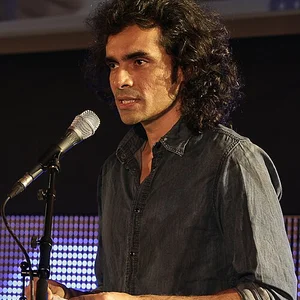

Imtiaz Ali is an Indian film director and screenwriter born in 1971 in Jamshedpur. He is known for his romantically charged, poetic films, including Jab We Met (2007) and Rockstar (2011). His work explores themes of love, freedom, and the search for identity.
Frequently asked questions
Key Facts
- Born on June 16, 1971, in Jamshedpur, Jharkhand, India
- Began his career with the film Socha Na Tha (2005)
- Achieved international recognition with Jab We Met (2007)
- Directed Highway (2014), selected for the Berlin International Film Festival
- Founder of the production company Window Seat Films
Works & Achievements
Imtiaz Ali's debut feature, a romantic comedy about an arranged marriage that spirals into an emotional farce. It establishes the hallmarks of his style: naturalistic dialogue and music as narrative.
His most popular film, following the unlikely encounter between a depressed man and an irrepressibly lively woman on a train. It remains one of the most beloved romantic comedies in contemporary Hindi cinema.
A film that weaves together two love stories set forty years apart, questioning the place of romance in an increasingly individualistic society. It marks the beginning of his collaboration with actor Saif Ali Khan.
An epic musical drama tracing the journey of a musician who must suffer in order to create. With a soundtrack composed by A.R. Rahman, the film is considered one of the landmark works of Hindi cinema in the 2010s.
An intimate road movie in which a young woman, abducted during a pre-wedding trip, develops an unexpected bond with her captor. The film journeys through rural India and explores female freedom with rare clarity.
A philosophical film about identity and social pressure, following a man who suppresses his true self to conform to family expectations. It is one of Imtiaz Ali's most personal and ambitious works.
Anecdotes
Imtiaz Ali began his career not behind a camera but on the theatre stages of Delhi, as a member of the IPTA (Indian People's Theatre Association). That training left a lasting mark on him: he considers theatre the fundamental school of storytelling, and his films always retain an intimacy and a dialogue-driven quality inherited from that experience.
To write the screenplay for *Jab We Met* (2007), Imtiaz Ali drew on a train journey he had taken, during which he observed passengers whose lives briefly intersected. The character of Geet, played by Kareena Kapoor, became one of the most beloved female roles in Hindi cinema of the 2000s, turning the actress into a generational icon.
For *Rockstar* (2011), Imtiaz Ali first conceived the character of Jordan — a musician in search of suffering in order to create — before writing a single line of dialogue. He asked singer Mohit Chauhan and composer A.R. Rahman to work on the soundtrack before filming began, so that the music could guide the story rather than the other way around. It is an exceptionally rare working method in Bollywood.
*Highway* (2014) was shot largely in remote regions of northern India — Rajasthan, Himachal Pradesh, Kashmir — with a lean crew and a mobile production. Alia Bhatt, then 20 years old, said the film had radically changed her understanding of what it means to be an actress. Imtiaz Ali took her on the road for several weeks before shooting even began.
Imtiaz Ali is one of the very few Indian filmmakers to have adapted a Bollywood story for Broadway: he was involved in the *Bollywood Steps* project in New York, which drew on the narrative and musical codes of Hindi cinema to reach Western audiences. He sees this kind of venture as a cultural bridge between India and the rest of the world.
Primary Sources
I don't think love stories are about two people falling in love. They are about two people finding themselves. The romance is just the vehicle.
I wanted to show the India that exists beyond the cities, beyond the malls and multiplexes. The highway is a metaphor for the journey we all need to take inside ourselves.
Music is not background in my films. Music is the film. When A.R. Rahman gives me a melody, I write the scene around it.
Theater taught me that the actor must live the moment, not perform it. I carry that belief into every scene I direct.
Key Places
Industrial city in eastern India where Imtiaz Ali was born in 1971. This steel city, built around the Tata factories, shaped his eye for the contrast between modernity and Indian tradition.
The city where Imtiaz Ali studied and launched his career in theatre. Delhi — its ancient alleyways, vibrant cultural scene, and blend of traditions — deeply influenced the way he tells stories about urban India.
The heart of the Indian film industry, where Imtiaz Ali built his career. He founded his production company Window Seat Films there — a name that reflects his love of travel and shifting perspectives.
The main settings of Jab We Met (2007), set along the railway lines of northern India. These mountain landscapes and small railway stations become a character in their own right within the film.
A region that recurs as a leitmotif throughout Imtiaz Ali's work (Rockstar, Jab Harry Met Sejal). He sees it as a symbol of melancholic beauty and impossible longing — both a paradise and a torn land.
A European city used as a backdrop in several of his films (Love Aaj Kal, Jab Harry Met Sejal). It symbolises Hindi cinema's opening to the world and the fascination of Indian youth with Europe.
Typical Objects

Imtiaz Ali is known for writing his stories by hand before typing them up. His notebooks contain dialogue, mood notes, and musical references all woven together.

Music always comes before writing in his creative process. He listens on repeat to compositions by his musical collaborators (A.R. Rahman, Pritam) to find the emotional core of a scene.

Imtiaz Ali scouts locations himself in remote regions of India. He photographs landscapes, faces, and natural light that will later inspire his cinematographer.

Urdu poetry (Gulzar, Faiz Ahmed Faiz) and the Sufi tradition run deep through his writing. Their references surface in the dialogue and song lyrics of his films.

A universal symbol of cinema, the clapperboard marks each take on his sets. Imtiaz Ali is known for encouraging improvisation between takes, often letting the camera roll after the official clap.

Roads and trains are ever-present in his work. His films are often built around a physical journey that is also an inner journey for the characters.
School Curriculum
Vocabulary & Tags
Key Vocabulary
Daily Life
Morning
Imtiaz Ali's day starts late, by his own admission: he is not a morning person and prefers to work at night. His mornings are devoted to reading — the press, Urdu poetry, scripts in progress — and to calls with his production teams based in Mumbai.
Afternoon
The afternoon is reserved for creative work: script meetings with his co-writers, rushes screenings during a shoot, or solo location-scouting drives through landscapes he explores alone with a small camera. He uses intensive music listening as a working method.
Evening
Evenings are often given over to screenings, working dinners with actors and composers, or late-night writing. Imtiaz Ali has said that his best ideas come to him at night, in the silence. He moves through the cultural circles of Mumbai and Delhi, between theatre and live music.
Food
As a contemporary Indian living between Delhi and Mumbai, his diet is varied: dal, rice, chapati, vegetables, with a preference for North Indian cuisine. On location scouts in rural areas, he eats whatever the local inhabitants eat, which he sees as a way of immersing himself in the realities of the real India.
Clothing
Imtiaz Ali favours a casual, urban style: jeans, T-shirts, light jackets. His look reflects the bohemian-intellectual aesthetic of India's creative circles. He does not wear a suit on set, preferring to stay mobile and unobtrusive on his shoots.
Housing
He divides his life between Mumbai, the centre of the film industry, and Delhi, the city where he trained. His apartments reflect his interests: poetry books, vinyl records, film posters. During itinerant shoots, he stays in hotels or local guesthouses, as close as possible to his crews.