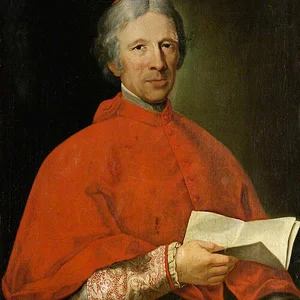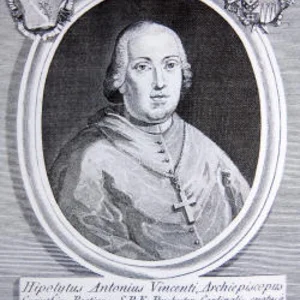

Italian Catholic prelate of the 19th century, elevated to the dignity of cardinal within the Roman Curia. He carried out his duties in the context of the Papal States, at a time of deep tensions between the Church and the emerging national states of Europe.
Ippolito-Antonio Vincenti-Mareri(1738 — 1811)
Ippolito-Antonio Vincenti-Mareri
7 min read
Frequently asked questions
Key Facts
- Italian Catholic prelate elevated to the cardinalate in the 19th century
- Active during the period of crisis facing the Papal States amid Italian unification
- Member of the Roman Curia, the administrative and spiritual center of the Catholic Church
- His career unfolded against the backdrop of relations between the Church and European secular powers
Works & Achievements
As a member of the Roman Curia, Vincenti-Mareri sat on various pontifical congregations responsible for managing the affairs of the universal Church — ecclesiastical discipline, relations with sovereign states, doctrinal matters, and canonical disputes.
His participation in this extraordinary conclave, held outside Rome on Habsburg territory following the captivity of Pius VI, contributed to the election of Pius VII and to preserving the institutional continuity of the papacy at the height of the revolutionary crisis.
Under Pius VII, he continued his administrative work within the Curia, taking part in the gradual implementation of the Concordat of 1801 and in defending the temporal rights of the Holy See against Napoleonic encroachments on the Papal States.
Anecdotes
In 1798, when French troops invaded Rome and proclaimed the Roman Republic, Cardinal Vincenti-Mareri had to make the difficult decision — as did many members of the Curia — whether to remain in the Eternal City or flee. This occupation profoundly disrupted the organization of the Catholic Church and forced its prelates to navigate between loyalty to the Holy See and political pragmatism in the face of the revolutionary occupiers.
The death of Pope Pius VI in captivity at Valence in 1799 plunged the Roman Curia into an unprecedented crisis. Vincenti-Mareri took part in the deliberations that led to the organization of the Conclave of Venice (1799–1800), an extraordinary event held outside Rome for the first time in centuries, under Habsburg protection, which ultimately elected Pius VII.
During the pontificate of Pius VII, Vincenti-Mareri witnessed the complex negotiations surrounding the Concordat of 1801 between Napoleon and the Holy See. This treaty, which reorganized the Church in France after the devastation of the Revolution, was hailed by some as a diplomatic victory and criticized by others as a capitulation to Bonapartist power.
In 1809, when Napoleon annexed the Papal States and had Pius VII arrested, the cardinals who refused to swear allegiance to the Empire were branded "black cardinals" as a mark of imperial disgrace. Vincenti-Mareri, then in the final years of his life, lived through the painful humiliation of a Church whose temporal head was a prisoner of an emperor.
Primary Sources
Cum Sanctissimus Dominus Noster Pius Papa VI... Hippolytum Antonium Vincentium Mareri in Sanctae Romanae Ecclesiae Cardinalem renuntiavit et creavit, omnibus juribus et privilegiis cardinalitiae dignitatis insignitum...
Records of the consistories, official ceremonies, and ordinations attended by Cardinal Vincenti-Mareri in the exercise of his duties within the Roman Curia, published regularly in this semi-official bulletin of pontifical life.
The registers of the Secretariat of State preserve the deliberations of the Roman congregations in which the Cardinal took part, particularly those addressing relations between the Holy See and the European powers during the upheaval of the Napoleonic era.
Key Places
The nerve center of Catholic Church governance, where Cardinal Vincenti-Mareri carried out most of his duties. The Curia coordinates the spiritual and temporal affairs of the Holy See from its Roman palaces.
A town in Lazio from which the noble Vincenti-Mareri family originated. This region of central Italy long belonged to the Papal States, maintaining centuries-old close ties with Rome.
La Serenissima hosted the extraordinary conclave that elected Pius VII, under the protection of the Habsburg dynasty of Austria. This was one of the defining moments experienced by the cardinals of Vincenti-Mareri's generation.
The French capital was the stage for the signing of the Concordat between Napoleon and Pius VII, a pivotal event for the entire European Catholic hierarchy and for the future of relations between the Church and modern states.
Typical Objects

A scarlet velvet cap with three ridges, the distinctive mark of a cardinal's rank. The Pope places it on the head of the new prince of the Church during a solemn consistory.

A gold ring set with an amethyst, presented by the Pope upon elevation to the cardinalate. It symbolizes the cardinal's union with the Church and his spiritual authority.

A cross worn on the chest by bishops and cardinals, suspended from a gold chain. It serves as a reminder of the prelate's pastoral mission and his devotion to the person of Christ.

An official document issued by the Pope, written on parchment and sealed with a lead seal (the "bulla"). Cardinals of the Curia draft, authenticate, and dispatch these documents to recipients throughout the Catholic world.

A prayer book containing the Divine Office — psalms, hymns, and biblical readings — which every cleric is required to recite each day. For a 19th-century cardinal, this object was the indispensable daily companion of his spiritual life.

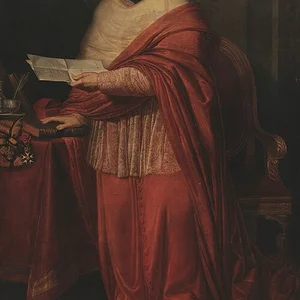
The cardinal's liturgical vestment, entirely bright red — a symbol of the blood shed for the faith. Reserved for major ceremonies, it stands in striking contrast to the black of daily life, which is accented with red piping.
School Curriculum
Vocabulary & Tags
Key Vocabulary
Daily Life
Morning
A cardinal of the Curia begins his day at dawn with the recitation of Lauds and the celebration of a private Mass in his personal chapel. He then dons his black cassock trimmed with red to receive his secretary and review the files that arrived the previous day from apostolic nuncios posted across Europe.
Afternoon
The afternoon is devoted to meetings of the Roman congregations — collegial assemblies where cardinals examine matters sent from every corner of the Catholic world — and to audiences with clergy, diplomats, or delegates of European Catholic princes. Tensions with Revolutionary and then Napoleonic France made these sessions particularly demanding from the 1790s onward.
Evening
The evening opens with the recitation of Vespers and Compline, either privately or in community. The cardinal may host members of the Roman nobility or fellow prelates for dinner to discuss Church affairs in a less formal setting, before retiring for the night with spiritual reading and an examination of conscience.
Food
A prince of the Church observes the liturgical calendar scrupulously at table: lean days on Fridays, abstinence during Lent and the vigils of major feasts. Roman pasta, fish from the Italian coast, vegetables from the Latium region, and wines from the Castelli Romani make up the bulk of a balanced diet, free from ostentatious excess.
Clothing
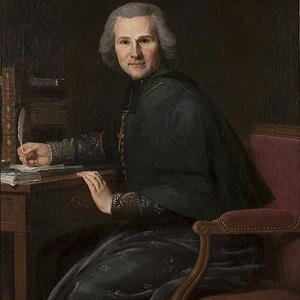
Outside liturgical ceremonies, the cardinal wears a black cassock with scarlet facings, a red *ferraiolone* (large cape) for official outings, and a red *solideo* (skullcap) on his head. At major solemn functions — consistories, ordinations, pontifical Masses — he dons the full ornaments of crimson velvet, with *mozzetta* and pectoral cross.
Housing
Cardinals of the Curia reside in vast apartments near the Vatican or in Roman palaces belonging to great noble families. These residences house a private chapel, a library where files and volumes of canon law accumulate, a reception room for audiences, and quarters for the secretaries, chaplains, and household staff in their service.
Historical Timeline
Period Vocabulary
Liens externes & ressources
Références
Œuvres
Participation aux congrégations romaines de la Curie
1780-1811
Rôle lors du Conclave de Venise
1799-1800
Action diplomatique sous Pie VII
1800-1811