 flip
flipIrish stew (mutton and potato stew)
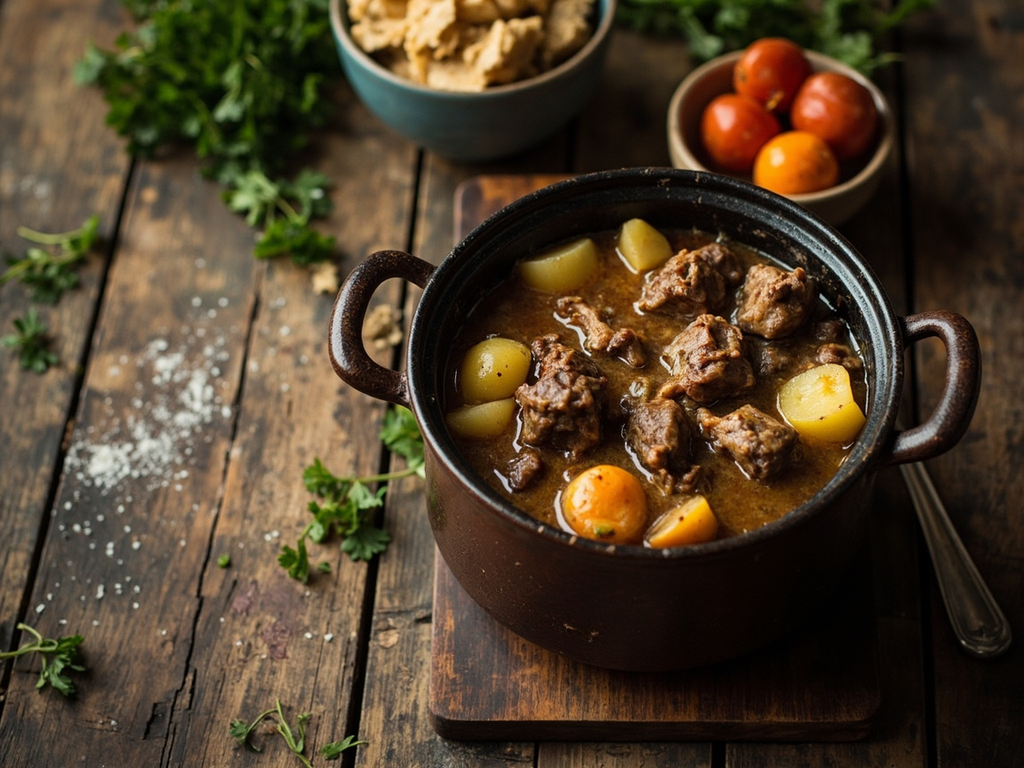
Irish stew (mutton and potato stew)
Why this dish? Born in Dublin, Iris Murdoch claimed her Irish roots. Irish stew, the emblematic dish of the island, slowly simmered in a single pot, embodies exactly the kind of meal she loved: convivial, no ceremony, shared among friends while conversation lingers.
A rustic stew of mutton (or lamb) long-cooked with potatoes and onions, with no other frills. The potatoes partly melt to thicken the broth, which becomes creamy and comforting.
I was born in Dublin, and one never quite forgets the table of one's childhood. This stew is of an honest simplicity: mutton, potatoes, onions, water, and nothing more — anyone who adds a thousand things has understood nothing of the matter. You let it simmer very gently for hours, while you talk, and the potatoes break down by themselves to thicken it all. It is the dish of long evenings among friends: you fill the plates, you fill the glasses, and philosophy can well wait until tomorrow.
- •Mutton (shoulder, on the bone) — generous chunks (base meat, flavor and gelatin)
- •Potatoes — in abundance (starch and thickener)
- •Onions — several (aromatic base)
- •Water — to cover (broth)
- •Parsley — a bunch (final freshness)
- •Salt and pepper — to taste (seasoning)
Irish stew (mutton and potato stew)
A rustic stew of mutton (or lamb) long-cooked with potatoes and onions, with no other frills. The potatoes partly melt to thicken the broth, which becomes creamy and comforting.
Why this dish? Born in Dublin, Iris Murdoch claimed her Irish roots. Irish stew, the emblematic dish of the island, slowly simmered in a single pot, embodies exactly the kind of meal she loved: convivial, no ceremony, shared among friends while conversation lingers.
I was born in Dublin, and one never quite forgets the table of one's childhood. This stew is of an honest simplicity: mutton, potatoes, onions, water, and nothing more — anyone who adds a thousand things has understood nothing of the matter. You let it simmer very gently for hours, while you talk, and the potatoes break down by themselves to thicken it all. It is the dish of long evenings among friends: you fill the plates, you fill the glasses, and philosophy can well wait until tomorrow.
Ingredients (period version)
- Mutton (shoulder, on the bone) — generous chunks (base meat, flavor and gelatin)
- Potatoes — in abundance (starch and thickener)
- Onions — several (aromatic base)
- Water — to cover (broth)
- Parsley — a bunch (final freshness)
- Salt and pepper — to taste (seasoning)
Ingredients
- Lamb or mutton shoulder on the bone — 800 g, in pieces (base meat)
- Floury potatoes — 1 kg (starch and thickener)
- Onions — 3 large, sliced (aromatic base)
- Stock or water — about 1 litre (cooking liquid)
- Flat-leaf parsley — 1 small bunch, chopped (final freshness)
- Salt, pepper — to taste (seasoning)
Method
- In a casserole, arrange a layer of onions, a layer of potatoes, and the meat pieces, alternating.
- Season with salt and pepper between layers. Finish with a layer of potatoes.
- Pour in the stock or water until almost covering.
- Bring gently to a simmer, cover, then cook over very low heat for 2 hours (or in the oven at 150°C).
- Check that the meat is tender and the top potatoes have melted into the juices.
- Sprinkle with chopped parsley and serve piping hot in deep plates.
How it was made : Authentic Irish stew from the 19th and early 20th centuries contained only mutton (a cheap, mature animal), potatoes, onions, and water — carrots and barley are later additions. The slow cooking tenderized tough, economical meat. It was the dish of modest families as well as large gatherings.
The contemporary twist : Serve directly from the cast-iron pot placed in the center of the table, family-style, with a loaf of sourdough bread for dipping.
Sources : Theodora FitzGibbon, A Taste of Ireland, 1968 · Florence Irwin, The Cookin' Woman: Irish Country Recipes, 1949
Iris Murdoch · Charactorium